49 works in this view — arrow keys or swipe to move between them.
Dance in Art
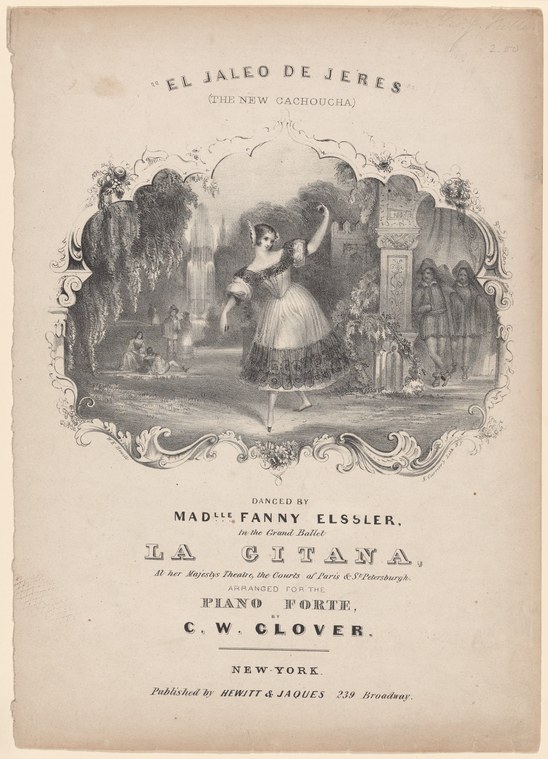
El jaleo de Jeres (the new cachoucha), danced by Madlle Fanny Elssler in the grand ballet La gitana: at her Majestys Theatre, the courts of Paris & St. Petersburgh Arranged for the piano forte, by C. W. Glover
Unknown artist
- Collection:
- Prints depicting dance
- Source:
- New York Public Library
- Rights:
- Public domain — free to use, share and adapt.
- Recorded as:
- Public Domain
Fanny Elssler was one of the defining figures of romantic ballet, rivaled only by Marie Taglioni. Her performances, and prints like this one, shaped audiences' understanding of what female virtuosity could be—and introduced Spanish and Cuban dance forms to European theaters. The cachoucha became so closely associated with her that it remained in the repertory for generations after her retirement; this print is evidence of a moment when a dancer and a dance became inseparable in the popular imagination.
What you are looking at
A theatrical stage scene set in a Spanish interior, rendered in dense black engraving on cream paper. A young woman in a white dress with a voluminous skirt dominates the foreground, her body caught mid-turn, one arm raised and the other extended. Her posture suggests rapid rotational movement. The setting is dimly lit and Gothic in feeling—a narrow passageway or alcove with deep shadows, arched doorways, and figures barely visible in the background. The composition is framed by an ornate decorative border of scrolls and flourishes, typical of music-cover engravings of the era. The woman's face is in profile, her attention directed toward the movement rather than outward. The skirt's swirl suggests a moment of suspended velocity.
The dancing
A single featured dancer, with additional figures in shadow. The principal dancer's frame is notably upright and frontal despite the rotational torque implied by the skirt's arc; her arms are styled in a romantic-ballet aesthetic—one raised above the head, one extended at shoulder height. The weight appears to shift through the turn; the leg supporting the movement is not clearly visible beneath the skirt's volume, but the upper body suggests a pivot en dehors. No partnering is evident, though the background figures suggest a theatrical ensemble.
The dance depicted
This print illustrates *El jaleo de Jeres* (The new cachoucha), danced by the celebrated dancer Fanny Elssler. The cachoucha was a Spanish-Cuban social dance that became a signature solo for Elssler and a major vehicle for romantic-era performers in the 1830s–1840s. The jaleo—a rapid, excited state—refers to the energy and virtuosity expected of the form. The print captures the characteristic elements: a single female dancer, rapid turning, a full skirt deployed as a dynamic element of the choreography, and a theatrical Spanish setting. Elssler's performance of this dance in London, Paris, and St. Petersburg was celebrated for its technical brilliance and dramatic presence.
How it was made
This is an engraving (likely steel-faced for durability), printed in black on wove paper and hand-tinted or left in monochrome. The fine cross-hatching and stippling create depth and shadow in the theatrical interior; the technique allowed for mass production and wide circulation—this was a popular theatrical souvenir and music-hall keepsake. The ornate framing border is characteristic of mid-19th-century sheet music covers and theatrical prints, serving both an aesthetic and marketing function. The medium's precision would have appealed to audiences wanting an accurate record of a celebrated performer and a memorable moment.
About this work
This engraving documents a celebrated performance of *El jaleo de Jeres*, a Spanish-inflected solo dance at the heart of the romantic ballet repertory. Fanny Elssler, one of the era's most virtuosic and charismatic dancers, performed this piece across Europe to enormous acclaim. The print functions as both a theatrical advertisement and a souvenir—a way for audiences who saw (or wished to see) the performance to own a memento. The cachoucha itself represents a key moment in ballet history: the incorporation of social and national dances into theatrical choreography, the celebration of individual virtuosity (especially female virtuosity), and the rise of the international dance celebrity. The image shows the dancer at a moment of rotational intensity, the skirt and upright frame conveying both technical control and theatrical presence.
How to look at it
Watch the skirt: it is the primary record of the movement. The way it fans and swirls outward tells you that the dancer is turning rapidly and with controlled power. Notice the dancer's upright carriage despite the rotational energy—this is a mark of classical training. The setting (the Spanish alcove) is theatrical and dramatic, not naturalistic; the sparse background figures place the soloist as the unambiguous focus. The decorative border frames the scene as a precious, collectable image—you are meant to want to own this moment. The profile view of the face is characteristic of romantic-era portraiture; it allows the body and its movement to be read without distraction from the dancer's expression.
The artist
The engraver is not identified in the catalogue record. The composer and arranger C. W. Glover prepared a piano-forte arrangement of music for the dance; Glover was a prolific arranger and conductor working in London in the mid-19th century. The print was published by Dewitt & Jaques of Broadway, New York, a major theatrical and music publisher of the period. The combination of engraver (anonymous), arranger (Glover), and publisher suggests a commercial theatrical-print operation producing both sheet music and performance documentation for an audience hungry for dance and musical entertainment.
The period
The romantic ballet era (roughly 1830–1860) was defined by a new interest in national and exotic dance forms, the elevation of the female dancer as the primary spectacle, and the emergence of international touring companies and star performers. Fanny Elssler's career (1820–1884) precisely spanned this era; she was known for her earthy, technically brilliant style in contrast to Marie Taglioni's ethereal, pointe-centered method. The cachoucha and other Spanish-Cuban dances were fashionable across Europe, appealing to romantic-era tastes for the picturesque and the sensual. The period saw an explosion of theatrical prints, sheet-music covers, and illustrated periodicals documenting famous dancers and performances—these objects were central to how dance circulated in the public imagination before photography.
Where it lives
This object is held in the New York Public Library's collection of prints depicting dance, part of the NYPL's extensive holdings of 19th-century theatrical ephemera. It functions as both a musical score annotation (C. W. Glover's piano arrangement) and a performance souvenir—a hybrid object that served multiple audiences: musicians, theater-goers, and collectors of dance iconography.
Dance in this work
Questions about this work
Who was Fanny Elssler and why was she important?
Fanny Elssler (1820–1884) was an Austrian dancer and one of the two most celebrated performers of the romantic ballet era, alongside Marie Taglioni. She was celebrated for her technical brilliance, earthy sensuality, and dramatic presence. She popularized Spanish and Cuban dances in European theaters and performed around the world, including extended tours of the United States. Her career demonstrated that a female dancer could be a major international star and business enterprise in her own right.
What is the cachoucha and why is it important?
The cachoucha is a Spanish-Cuban social dance that entered European theatrical repertory in the 1830s. It represents an important moment in dance history: the movement of vernacular and national dances into the concert-hall ballet. The form typically featured a solo female dancer executing rapid turns, sharp accents, and dramatic poses with a full skirt. For Elssler, the cachoucha became her signature vehicle—the dance most closely associated with her name and legacy.
What does 'jaleo' mean and how does it relate to the dance?
'Jaleo' is Spanish for an excited, lively state or commotion. In the context of this dance, it refers to the quality of energetic intensity and virtuosic display that characterizes the performance. Calling it 'el jaleo de Jeres' (the excitement of Jerez, a city in Andalusia) attaches Spanish place and authenticity to the piece while signaling the rapid, brilliant execution expected of the dancer.
Why was this print published and who would have bought it?
Theater-goers and music lovers bought prints like this as souvenirs and mementos of celebrated performances. The print also served as sheet music—Glover's piano arrangement is documented on the cover. Such prints were sold in theaters, music shops, and by subscription; they allowed audiences to relive a memorable performance, display the image at home, and play the music on their own piano. They were popular culture artifacts, similar to playbills and postcards.
More dance artwork





