49 works in this view — arrow keys or swipe to move between them.
Dance in Art
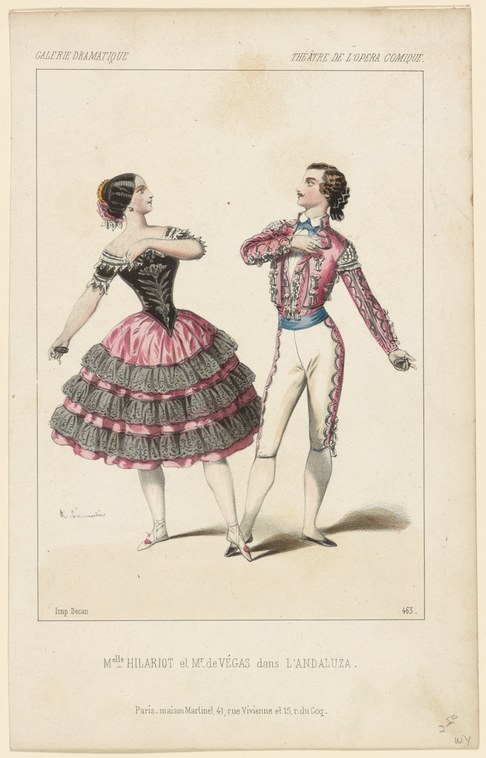
Melle Hilariot et Mr de Végas dans L'Andaluza
Unknown artist
- Collection:
- Prints depicting dance
- Source:
- New York Public Library
- Rights:
- Public domain — free to use, share and adapt.
- Recorded as:
- Public Domain
This print documents a specific performance and named dancers whose work would otherwise be lost to history. It also exemplifies the Romantic era's fascination with Spanish and Andalusian aesthetics in theatrical dance—a taste that shaped ballet and popular dance across Europe. The image shows how mid-19th-century theater used costume, print, and celebrity to market dance to audiences.
What you are looking at
A hand-colored theatrical print showing two dancers in mid-performance against a plain background. On the left, a female dancer in a black corseted bodice and voluminous pink skirt with black lace trim stands in profile, her torso angled and one arm extended. On the right, a male dancer in an ornate pink and purple embroidered jacket with white stockings and dark shoes faces her, his posture open and his arms gesturing. Both figures are poised in an attitude of mutual engagement, frozen in what appears to be a moment of flirtation or courtship. The woman's skirt displays multiple tiers of black-trimmed ruffles, and her hair is styled in the fashion of the mid-19th century. The man's costume is lavishly decorated with scrollwork embroidery. The composition is symmetrical and frontal, with the figures occupying the center of the frame against an unadorned cream ground.
The dancing
Both dancers stand upright with engaged postures. The woman's weight appears centered, with her torso twisted to address her partner while her arm extends outward in a gesture of presentation or invitation. The man stands with his legs slightly apart in a balanced stance, both arms raised in an open, welcoming position at roughly shoulder height. Their relative positioning suggests they are separated by a small distance and facing each other diagonally. There is no closed hold; instead, the dancers relate through gesture and spatial attention rather than physical contact.
The dance depicted
The costume, pose, and print style identify this as a scene from *L'Andaluza*, likely a theatrical dance or ballet featuring Spanish or Andalusian themes, which were popular in European dance and opera during the mid-19th century. The woman's dress—the black corseted bodice with a voluminous multi-tiered skirt—and the man's ornate embroidered jacket are consistent with Romantic-era ballet costume and the vogue for Spanish-inspired theatrical dance that emerged in the 1830s–1850s. The titled performers, Mlle Hilariot and M. de Végas, suggest this was a popular or notable dance of its time, though no detailed choreographic information is recoverable from the image alone.
How it was made
This is a hand-colored lithographic or engraved print, likely produced for commercial theatrical distribution. The outlined figures are printed in black line with watercolor or lithographic color applied afterward—evident in the flat, translucent washes of pink, black, and purple. Such prints served as souvenirs of notable performances and helped publicize dancers and works to a broad audience. The technique was economical enough to allow large print runs, making these images accessible to middle-class admirers of theater and dance.
About this work
This is a mid-19th-century theatrical print documenting a performance moment from *L'Andaluza*, a Spanish-themed dance work. It captures two named dancers—Mlle Hilariot and M. de Végas—in an attitude of mutual engagement, their costumes and poses carefully rendered to advertise the exotic and romantic appeal of the work. The print belongs to a widespread tradition of theatrical imagery that helped define the visual identity of Romantic-era dance and made performers into recognizable public figures. For dance historians, it provides evidence of the international circulation of Spanish and Andalusian themes in European ballet and theatrical dance, and of the commercial machinery that promoted individual dancers and choreographed works.
How to look at it
Notice the careful balance between the two figures despite their separation: the woman's extended arm and angled torso mirror and complement the man's open gesture, creating a visual dialogue. The artist chose a moment of approach or invitation rather than a supported lift or locked hold—typical of the courtship narratives favored in Romantic-era dance. The ornate costume detail (especially the man's embroidered jacket) was meant to be read from a distance, as it would be from the theater audience. The print itself was meant to be studied closely as a memento, so the precision of line and the hand-coloring lend it an air of intimacy despite its theatrical subject.
The artist
The artist is not recorded in the catalogue. The print is signed (lower left) but the signature is not legible in the reproduction. The work was published by Martinet in Paris, at rue Vivienne, a major publisher of theatrical prints and engravings during the 19th century. Martinet's catalog included thousands of images of performers, operas, and ballets, making his prints a primary source for understanding how theater was visualized and consumed during this period.
The period
The 1830s–1850s saw an explosion of interest in Spanish, Moorish, and Andalusian themes in European art, music, and dance—a taste fed by travel writing, Orientalism, and Romantic-era exoticism. In ballet, this period immediately followed the great successes of Romantic works like *La Sylphide* (1832), and the genre was eager for new subjects and settings. Spanish and character dances became increasingly fashionable in theatrical contexts, often performed by virtuoso solo dancers or in pas de deux. Lithographic and engraved theatrical prints were a booming industry by this time, with publishers like Martinet supplying images to fans, theater-goers, and collectors.
Where it lives
The work is held in the New York Public Library's collection of prints depicting dance. It is a commercial theatrical souvenir, typical of 19th-century Paris publishing.
Dance in this work
Questions about this work
Who were Mlle Hilariot and M. de Végas?
They were named performers in theatrical dance during the mid-19th century, identified in this print as the dancers in *L'Andaluza*. Beyond their appearance in this image and presumably other contemporary prints, detailed biographical information does not appear to survive in standard dance histories.
What is L'Andaluza?
It was a theatrical dance work featuring Spanish or Andalusian themes, popular in European theaters during the Romantic era. The exact choreographer, date of premiere, and whether it was a ballet or a theatrical dance number are not documented in the print itself.
How were these prints made and distributed?
Theatrical prints were produced by commercial publishers like Martinet in Paris. The design was engraved or lithographed, then hand-colored with watercolor or lithographic pigment. They were sold as souvenirs to theater-goers and fans, helping to publicize performances and create a market for the dancers' images.
What does the costume tell us about the dance?
The woman's black-corseted bodice and multi-tiered skirt, and the man's ornate embroidered jacket, are consistent with mid-19th-century theatrical dance costume and the fashion for Spanish-inspired works in European ballet. The lavish decoration suggests a work meant to be visually spectacular and exotic.
More dance artwork





