49 works in this view — arrow keys or swipe to move between them.
Dance in Art
Petra Camara
Unknown artist
- Collection:
- Prints depicting dance
- Source:
- New York Public Library
- Rights:
- Public domain — free to use, share and adapt.
- Recorded as:
- Public Domain
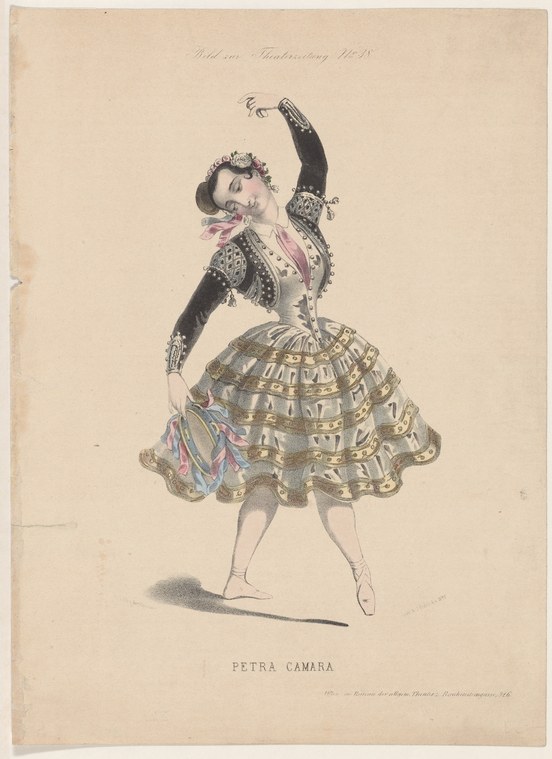
This is a direct record of how a Romantic ballet dancer presented herself and was presented to the public. The image tells us what Petra Camara wore, how she posed, and what physical ideals the era valued—the lifted spine, the upward gaze, the ethereal silhouette. For historians, it is evidence of the costume, the body aesthetic, and the theatrical marketing apparatus of mid-nineteenth-century ballet.
What you are looking at
A solo female dancer in Romantic-era theatrical dress occupies the center of the composition, captured mid-movement in a pose of balletic elevation and grace. She wears a fitted black velvet jacket with ornamental frogging or embroidered detail across the chest, paired with a voluminous skirt of pale silk or tulle in a gathered, dome-like silhouette characteristic of 1840s fashion. The skirt is printed or painted with a geometric pattern in gold and muted colors suggesting architectural or decorative motifs. Her pose is dynamic: the body tilts slightly, one arm raised expressively overhead with fingers extended, the other arm positioned at the torso. Her weight appears centered on one leg while the other extends or lifts, and her gaze is directed upward in a romantic, ethereal manner. The figure is rendered with careful attention to the fall of fabric and the modeling of the limbs. The background is plain and neutral, allowing the figure to dominate. A shadow beneath the dancer suggests a stage floor. The whole composition has the formal, posed quality of theatrical portraiture rather than a scene of social dancing.
The dancing
The dancer stands in a balletic frame with the torso lifted and engaged. One leg appears to support the full weight while the other is extended or in a position suggesting elevation; the line from hip through foot is elongated. The raised arm follows a classical balletic line from the shoulder, creating an arc overhead. The positioning suggests she is either in a rising moment of movement or hovering in a held pose. Her head carriage follows the raised arm, creating an upward trajectory through the body. The body demonstrates the turned-out positioning, lifted spine, and ethereal weightlessness central to Romantic ballet vocabulary.
The dance depicted
This is a portrait of a Romantic-era ballet dancer, most likely from the 1840s based on the costume and stylization. The pose and aesthetic align with the vocabulary of Romantic ballet, which emphasized lightness, otherworldliness, and the illusion of effortless elevation. The dancer's name is given as Petra Camara in the title, likely a performer of that period, though historical records of her career are limited. The image shows her in what appears to be a role-specific costume—the decorated jacket suggests character or national dress within a ballet narrative—and the pose captures a moment of lyrical, upward-moving choreography characteristic of the style.
How it was made
This is a hand-colored lithographic print or engraving, typical of theatrical portraiture from the mid-nineteenth century. The technique combines lithographic stone printing with careful hand-coloring in watercolor or gouache, allowing for fine detail in the face and hands while building up rich, saturated color in the costume. The gold patterning on the skirt and the subtle modeling of the velvet jacket suggest a skilled colorist's hand. This was the dominant format for circulating images of celebrated performers to a broad public audience, reaching fans and theater-goers across Europe and America. The clarity and detail indicate a professional theatrical publication, likely produced by a Paris or London printing house.
About this work
This is a portrait print of the dancer Petra Camara in a Romantic ballet costume, rendered as a lithographic print with hand coloring. It represents the theatrical fashion of the 1840s—the height of Romantic ballet—at the moment when lithography had become the primary technology for mass-producing and marketing images of celebrated performers. The work is both a document of dance costuming and a piece of commercial theatrical publicity, one of hundreds of similar prints that made the stars of the era recognizable across the European continent. It belongs in a gallery of dance imagery because it captures not a narrative ballet scene but the idealized, posed presentation of the dancer as a public figure—how the performer wished to be seen and remembered.
How to look at it
Attend to the moment the artist chose to freeze: not a weight-bearing stance but a rising, ethereal moment captured mid-movement. The upward trajectory of the arm and the gaze, combined with the apparent lightness of the supporting leg, creates the illusion of elevation and weightlessness central to Romantic ballet's visual language. The costume, too, is worth studying—the black jacket provides visual weight and definition to the upper body, while the gathered, patterned skirt emphasizes the lower body's volume and creates the silhouette that made Romantic ballet visually distinctive. This is a posed portrait, not a candid scene, so understand it as theatrical presentation: this is how Petra Camara wanted to be seen and remembered.
The artist
The print is unsigned and the colorist or lithographer is not recorded. Works of this type were often produced in publishing workshops where engravers, lithographers, and colorists worked collaboratively. The composition and hand-coloring style suggest a professional theatrical print workshop, likely based in Paris (the center of ballet publishing) or London, operating in the 1840s-1850s.
The period
The 1840s were the height of Romantic ballet, when works such as La Sylphide (1832) and Giselle (1841) had established a new aesthetic centered on the supernatural, the ethereal, and the emphasis on the female dancer's weightless elevation. Lithographic portraiture of ballet dancers was at its commercial peak; every celebrated performer of the era—Marie Taglioni, Fanny Essler, Carlotta Grisi—was circulated in prints like this one. These images functioned as both fan memorabilia and promotional material, creating a star system and allowing the urban public to know the faces and bodies of celebrated performers. The costume shown here—the fitted jacket with decorative embroidery and the gathered skirt—is characteristic of the era and suggests a specific role within a ballet narrative, though the particular production cannot be determined from the image alone.
Where it lives
The print is held in the New York Public Library's collection of theatrical prints depicting dance. It is listed in the catalog without attribution of artist, date, or medium, indicating that such works were often uncredited products of commercial publishing.
Dance in this work
Questions about this work
Who was Petra Camara?
Petra Camara is known from theatrical records and prints to have been a professional ballet dancer active in the 1840s-1850s, likely performing in European theaters. Beyond what appears in her portrait and theatrical announcements of the era, detailed biographical information is scarce. She was celebrated enough to merit a published portrait print, suggesting she held a notable position in the ballet companies of her time.
What is the costume she is wearing?
The fitted black velvet jacket with ornamental embroidery and the gathered silk skirt are characteristic of Romantic-era ballet costume, often used for character roles or national dances within larger ballet narratives. The specific patterning and cut suggest a defined role—possibly a character from a story ballet—rather than the classical ballet costumes used for purely abstract or mythological roles.
How was this print made?
This is a lithographic print that has been hand-colored, a standard technique for producing theatrical portraiture in the 1840s-1850s. An image was drawn on a lithographic stone, printed in black or a light tone, and then each print was individually colored by hand, allowing for customization and richness of detail. This process was labor-intensive but far cheaper than oil painting, making celebrity portraiture affordable to a mass market.
Why do so many prints of Romantic ballet dancers survive?
Lithographic portraits of ballet dancers were commercial products, produced in large numbers and distributed widely to fans, theaters, and collectors. Unlike paintings, they were affordable and meant to circulate. Many examples survive because they were kept as fan memorabilia, pasted into scrapbooks, or collected by theaters; the New York Public Library holds extensive collections of such prints from this era.
More dance artwork





