49 works in this view — arrow keys or swipe to move between them.
Dance in Art
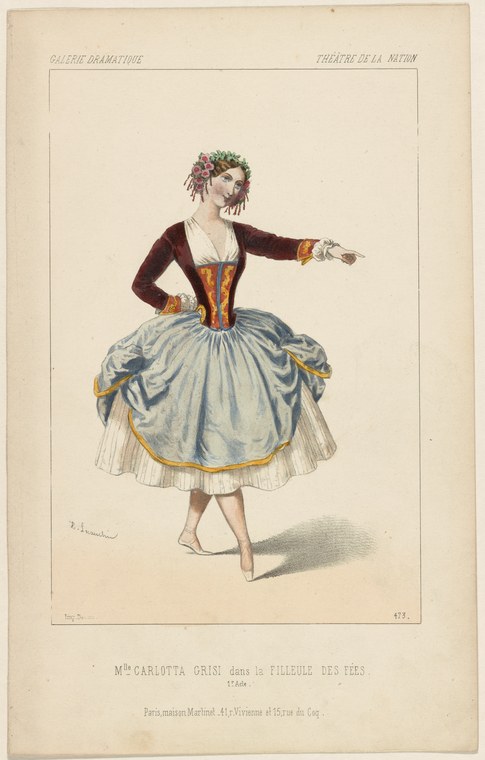
Théâtre de la Nation. Mlle Carlotta Grisi dans La filleule des fées, 1r acte
Unknown artist
- Collection:
- Prints depicting dance
- Source:
- New York Public Library
- Rights:
- Public domain — free to use, share and adapt.
- Recorded as:
- Public Domain
Carlotta Grisi was among the most technically accomplished and celebrated ballerinas of the Romantic era, and imagery of her in costume is primary documentation of how Romantic ballet was costumed, posed, and presented to audiences. This print preserves a record of a now-lost ballet and captures the aesthetic conventions of mid-19th-century theatrical dance portraiture—the emphasis on the costume, the narrative gesture, and the carefully composed image meant to be studied and collected.
What you are looking at
A single female dancer stands in three-quarter view against a plain cream background, captured mid-performance in a moment of theatrical gesture. She wears the costume of Romantic ballet: a dark burgundy or chocolate-brown velvet jacket with a fitted bodice and orange-gold trim, paired with a voluminous skirt of pale blue silk caught up at intervals with swags of orange-gold ribbon, revealing white petticoats beneath. Her hair is dressed elaborately with flowers and greenery in the manner of mid-19th-century stage fashion. Her left arm extends gracefully outward in a gesture of address or invitation, while her right hand rests near her body. She stands en demi-pointe (not full pointe), with her weight distributed across her feet in a posture suggesting poise rather than active movement. The composition isolates her against the white field, emphasizing the silhouette of the costume and the elegant proportions of her bearing.
The dancing
The dancer presents herself in an open, frontal pose with the extended left arm suggesting a moment of narrative address—characteristic of Romantic-era ballet where the corps and principals often paused to acknowledge the audience or a stage partner. Her posture is upright but not rigid, with shoulders relaxed and the carriage of the head turned slightly to follow the line of the extended arm. Her feet are in a neutral stance rather than a formal ballet position, suggesting a moment of repose or theatrical acknowledgment rather than active dancing. The entire figure is framed to emphasize the silhouette and the elaborate costume rather than the technical vocabulary of movement.
The dance depicted
This is a portrait of Carlotta Grisi, one of the most celebrated ballet dancers of the Romantic era, in a role from *La Filleule des Fées* (*The Fairy's Godchild*), a ballet that premiered in the 1840s. The costume and pose are entirely consistent with the Romantic ballet repertoire: the short skirt (mid-calf length, not the ankle-length dress of classical court dance), the pointe-work suggested by the alignment of the foot, and the narrative gesture all belong to the theatrical ballet of the second quarter of the 19th century. The image records not a moment of dancing but a moment of stillness—the kind of pose a dancer would hold for a portrait or a climactic moment in the narrative, allowing the audience to admire both the body and the elaborate costume. Grisi was known for her technical prowess and her ability to command the stage in roles that blended mime, dance, and theatrical presence.
How it was made
This is a hand-colored lithograph or engraving from the mid-19th century, executed in a technique typical of theatrical portraiture of the period—fine line work for the costume details and flesh tones rendered with tinted washes or careful hand-coloring. The technique allowed for rapid, affordable reproduction and distribution, making such prints a standard form of celebrity publicity for theatrical performers. The delicate line work and the careful rendering of the costume detail suggest this was a serious commission, likely intended for sale to theatre-goers and collectors of theatrical imagery. The signature visible at lower left indicates a named artist, though not recorded in the catalogue.
About this work
This is a theatrical portrait of the Romantic-era ballerina Carlotta Grisi, rendered as a hand-colored print that served as both documentation of her costume and promotion of her celebrity. It dates to the mid-19th century and records a moment from *La Filleule des Fées*, a ballet now known primarily through such imagery and the historical record. The work belongs to the substantial archive of 19th-century dance portraiture that documented the Romantic ballet repertoire and its stars before photography became the dominant medium. Such prints were collected by opera-goers and dance enthusiasts and served as souvenirs of celebrated performances.
How to look at it
The viewer should attend to the costume detail, which tells the story of how Romantic ballet was dressed: the contrast between the fitted bodice and the voluminous skirt, the strategic use of color and ribbon, the elaborate headdress that frames the face. The pose is not a dance position but a theatrical stance designed to display the body and costume; notice how the extended arm creates a line that carries the viewer's eye across the composition. The isolation of the figure against the plain background emphasizes the silhouette and makes the costume the primary subject—a deliberate choice that privileges the visual spectacle of Romantic ballet over the documentation of movement.
The artist
The catalogue record does not identify the artist. The signature is partially legible at lower left but not recorded. The style and execution are consistent with the commercial theatrical portraiture workshops of Paris in the 1840s-1850s, when such prints were produced in volume by both named and anonymous artists working for theatre-going audiences and celebrity collectors.
The period
This print dates to the height of the Romantic ballet era in Paris, the 1840s-1850s, when ballet had become the dominant theatrical form and Romantic narrative ballets such as *Giselle*, *La Sylphide*, and *La Filleule des Fées* were in active repertoire. This was the period of Carlotta Grisi's greatest fame, following her debut in Paris in 1841 and her roles in the most celebrated Romantic ballets. The costume and aesthetic of the image—the short skirt, the pointed foot, the elaborate floral headdress—represent the standardized visual language of Romantic ballet as it had developed by mid-century. Such theatrical portraiture was a major genre of commercial art, produced by lithographic workshops as both souvenirs and promotional material.
Where it lives
This print is held in the New York Public Library's collection of prints depicting dance. It is catalogued as a theatrical portrait from the mid-19th century but lacks a recorded artist, date, or medium. It is one of a substantial archive of similar prints documenting the careers and costumes of celebrated Romantic-era dancers.
Dance in this work
Questions about this work
Who was Carlotta Grisi?
Carlotta Grisi (1819–1899) was an Italian dancer who became one of the most celebrated ballerinas of the Romantic era. She trained in Italy and became famous across Europe for her technical brilliance, dramatic presence, and roles in the most important ballets of her time. She danced the original Giselle in Paris in 1841 and created roles in many significant Romantic ballets. She was known for combining technical virtuosity with dramatic acting ability.
What is *La Filleule des Fées*?
*La Filleule des Fées* (*The Fairy's Godchild*) was a ballet of the mid-19th century performed by leading dancers of the era including Carlotta Grisi. Like other Romantic ballets, it combined narrative mime, classical dance vocabulary, and spectacular costuming. The title suggests a fairy-tale plot typical of the Romantic repertoire, but the ballet is now known primarily through such costume prints and historical records, as it is no longer performed.
Why would a dancer need a portrait like this?
Such portraits served multiple purposes: they were sold as souvenirs to theatre-goers who wished to remember a celebrated performance; they were used as promotional material by the theatre; they documented the costume and appearance of major roles for the historical record; and they functioned as celebrity merchandise for famous dancers. These prints were the equivalent of 19th-century publicity photography and helped build the fame and celebrity of dancers like Grisi.
What does the costume tell us about Romantic ballet?
The costume reflects the standardized visual language of Romantic ballet: the short skirt (called a tutu in later terminology) allows display of the legs and footwork; the fitted bodice emphasizes the torso and carriage of the body; the pale color and delicate fabric create the ethereal effect the Romantics associated with the female dancer; the elaborate floral headdress was typical of theatrical fashion and narrative costume. Together, these elements created a visual spectacle designed to showcase the dancer's body and the narrative action equally.
More dance artwork





