49 works in this view — arrow keys or swipe to move between them.
Dance in Art
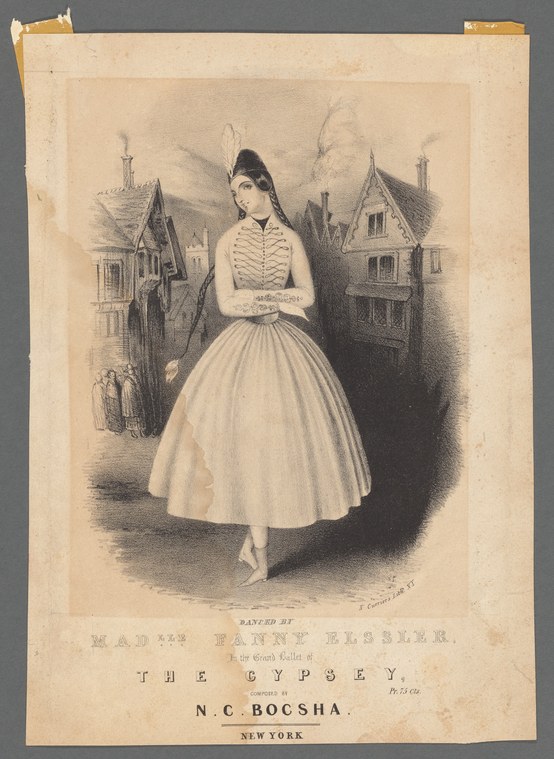
[The cracovienne] danced by Madlle. Fanny Elssler, in the grand ballet of The gypsey, composed by N.C. Bocsha [sic]
Unknown artist
- Collection:
- Prints depicting dance
- Source:
- New York Public Library
- Rights:
- Public domain — free to use, share and adapt.
- Recorded as:
- Public Domain
Fanny Elssler was one of the first international dance superstars, and this image is evidence of her celebrated repertoire and her status as a subject worthy of commercial reproduction. For historians of dance and visual culture, such prints are primary documents of how Romantic ballet was actually performed, costumed, and marketed—information rarely recorded in choreographic notation or written reviews.
What you are looking at
A young woman in Romantic-era theatrical dress stands alone in a carefully composed studio setting, her body positioned in a graceful contrapposto stance. She wears a fitted corseted bodice with decorative frogging or braiding across the front, and a voluminous skirt that falls to mid-calf—the silhouette characteristic of 1840s ballet costume. Her dark hair is pulled back and adorned with what appears to be feathers or plumes, a detail matching the title's reference to the Gypsy ballet. The setting behind her depicts European architecture with steeply pitched rooflines and Gothic Revival details, rendered in soft graphite shading that creates atmospheric depth. The figure is rendered in a three-quarter view, her weight settled on one leg in a pose suggesting repose between movement, her arms held at a natural but elegant angle. The entire composition—figure, costume, setting—is executed in the refined lithographic technique of theatrical portraiture that became standard documentation of celebrated dancers during the Romantic ballet period.
The dancing
The dancer's weight is balanced on her back leg in a pose of relaxed but refined readiness—not an active step but a moment of stillness. Her upper body is upright with shoulders back and arms held softly at the sides in a natural frame, without the extreme turnout or lifted port de bras that would characterize a dramatic ballet phrase. Her stance suggests the conventions of posed theatrical portraiture rather than a captured moment of choreography. The single isolated figure and the studio setting indicate this is a formal likeness of the dancer rather than a scene of ballet action.
The dance depicted
This is a theatrical portrait of Fanny Elssler (1810–1884), the Austrian prima ballerina, in character dress for 'La Gypsy' (also known as 'The Gypsy'), a ballet choreographed by N. C. Bocsha and mounted at the Paris Opera in the mid-1840s. Elssler was celebrated for her vivacity and technical brilliance, particularly in character dances and national dances, a reputation earned during her American tour (1840–1842) where she achieved unprecedented star status. The costume here—the corseted bodice, plumed headdress, and full skirt—represents the theatrical fantasy of the Romantic ballet's interpretation of Gypsy culture rather than any historical dress, but the specificity of the costume and title anchor this work as a document of a real production and a real dancer's celebrity moment.
How it was made
This is a lithograph, a technique that allowed rapid reproduction and wide distribution of theatrical images. The image shows skilled use of tonal shading and fine line work to render form and fabric, with particular attention to the soft modeling of the figure's face and hands. Lithographic portraits of dancers were the chief means by which theatrical stars circulated their images to the public during the 1830s–1850s, serving as souvenirs, promotional material, and evidence of a dancer's fame and repertoire. The inscription at the bottom—naming the dancer, the ballet, and the composer—was typical of such commercial prints, which were sold at the theater and in print shops across Europe and America.
About this work
This is a lithographic portrait of Fanny Elssler in costume as the heroine of 'La Gypsy,' a mid-nineteenth-century Romantic ballet. The work documents both a celebrated dancer at the height of her fame and the theatrical visual culture of the Romantic period—the elaborate costume fantasy, the use of national and character dances as a vehicle for star performance, and the mass production of dancer portraits as objects of public consumption. The print belongs to a vast genre of theatrical ephemera that has largely disappeared from historical view but was central to how nineteenth-century audiences knew and celebrated dance.
How to look at it
Attend to the precision of the costume detail—the frogging on the bodice, the plume headdress, the cut of the skirt—which was as much a part of Elssler's fame as her dancing. Note the pose: this is not a dramatic leap or turnout but a moment of composed elegance, the kind of pose that would have appeared in programs or lobby prints. The architectural setting is rendered in soft shadow, a framing device that isolates the figure and emphasizes her status as the subject of the portrait. The inscribed title, composer, and dancer's name below the image identify this as a commercial product, a souvenir and advertisement rolled into one.
The artist
The artist is not named in the inscription. Lithographic portraits of dancers in this period were often produced by theater-connected printmakers working in Paris, London, and New York; some were based on sketches by the dancers themselves or their associates. The work shows the professional competence of commercial theatrical portraiture but does not carry a distinctive artistic signature that would aid attribution. The print's execution suggests a mid-level Parisian or London shop producing such work in quantity during the 1840s.
The period
This print dates to the height of the Romantic ballet (approximately 1830–1860), when the medium was undergoing rapid professionalization and international star-making. Fanny Elssler emerged as a rival to Marie Taglioni during the 1830s, and her American tour (1840–1842) made her the first European ballet dancer to achieve mass celebrity in the United States. During this period, lithography had become the standard technology for theatrical portraiture, and dancers' images circulated in the thousands. 'La Gypsy' was one of several ballets of the 1840s that drew on Romantic Orientalism and the fascination with national and character dances as exotic spectacle. The ballet's success reflected the era's hunger for novelty and the audience's appetite for star performers in character roles.
Where it lives
This lithograph is held in the Prints depicting dance collection at the New York Public Library, one of the major repositories of American theatrical ephemera. Such prints were distributed widely during the 1840s and many survive in institutional collections, though their fragility and the lack of systematic cataloging means that many images of celebrated dancers from this period remain poorly documented.
Dance in this work
Questions about this work
Who was Fanny Elssler?
Fanny Elssler (1810–1884) was an Austrian-born ballerina and one of the great stars of the Romantic ballet. She was known for her brilliant technique, vivacity, and mastery of character dances and national dances. Her American tour (1840–1842) made her the first European ballet dancer to achieve mass celebrity in the United States, a phenomenon documented in prints, newspapers, and popular memorabilia.
What was 'La Gypsy' or 'The Gypsy'?
A ballet choreographed by N. C. Bocsha for the Paris Opera, likely in the mid-1840s, during the height of Romantic ballet's interest in exotic and national themes. The work gave Elssler a starring role in character costume, which was central to her appeal as a dancer. The ballet has not survived in the repertoire and is known chiefly through prints and reviews.
Why are so many images of dancers from this era lithographs?
Lithography was the standard commercial printing technology of the 1830s–1850s, allowing rapid reproduction and distribution of theatrical images. A single drawing could be printed in hundreds of copies and sold as souvenirs at theaters and print shops. This made lithography the chief means by which dancers' images circulated to the public and built their fame.
What does her costume tell us?
The corseted bodice, plumed headdress, and full skirt represent the Romantic ballet's theatrical fantasy of Gypsy culture rather than historical dress. The specificity and quality of the costume detail reflects how important visual spectacle was to Romantic ballet and how much of a dancer's celebrity depended on glamorous costume and character roles.
More dance artwork





