49 works in this view — arrow keys or swipe to move between them.
Dance in Art
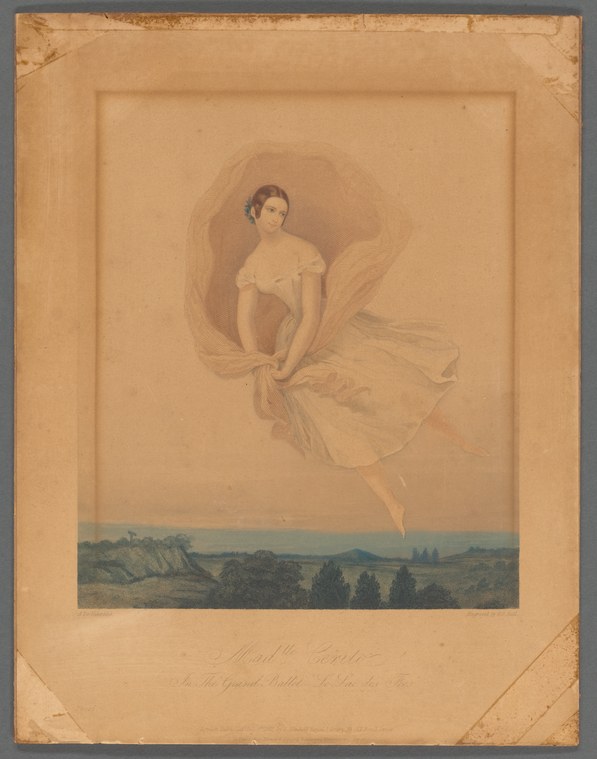
Madlle. Cerito [sic] in the grand ballet Le lac des fées
Unknown artist
- Collection:
- Prints depicting dance
- Source:
- New York Public Library
- Rights:
- Public domain — free to use, share and adapt.
- Recorded as:
- Public Domain
Cerito was among the greatest ballerinas of the nineteenth century, yet her performances survive only in prints like this. The image shows us what Romantic ballet meant to its audience: an escape into a realm of grace and fantasy, where the female body became weightless and supernatural. For historians and dancers, this print is evidence of how the period's most famous performers were mythologized and marketed.
What you are looking at
A woman in classical dress floats upward through clouds above a landscape, her body contorted in an impossible arch. She wears a pale tunic or corset with a diaphanous skirt that billows around her in the spiral of her ascent. Her dark hair is pulled back and her face is serene, almost expressionless, as she rises. The landscape below—rendered in muted greens and grays—shows a river valley with forested banks and distant mountains, receding into haze. Above her, the sky opens in pale washes of sepia and cream. The entire composition is framed within nested rectangular borders, a device typical of theatrical prints of the Romantic era. The figure dominates the upper half of the page; the landscape occupies the lower third. The overall effect is dreamlike and allegorical—a supernatural vision of grace and weightlessness.
The dancing
A single figure, female, occupies the canvas. Her body is in a deep, extended backbend—arched from knees through head in a line that defies anatomical probability. Her arms are positioned loosely at her sides or slightly lifted. Her legs appear to extend upward, with pointed feet or toes visible. The posture suggests both classical training and a moment of impossible elevation; the artist has chosen a moment of perfect suspension, neither rising nor falling. There is no evidence of a partner or supporting hand.
The dance depicted
The catalogue identifies this as Mademoiselle Cerito in the grand ballet *Le lac des fées* (The Lake of the Fairies). Fanny Cerito (1817–1909) was one of the leading ballerinas of the Romantic era, and *Le lac des fées* was likely one of the full-length story ballets of the 1840s–50s in which she performed. The image shows her in a moment of supernatural ascent or transformation—a scene characteristic of Romantic ballet, where the heroine often becomes weightless, magical, or transcendent. The extreme backbend and the dreamlike setting are hallmarks of how Romantic ballet was imagined in prints: not as a technique but as an illusion of effortless flight and otherworldly grace. This is a theatrical fantasy, not a record of actual stage movement.
How it was made
The work is a hand-colored print, most likely a lithograph or tinted lithographic drawing. The technique is evident in the soft, powdery quality of the sepia tones, the delicate layering of color washes (particularly in the sky and landscape), and the fine, controlled linework defining the figure. The borders are printed. The hand-coloring is fluid and atmospheric, especially in the clouds and distant landscape, suggesting commercial theatrical print production. This medium was standard for dance prints of the 1840s–60s, widely circulated and affordable, designed to commemorate performances and market star dancers to the public.
About this work
This is a commemorative theatrical print of Fanny Cerito, one of Romanticism's greatest ballerinas, in a moment of supernatural transcendence from the fairy-tale ballet *Le lac des fées*. The image captures the core fantasy of Romantic ballet: a woman lifted beyond gravity and earthly constraint, suspended in impossible grace above a real landscape. Cerito was celebrated across Europe for her technical brilliance and dramatic presence; prints like this one circulated as souvenirs and advertisements, fixing her image in the public imagination. The work belongs in a gallery of dance art because it shows us how a major art form of its time was imagined and sold—not as athletic training but as magic.
How to look at it
Notice the impossible geometry of the body—no dancer can actually achieve this backbend and float upward. The artist has frozen the fantasy, not the fact. Look at how the landscape grounds the image in reality while the figure transcends it; this is the Romantic theatre's central trick: ordinary scenery below, supernatural vision above. The detail of her face—calm, almost absent—is crucial; she is not exerting or straining, but effortlessly becoming something other than human. The borders and text at the bottom identify this as a commercial product, a piece of fan culture.
The period
This print dates from the height of Romantic ballet, likely the 1840s or 1850s. Ballet had become the dominant theatrical dance form across Europe; women dancers were international celebrities; and the supernatural—fairies, sylphs, ghosts, enchanted lakes—dominated the repertory. *La Sylphide* (1832) and *Giselle* (1841) had established the aesthetic: weightless, ethereal female bodies in tutus, often ascending or floating. Cerito was one of the four greatest dancers of the age (alongside Marie Taglioni, Carlotta Grisi, and Lucile Grahn) and performed regularly in Paris, London, and Milan. Theatrical prints of dancers were mass-produced during this period, hand-colored and sold as souvenirs and publicity. They were not always realistic; they were often more fantastical than the stage itself.
Where it lives
The work is held in the New York Public Library's Prints collection, which specializes in theatrical and dance imagery. It is catalogued as a commemorative theatrical print, a common genre in nineteenth-century popular culture.
Dance in this work
Questions about this work
Was Fanny Cerito really able to move like this?
No. This print is theatrical fantasy, not documentary. Romantic ballet dancers were technically brilliant, but no one could achieve or sustain this extreme backbend mid-flight. The print imagines the ideal of Romantic ballet—weightlessness and transcendence—rather than recording actual movement. It is more akin to a publicity portrait or a painted tribute than a study of technique.
What was *Le lac des fées*?
A grand ballet, likely from the 1840s–50s, in which Cerito performed. It belongs to the wave of fairy-tale and supernatural ballets that dominated European stages after *La Sylphide*. The title translates as 'The Lake of the Fairies,' suggesting a magical setting with transformations and impossible feats. The ballet itself is now lost, known only through prints and reviews.
Why is she arching backward?
The backbend suggests vulnerability, surrender, and transcendence simultaneously. In Romantic ballet iconography, the arched or swooning body often signals a moment of magic or loss of earthly constraint. It is a pose that reads as both dramatic and otherworldly—exactly what the Romantic theatre wanted its audience to feel.
More dance artwork





