49 works in this view — arrow keys or swipe to move between them.
Dance in Art
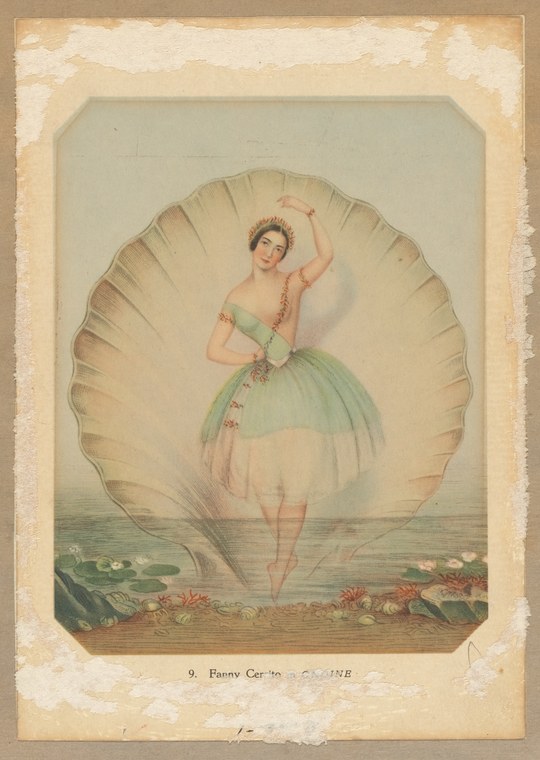
Fanny Cerrito in Ondine
Unknown artist
- Collection:
- Prints depicting dance
- Source:
- New York Public Library
- Rights:
- Public domain — free to use, share and adapt.
- Recorded as:
- Public Domain
Fanny Cerrito was among the finest ballerinas of the Romantic era, and *Ondine* was one of her signature roles. This print is documentary evidence of how celebrated dancers were marketed and remembered, and of the technical and aesthetic standards of mid-19th-century ballet. For historians of dance, prints like this one are primary sources on costume, pose, and the visual ideals of the period when they cannot attend a live performance.
What you are looking at
A young woman in Romantic-era costume stands en pointe within an enormous scallop shell that frames her like a stage within the stage. She wears a pale green tulle skirt, fitted bodice, and a jeweled headdress or crown. One arm is raised overhead in a graceful curve; the other gestures downward across her torso. Her pose suggests the moment of a pirouette arrested mid-turn. The setting is fantastical: the shell's ridged interior dominates the composition, rendered in soft grays and golds, while below her feet a rocky shoreline materializes with seaweed and coral. The lighting is ethereal, with the shell glowing as though illuminated from within. The whole image has the quality of a lithograph tinted by hand—soft, dreamlike, and theatrical. A handwritten inscription at the bottom reads 'Fanny Cerrito in Ondine,' identifying both the dancer and the character she portrays.
The dancing
The dancer stands in a classical ballet pose with weight balanced on the supporting leg, the other leg extended or gathered beneath her. Her arms frame her face and upper body in the Romantic vocabulary—one lifted, one lowered—creating a vertical axis through the figure. Her posture is upright and elongated; the pointe shoes are visible beneath the skirt. The pose is introspective and weightless, emphasizing the ethereal quality expected of the Romantic ballerina. The absence of partnering and the solitary, symmetrical framing within the shell suggests this is a moment of lyrical repose or transformation.
The dance depicted
This is Romantic ballet, specifically a scene from *Ondine*, a celebrated work of the 1840s. Fanny Cerrito was one of the great Italian ballerinas of the era, and *Ondine* was a signature role that showcased the technical virtuosity and otherworldly presence the Romantic ballet demanded. The ballet told the story of a water nymph (ondine) who falls in love with a mortal knight; the shell setting visualizes her aquatic nature and the supernatural element central to the narrative. The choreography we can infer from this pose emphasizes verticality, balance, and the illusion of effortlessness—the aesthetic of mid-19th-century classical ballet. The image documents how such roles were marketed and circulated to a paying public.
How it was made
This is a hand-colored lithograph, a commercial print medium widely used in the 1840s and 1850s to distribute images of celebrated dancers to theaters and homes. The technique allowed soft gradations of tone and watercolor-like effects (visible in the translucent shell, the gauzy tulle, and the atmospheric lighting), which suited the Romantic aesthetic. Lithography's relative ease and low cost compared to engraving made it the dominant medium for theatrical portraiture of the period. The coloring appears to have been added by hand in a workshop, a common practice; the colored prints were more expensive and more likely to be purchased by devotees or collected in scrapbooks.
About this work
This is a commercial theatrical print documenting Fanny Cerrito in the Romantic ballet *Ondine*, likely from the 1840s or early 1850s. The work is a hand-colored lithograph, a form of mass-produced portraiture that made celebrated dancers available to a wide audience during an era when ballet was a major entertainment in European and American cities. Cerrito was an internationally touring star, and prints like this one were sold at the stage door, collected in albums, and displayed in homes as mementos of performances or as tokens of devotion to the dancer. The image is both a document of a specific performance tradition and an artifact of 19th-century celebrity culture.
The work belongs in a gallery of dance in art because it captures the visual language and technical ideal of Romantic ballet: the pointe work, the ethereal costume, the solitary female figure, the fantastical setting, and the emotional restraint and verticality of the pose. It also reveals how the dance was translated into static image—the lithograph freezes a moment of apparent repose, suggesting the dancer's grace and otherworldly quality while avoiding the awkwardness of capturing actual movement. This is how dancers and their art were circulated, remembered, and imagined by the public.
How to look at it
Attend to the pose and its framing. The dancer is caught in a moment of apparent suspension, neither arriving nor departing—a moment that would be impossible to hold in actual performance but is perfectly suited to a static image. The scallop shell serves not only as an identifying emblem of the water nymph but also as a compositional device that centers and isolates the figure, making her the sole focus. The soft lithographic line and the hand coloring emphasize the ethereal quality; note how the shell glows and how the tulle is rendered almost transparent. This is not documentary realism but idealized portraiture: the dancer is shown as the audience wished to remember her, weightless and composed, not in the effort or sweat of actual performance.
The artist
The artist is not recorded. Hand-colored lithographs of dancers were produced in commercial workshops, often anonymously or under the publisher's name. The style and composition—the centered figure, the allegorical setting, the soft coloring—are typical of mid-19th-century theatrical portraiture. Such prints were sometimes based on sketches or paintings by recognized artists, but many were studio productions designed for quick reproduction and circulation. The inscription 'Fanny Cerrito in Ondine' was added by hand, as was common practice.
The period
The 1840s and 1850s were the height of the Romantic ballet era, when works like *Giselle*, *La Sylphide*, and *Ondine* dominated European stages. Romantic ballet emphasized ethereality, verticality, pointe work, and supernatural or tragic narratives. The female dancer was the center of the stage; male dancers served largely as partners. The period saw intense fandom around celebrated dancers like Marie Taglioni, Carlotta Grisi, and Fanny Cerrito, who toured internationally and generated enormous demand for portraits and mementos. Lithography, perfected in the late 18th century, was the dominant medium for theatrical portraiture by the 1840s, and it allowed publishers to meet this demand profitably. These prints were sold at theaters, in shops, and through mail order, making them a significant form of commercial visual culture.
Where it lives
This work is held in the New York Public Library's 'Prints depicting dance' collection, a major archive of theatrical portraiture and dance documentation. It is catalogued only as 'Fanny Cerrito in Ondine' with no recorded artist, date, or medium, which is typical for commercial prints of the period. The NYPL collection includes thousands of such prints, acquired over decades and now a crucial resource for the study of 19th-century dance and performance culture.
Dance in this work
Questions about this work
Who was Fanny Cerrito?
Fanny Cerrito (1817–1909) was an Italian ballerina and choreographer, born in Naples. She was one of the four greatest dancers of the Romantic era, alongside Marie Taglioni, Carlotta Grisi, and Lucile Grahn. She was known for her technical brilliance, her dramatic presence, and her ability to dance on pointe with extraordinary control. She toured throughout Europe and America, and was a major star from the 1830s through the 1850s. She also choreographed several ballets and was the first woman to receive credit as a choreographer in major European theaters.
What is *Ondine*?
*Ondine* is a Romantic ballet with choreography by Jules Perrot and music by Cesare Pugni, first performed at Her Majesty's Theatre in London in 1843. The story, based on the German myth of the water nymph, centers on Ondine, a spirit of a lake who falls in love with a mortal knight, Sir Huldbrand. The ballet was a major vehicle for ballerinas of the era, including Fanny Cerrito. It showcased the ethereal, supernatural quality that Romantic ballet prized, with extensive pointe work and pantomime.
What is a hand-colored lithograph?
A lithograph is a print made from a stone or metal plate on which an image is drawn with a greasy ink or crayon. The image is chemically fixed so that it attracts ink and repels water. Paper is then pressed against the plate to transfer the image. Hand-colored lithographs are prints to which color has been added by hand, usually by workers in a workshop who applied watercolor or gouache to each print individually. This was common practice for theatrical portraits in the 19th century, and the coloring helped make the dancer's costume and appearance more lifelike and appealing.
Why did dancers and theaters sell prints like this?
Prints of celebrated dancers were a major source of income for both the performers and the theaters. They were sold at the stage door, in theaters, and through publishers, and were eagerly bought by devoted fans. Dancers built their fame partly through circulation of their image, and a favorable portrait enhanced their celebrity. For theaters, prints were a way to extend the reach of a performance beyond those who could attend live shows. They were also affordable souvenirs of an evening at the theater, and collecting prints of favorite dancers was a common leisure activity.
More dance artwork





