49 works in this view — arrow keys or swipe to move between them.
Dance in Art
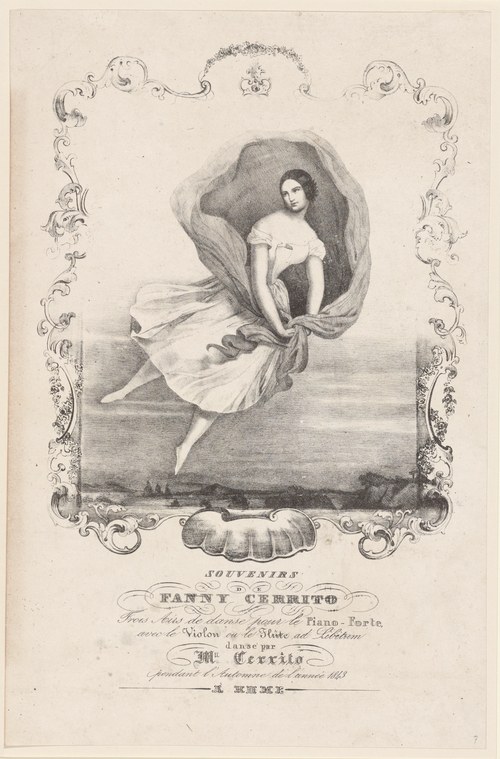
Souvenirs de Fanny Cerrito: trois airs de danse pour le piano-forte, avec le violon ou le flûte ad libitum, dansé par Mll Cerrito pendant l'automne de l'année 1843 à Rome
Unknown artist
- Collection:
- Prints depicting dance
- Source:
- New York Public Library
- Rights:
- Public domain — free to use, share and adapt.
- Recorded as:
- Public Domain
Fanny Cerrito was one of the four greatest ballerinas of the Romantic era; this print documents her work in Rome in 1843 and shows how her performances were memorialized and sold to the public. The image crystallizes the visual language of Romantic ballet—the floating female body, the pale costume, the nocturnal setting—that would define the genre's aesthetic for generations.
What you are looking at
A young woman in a white Romantic-era ball gown floats weightlessly above a moonlit landscape, her pale silk skirts billowing around her in defiance of gravity. She wears an off-shoulder chemise dress with a fitted bodice, her dark hair crowned with flowers or jewels, and gazes downward with a serene, almost trance-like expression. The background shows a distant town or village beneath a crescent moon, rendered in soft gray wash that creates an ethereal, dreamlike atmosphere. The entire composition is framed by an elaborate ornamental border in the rococo style—curling acanthus scrolls, shell motifs, and cherub heads—which signals this as a title page or souvenir print. At the base, the inscription names Fanny Cerrito and dates the work to autumn 1843 in Rome.
The dancing
A single female dancer is shown in a lifted, extended pose—her body angled gracefully, one leg raised in a gesture of elevation that suggests she is mid-leap or sustained in the air. Her posture is upright but softly curved; her arms are not sharply extended but held in a gentle, rounded position suggesting the port de bras of Romantic ballet. The artist has captured the moment of suspension rather than contact with the ground, creating an illusion of weightlessness that is the defining trick of Romantic-era aerial imagery.
The dance depicted
This is a souvenir engraving of Fanny Cerrito, a major Italian-French ballerina of the Romantic period, preserved to commemorate three dance airs she performed or choreographed in Rome in autumn 1843. The title indicates these were keyboard and violin pieces ('trois airs de danse pour le piano-forte, avec le violon ou la flûte'). Cerrito was celebrated for her technical virtuosity, dramatic presence, and the illusion of effortless elevation—qualities the print captures through the figure suspended impossibly above the earth. While no specific ballet is named, the costume and setting align with the Romantic ballet aesthetic of the 1840s, when sylphide-like heroines were central to the genre.
How it was made
This is a steel or copper engraving with hand or lithographic tinting in gray wash—a technique common for theatrical souvenir prints of the 1840s. The ornamental border and inscription at foot identify it as a title page or cover print, likely for a published score or a souvenir of a performance season. The combination of fine engraved line-work with broad atmospheric wash allowed for both precise rendering of costume detail and the romantic, ethereal effects the subject demanded. Such prints circulated widely among the urban middle classes as affordable mementos of celebrated performers.
About this work
This engraving preserves the image of Fanny Cerrito in an iconic Romantic ballet pose—floating above a moonlit landscape in the ethereal costume and weightless elevation that defined the period's most celebrated female dancers. It functions simultaneously as a theatrical souvenir, a musical title page, and a record of a specific performance season in Rome. The work demonstrates how Romantic ballet was marketed and remembered: not through narrative or social context, but through the isolated, transcendent image of the ballerina herself, suspended between earth and dream.
The print belongs in a gallery of dance art precisely because it captures the central visual fantasy of Romantic ballet—the illusion that the female dancer has transcended gravity and the material world. For historians of dance, it documents both Cerrito's star status and the aesthetic conventions of how her art was reproduced and circulated. For viewers, it reveals the period's obsession with the ethereal and the weightless as expressions of female artistry and desire.
How to look at it
Attend to the pose: the dancer is frozen in a moment of impossible elevation, with her body angled and extended in a way that defies the logic of earthbound movement. This is not naturalistic dance representation but rather a visualization of the dancer's gift—her ability to seem weightless. Note how the artist has used the soft gray wash of the background to separate the white-clad figure from the earth below, emphasizing the gulf between her and the ordinary world. The ornamental frame signals that this is a precious keepsake, a collected item, not a documentary image; it is meant to enshrine the memory of Cerrito rather than capture the specifics of a particular step or phrase.
The artist
The engraver is not recorded in the catalogue. The print was likely produced by a Roman or Paris publisher as a commercial souvenir, following the established format for theatrical prints of the Romantic period. The ornamental border design and engraving technique are consistent with mid-nineteenth-century theatrical ephemera.
The period
By 1843, Romantic ballet had reached its zenith. The ballerina had become the central focus of choreography and visual representation, replacing the more balanced male-female partnerships of earlier decades. Fanny Cerrito (1817–1909) was one of four rival "étoiles" of the 1840s—alongside Marie Taglioni, Lucile Grahn, and Carlotta Grisi—and these dancers were celebrities whose images were mass-produced as engravings, lithographs, and theatrical photographs. Rome, where this souvenir was made, had a thriving operatic and balletic culture. The inscription indicates this print memorialized a season of performances rather than a single ballet, suggesting Cerrito performed multiple roles and choreographic pieces that autumn.
Where it lives
This engraving is held in the New York Public Library's collection of prints depicting dance. It is classified as a theatrical souvenir or title page, likely distributed as a memento of Cerrito's performances in Rome or as a cover for a published musical score.
Dance in this work
Questions about this work
Who was Fanny Cerrito?
Fanny Cerrito (1817–1909) was an Italian ballerina who became one of the most celebrated dancers of the Romantic era. She performed across Europe—in Italy, France, England, and Russia—and was known for her technical brilliance, dramatic presence, and the illusion of weightless elevation. She was a rival and peer of Marie Taglioni and competed fiercely with the other great ballerinas of the 1840s. She also choreographed many of her own roles.
What does 'Romantic ballet' mean?
Romantic ballet (c. 1830–1870s) is characterized by an obsession with the supernatural, the ethereal, and the female dancer as the central figure of spectacle. The ballerina in a pale tulle skirt, performing feats of elevation and weightlessness, became the iconic image of the period. Male dancers receded into supporting roles. Narratives often involved ghosts, sylphs, or enchanted heroines. This engraving captures the visual language perfectly—the pale costume, the floating pose, the nocturnal setting.
What are 'airs de danse'?
An 'air de danse' is a self-contained musical piece designed for dancing, typically published for piano or small instrumental ensemble. The title indicates that a composer—unnamed here—wrote three such pieces, and that Cerrito either danced to them or created choreography for them in Rome. These were sold as sheet music for home performance and for theater use, and the engraved print served as the cover or title page.
Why is she floating?
She is not literally floating; the artist has frozen her in a moment of elevation—a jump or leap captured at its apex. In Romantic ballet, the illusion of weightlessness was central to the ballerina's art and mystique. By showing her suspended above the earth, the engraver has visualized her as transcendent, otherworldly, and beyond the laws of gravity—a perfect image of Romantic ideals.
More dance artwork





