49 works in this view — arrow keys or swipe to move between them.
Dance in Art
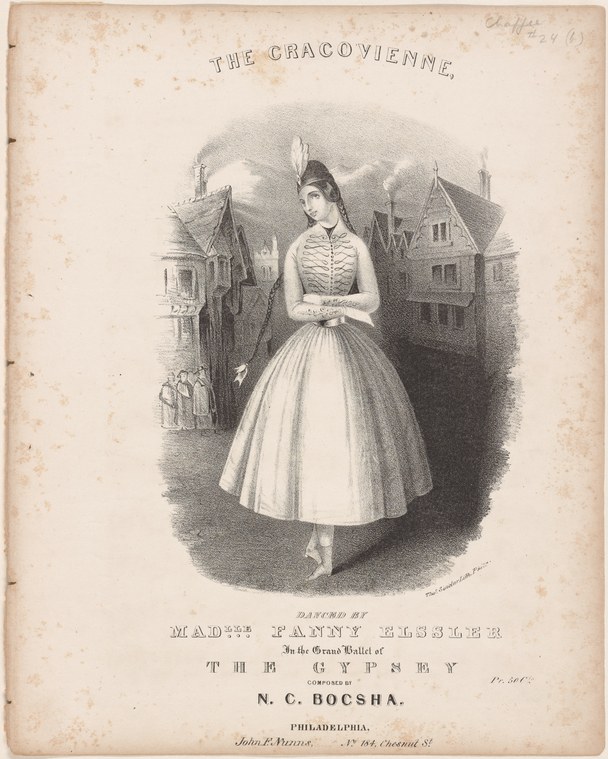
The cracovienne, danced by Madlle Fanny Elssler in the grand ballet of the Gypsey
Unknown artist
- Collection:
- Prints depicting dance
- Source:
- New York Public Library
- Rights:
- Public domain — free to use, share and adapt.
- Recorded as:
- Public Domain
Fanny Elssler was one of the two most celebrated dancers of the Romantic ballet era, and the cracovienne was one of her signature roles—this print is evidence of her international celebrity and of the commercial machinery that surrounded theatrical stardom in the 1840s. The work shows how dance and visual media were already fused in the nineteenth century: a dancer's reputation rested not only on live performance but on the circulation of printed images that shaped how she was remembered and imagined.
What you are looking at
A young woman stands alone in an urban street, posed in a moment of stillness rather than active movement. She wears a mid-nineteenth-century dress with a fitted bodice and full skirt that falls to mid-calf, typical of the 1840s. Her posture is upright and composed, with her arms held at her sides in a formal stance. Behind her, a row of tall buildings with steep roofs and ornate windows creates a European townscape—the architecture suggests Central Europe, consistent with the title's reference to Cracow. The scene is rendered in careful lithographic shading that gives dramatic depth to the urban setting while the figure remains brightly lit, isolating her against the darker background. There is no suggestion of movement or partnering; instead, the image presents the dancer as a portrait subject in a recognisable place.
The dancing
The dancer's body is presented in formal stillness rather than in the midst of a step or turn. Her frame is upright, her arms relaxed at her sides or clasped before her. Her weight appears evenly distributed, and her legs are straight beneath the full skirt—there is no suggestion of weight transfer, lift, or the dynamic carriage that characterises active dance. The isolation of a single figure, posed rather than moving, was typical of theatrical portrait prints where the dancer is shown as a performer in costume rather than caught mid-performance.
The dance depicted
The title identifies this as 'The Cracovienne,' a Polish national dance that became a staple of Romantic-era ballet from the 1830s onward. The cracovienne was a vigorous, earthy couple-dance from Krakow, characterised by quick, springing steps and energetic partnering—yet this image shows Madlle Fanny Elssler alone and stationary, dressed for performance but not performing. This is a publicity portrait rather than a representation of the dance in motion. Elssler, one of the most celebrated dancers of the 1830s and 1840s, was known for her dramatic character dances and her rival status to Marie Taglioni in the ballet world. The cracovienne would have been a vehicle for her to display technical brilliance and nationalistic charm to audiences hungry for exotic European folk material filtered through the ballet aesthetic.
How it was made
This is a lithographic print, identifiable from the fine tonal gradation, the soft edges achieved through stone-based drawing, and the careful use of crayon-work visible in the skirt and architectural shading. The technique allowed for relatively rapid production and wide distribution—such theatrical portraits were commercial prints sold to audiences as souvenirs and collectibles, far cheaper and more accessible than paintings. The signature line at bottom suggests a named lithographer, though the identity is not clearly legible in this image. The print's circulation through shops and theatres made these images a primary way audiences encountered and remembered star dancers of the era.
About this work
This is a theatrical portrait lithograph commemorating Fanny Elssler's performance of the Cracovienne, a Polish national dance, in the context of a larger ballet called 'The Gypsey.' It dates to the 1840s and was produced in Philadelphia, suggesting either a tour stop or a commercial reprint for the American market. The image does not depict the dance in action; instead, it presents the famous dancer as a costumed figure in a recognisable place—a mode of theatrical portraiture that made stars visible and memorable to a broad public. The work belongs in a gallery of dance art because it documents how dance entered mass culture in the nineteenth century, not through action photographs or paintings of performance, but through prints that made the dancer's face, costume, and name circulate as commodities and cultural symbols.
How to look at it
Attend to the contrast between the dancer's formal stillness and the urban energy of the setting behind her. The lithographer chose not to capture a moment of movement but to present the dancer as a public figure—recognisable, posed, and available for consumption as an image. The architectural setting grounds her in a specific place (Cracow, or a viewer's imagination of it), while her stillness and direct vertical axis keep the focus on her costume and bearing. This is a portrait in the tradition of theatrical celebrity imagery, not a document of dance in motion.
The artist
The lithographer is not positively identified in the catalogue record, though the inscription indicates a named practitioner. The print was issued by John F. Ditman of Philadelphia, making this a product of the transatlantic trade in theatrical prints. Philadelphia was a major centre for lithographic production in the early nineteenth century, and theatrical portrait prints were a significant commercial genre. Without further research, the specific artist's practice cannot be detailed.
The period
The 1840s were the height of Romantic ballet, when dancers like Taglioni, Elssler, and Cerito dominated European and American stages. Nationalism and exoticism were fashionable both in ballet and in visual culture; choreographers and dancers mined European folk traditions for dramatic and technically showy material. The cracovienne fit perfectly into this appetite for authentic-seeming national dances made theatrical. At the same time, lithography had made theatrical portraiture a mass medium. Prints like this one were sold in theatre lobbies and bookshops, making famous dancers visible to audiences who might never see them perform and to those who wanted to own an image of the star they had witnessed on stage.
Where it lives
This print is held in the New York Public Library's collection of prints depicting dance. It was issued in Philadelphia by John F. Ditman, indicating it was a commercial product aimed at theatre audiences in America, possibly coinciding with or following Elssler's known tours to the United States.
Dance in this work
Questions about this work
Did Fanny Elssler really perform this dance, or is this just a promotional fantasy?
Yes, Elssler was celebrated for character dances including folk-based pieces. The cracovienne was a recognised theatrical dance derived from Polish tradition, and it fit her reputation as a brilliant technician of character material. However, this image is a portrait, not a performance document, so it shows her in costume and setting but not in the act of dancing. It is a promotional image designed to link her name and face with the role.
Why does she look so still and formal if this is supposed to be a dynamic dance?
Theatrical portrait prints were designed for mass circulation and fame-building, not for documenting choreography. A posed, frontally lit image was more legible, more reproducible, and more suitable for hanging in a parlour or theatre lobby than a snapshot of motion would be. The stillness allowed viewers to examine her costume and bearing as a star performer.
What is the 'Grand Ballet of the Gypsey' mentioned in the title?
This was a full-length ballet (now lost) in which the Cracovienne was a featured number or act. Multi-act ballets of the 1840s often included a series of character dances representing different nations or regions, and the Cracovienne would have been one such 'number.' The gypsy subject allowed for an eclectic collection of folk-inspired dances.
Why was this print made in Philadelphia?
Elssler toured the United States between 1840 and 1842, a highly publicised and financially successful venture. American publishers capitalised on her fame by producing prints of her famous roles, both to sell as souvenirs and to advertise upcoming performances. The Philadelphia print trade was flourishing, and theatrical portraits were a reliable commercial product.
More dance artwork





