49 works in this view — arrow keys or swipe to move between them.
Dance in Art
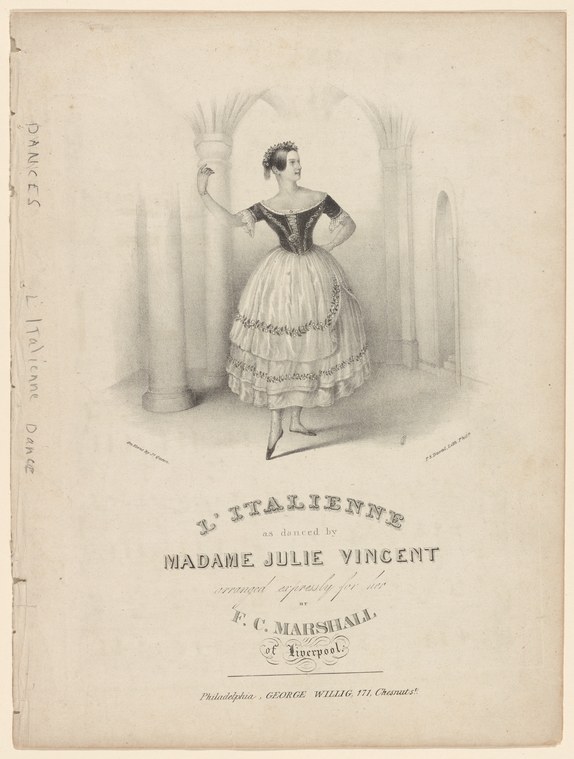
L'Italienne as danced by Madame Julie Vincent: arranged expressly for her by F. C. Marshall of Liverpool
Unknown artist
- Collection:
- Prints depicting dance
- Source:
- New York Public Library
- Rights:
- Public domain — free to use, share and adapt.
- Recorded as:
- Public Domain
This print is significant as documentary evidence of provincial ballet choreography and performance in the nineteenth century—a record of a work that would otherwise be invisible to history. It also illustrates the circulation of dance knowledge through printed imagery: the lithograph was itself a form of dance teaching and remembrance, allowing audiences and dancers to retain and study a role after performance.
What you are looking at
A woman in mid-nineteenth-century theatrical dress stands in a classical columned interior, posed in profile facing stage-left. She wears a black silk corsage with short sleeves and a voluminous skirt of white gauze or similar diaphanous fabric, gathered at the waist and trimmed with decorative bands at the hem—a silhouette characteristic of Romantic-era ballet. Her dark hair is styled close to the head. She holds one arm aloft with a graceful curve, while her weight appears to rest on one leg in a poised, balletic attitude. The setting is sparse: two tall classical columns frame the figure, and the background is rendered in soft gray wash, creating an ethereal, theatrical atmosphere. The composition emphasizes the vertical line of the body and the play of light on the gathered skirt.
The dancing
A single female dancer occupies the frame, her body aligned in three-quarter profile. Her raised arm describes a soft, arcing line typical of early Romantic ballet port de bras. Her standing leg appears straight and engaged, supporting the body in what may be a développé or attitude derrière; the free leg is not clearly visible but suggested by the tilt of her torso. Her shoulders are held back and relaxed. The pose conveys both stillness and the suggestion of motion—a moment extracted from a sequence, not a static tableau.
The dance depicted
This is a Romantic ballet, most likely a character or national dance interpolation within a larger work. The title 'L'Italienne' (The Italian Woman) suggests a divertissement number, a style of short national or ethnic dances that were popular within nineteenth-century ballets. The arrangement by F. C. Marshall of Liverpool for Madame Julie Vincent indicates this was a vehicle choreographed for a specific performer, likely performed in provincial British theatres. The costume—the black bodice and white gathered skirt—is consistent with mid-nineteenth-century Romantic ballet dress, though 'L'Italienne' as a national character would have carried particular associations with lightness, charm, and southern European expressiveness.
How it was made
This is a lithographic print, identifiable from the soft crayon marks, the tonal gradation in the background wash, and the characteristic lineweight of lithography. The technique allowed for the rapid production and wide circulation of theatrical imagery in the nineteenth century. It was likely distributed as a souvenir or promotional material for the performance—evidence of the work's local or touring appeal. The delicate handling of the drapery and the atmospheric background are consistent with theatrical lithography of the 1840s–1860s, a period when such prints were a standard means of publicizing dancers and roles.
About this work
This is a lithographic print depicting a Romantic ballet divertissement arranged for a specific performer in mid-nineteenth-century Britain. The work documents both a particular choreography (arranged by F. C. Marshall, a Liverpool-based figure) and the material culture of ballet in the provinces—the prints, advertisements, and costume details that circulated knowledge of dance beyond London or major capitals. It belongs to the substantial body of Romantic ballet ephemera: single-figure studies of dancers in iconic roles, frozen in poses that summarized character and movement vocabulary for audiences who might never see the actual performance. The image captures the visual language of Romantic dance—the ethereal silhouette, the arching port de bras, the integration of body and costume—at a moment when ballet was becoming a widely consumed theatrical commodity in Britain.
How to look at it
Observe the moment the artist chose to capture: neither a full grand movement nor a stationary pose, but a transitional instant—the body gathering itself, weight shifting, the arm rising in the arc of an épaulement or port de bras. Notice how the skirt is rendered as a sculptural volume that extends and frames the body, almost more important visually than the limbs themselves—a hallmark of Romantic dance design, where the costume was inseparable from the movement vocabulary. The classical columns and severe background serve to isolate the figure, emphasizing that this is a single performer in a spotlight moment, not a group scene.
The artist
The artist of the print is not recorded in the catalogue. The design carries the signatures or initials of two hands (visible at lower left and right), suggesting collaboration between a draughtsman and a lithographer—a standard practice for theatrical prints of this era. The work was published in Philadelphia by George Willis (Chestnut Street), indicating American production or distribution despite the British subject matter and choreographer.
The period
This print dates to the height of the Romantic ballet era in Europe and its circulation in Britain and America. By the 1840s–1860s, national dances and character pieces had become standard attractions within longer narrative ballets; the 'Italian' dance was a stock divertissement, coded to suggest Mediterranean charm and gaiety. Lithographic theatre prints were the mass media of the period, democratizing access to images of celebrated performers and roles. The arrangement of a dance for a named performer was common practice—choreography was often bespoke, tailored to the strengths and popularity of individual dancers rather than to a fixed dramatic text.
Where it lives
The work is held in the New York Public Library's collection of prints depicting dance, catalogued as ephemera from an unknown date. The publication imprint places it within the circulation of American theatrical print production, though the subject (British choreography, British performer) suggests it may have travelled or been reprinted in America.
Dance in this work
Questions about this work
What is 'L'Italienne' and why would a dance have that title?
National dances and character pieces were standard attractions in nineteenth-century ballets. 'L'Italienne' refers to a short solo or pas designed to evoke 'Italian' character—typically coded as light, graceful, and sunny. Such dances allowed choreographers to display a performer's technique and charm while offering audiences a moment of geographic or cultural exoticism within a larger work. The title tells us both the dance form and the character the dancer was meant to embody.
Who was Madame Julie Vincent and why does the credit matter?
The credit acknowledges that this choreography was created for a specific named performer. In nineteenth-century practice, dances were often bespoke creations tailored to a dancer's abilities and popularity. By crediting both the choreographer (Marshall) and the dancer (Vincent), the print recognizes that the role existed because of Vincent's fame, and would likely not have been danced in quite this form by another performer. Such credits preserve the names of otherwise undocumented dancers and choreographers.
What does this print tell us that a written description would not?
The visual record shows the exact silhouette of the costume, the posture and arm position that characterized the role, and the theatrical conventions of the moment—the columned interior, the atmospheric lighting, the scale and presentation. A programme note would list the dance; this image preserves how it looked, how the dancer inhabited the space, and what audiences would have seen and remembered.
More dance artwork





