49 works in this view — arrow keys or swipe to move between them.
Dance in Art
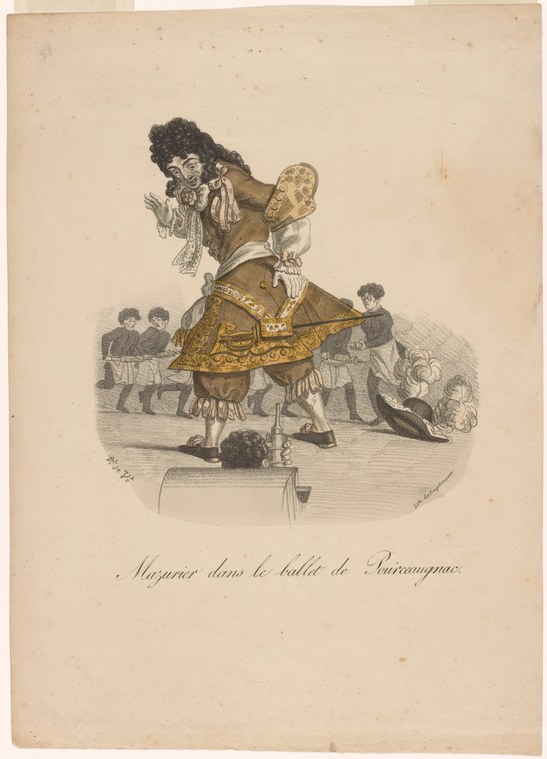
Mazurier dans le ballet de Pourceaugnac
Unknown artist
- Collection:
- Prints depicting dance
- Source:
- New York Public Library
- Rights:
- Public domain — free to use, share and adapt.
- Recorded as:
- Public Domain
Mazurier was one of the first male dancers to achieve superstardom through comic and pantomimic performance rather than classical technique, establishing a tradition that shaped popular dance entertainment for decades. This print captures a moment that was considered extraordinary enough to be worth recording and selling to the public—evidence of what audiences valued, what bodies could do, and what the theatrical body could express beyond the vocabulary of classical ballet. For anyone studying the history of theatrical dance, the place of comic performance and male virtuosity, or the relationship between dance and popular culture in the 19th century, this image is essential documentation.
What you are looking at
A theatrical dancer in elaborate costume dominates the composition, balanced impossibly on one leg with the other raised high behind, arms extended in theatrical gesture. The figure wears a richly decorated jacket or tunic in gold and brown with ornamental embroidery, white stockings, and heeled shoes. The dancer's face is animated and expressive, with exaggerated features characteristic of theatrical caricature. Around this central figure, smaller figures in simple dress appear to be spectators or supporting players, arranged in a loose semi-circle. The setting is minimal—a simple platform or stage floor with minimal background detail—which focuses all attention on the virtuosic pose and ornate dress of the principal performer. The print is hand-colored, with careful attention to the rich tones of the costume.
The dancing
The primary dancer stands on one leg with the supporting knee slightly bent, the free leg raised sharply behind in an attitude derrière or similar vertical extension. Both arms are held aloft in an open, expansive frame—the upper arm high and the forearms extended, palms facing outward in a gesture of theatrical presentation or celebration. The torso is upright and proud. The pose is held in a moment of display rather than transition, suggesting a climactic moment or a signature position within a choreographed piece. The smaller figures around the edges appear to be witnesses rather than participants, creating a clear hierarchy of performer and audience within the frame.
The dance depicted
This is almost certainly a record of Mazurier, a famous French dancer and pantomime performer of the early 19th century, dancing in the ballet-pantomime *Le Diable boiteux* (The Devil on Two Sticks), which premiered in 1836 and became one of the great successes of the Romantic era. The extreme verticality of the pose, the theatrical flamboyance of the costume, and the emphasis on expressive gesture rather than balletic line are characteristic of pantomime and the acrobatic, comic dance style that Mazurier made famous. The inscription confirms this is Mazurier performing; the title *Mazurier dans le ballet de Pourceaugnac* most likely refers to a related work or a performance associated with Molière's *Monsieur de Pourceaugnac*, which was frequently adapted for the stage with dance and pantomime elements during this period. The high extension and dramatic pose suggest a style of dance that prized virtuosity, flexibility, and physical comedy above the ethereal restraint of classical ballet.
How it was made
This is a hand-colored engraving or etching, likely from the 1830s–1840s based on the style and subject matter. The tonal work is achieved through fine cross-hatching and parallel lines, with the hand-coloring applied afterward to define the costume detail and create theatrical atmosphere. The technique allowed for multiple impressions to be printed and distributed, making this the kind of popular theatrical souvenir that would have been sold in Paris theater lobbies and collected by dance enthusiasts. The precision required to render the dancer's pose and the ornamental detail of the costume suggests an artist of skill working from a live performance or a detailed study, and the image would have served both as documentation and as publicity for this celebrated performer.
About this work
This is a theatrical print recording Mazurier, one of the most celebrated dance performers of the French Romantic stage, in a moment of virtuosic display from a comic pantomime ballet. The work documents not the ethereal, classical ballet aesthetic that is often associated with this era, but the equally important tradition of comic dance, pantomime, and acrobatic spectacle that drew large audiences and produced iconic performers. The extreme pose—a high vertical extension achieved through flexibility and strength—and the ornate, naturalistic costume suggest a style of performance that was closer to circus and music-hall entertainment than to the formalized classical ballet that dominated ballet academies. As a printed image, it is an artifact of the 19th-century theater industry: a souvenir, a record, and a form of publicity that kept famous performances alive in public memory long after the curtain fell.
How to look at it
Notice the impossibility of the pose: the extreme height of the raised leg, the openness of the arms, the balance on a single leg in a heeled shoe. This is not a moment of transition between steps but a held display—a pose designed to astonish and delight an audience by demonstrating what a trained body could achieve. Observe also the face: exaggerated, animated, engaging the viewer directly rather than lost in the abstract reverie of classical ballet. The costume is equally theatrical—ornamental, colorful, designed to catch light and draw the eye. The smaller figures around the edges anchor this as a performance, a moment in a story, rather than a pure abstraction of movement. Ask yourself: what kind of dancer, and what kind of audience, would prize this particular image of the body?
The period
This print dates to the heyday of the Paris Opera and the Romantic ballet era (1830s–1840s), when *La Sylphide* and *Giselle* were establishing new aesthetic standards for classical ballet. Yet simultaneously, comic pantomime and acrobatic dance remained hugely popular with mass audiences. Mazurier's success demonstrates that Romanticism in dance was not a monolithic aesthetic: while some dancers pursued the ethereal, otherworldly ideal of the sylph, others—particularly male dancers—found fame and fortune in spectacular displays of flexibility, strength, and comic timing. The ornate costume and the theatrical setting suggest this is from a work in the tradition of Molière's comedies adapted for musical theater, which typically mixed spoken comedy, pantomime, and dance. Hand-colored prints like this were a primary means of circulating images of famous performers, making them precursors to theatrical photography and a crucial source for understanding what Romantic-era dance actually looked like in practice.
Where it lives
This print is held in the New York Public Library's collection of prints depicting dance. It is a hand-colored engraving or etching, likely a single-sheet theatrical souvenir from the 1830s–1840s, produced and distributed in Paris during the height of Mazurier's career.
Dance in this work
Questions about this work
Who was Mazurier?
Mazurier (François-Joseph Mazurier, 1801–1868) was a French dancer and pantomime performer who became a major star of the Paris Opera and Comédie-Italienne in the 1830s and 1840s. He was famous for his acrobatic flexibility, his comic timing, and his ability to combine spoken dramatic performance with virtuosic dance. He made his name in comic roles and pantomime ballets, and was considered one of the finest male dancers of the Romantic era, even as his style differed dramatically from the classical aesthetic of dancers like Nijinsky's era.
What is *Le Diable boiteux* (The Devil on Two Sticks)?
It is a ballet-pantomime that premiered in 1836, based on Lesage's 1707 satirical novel. It became one of the great successes of the 1830s and featured Mazurier in the leading role as a witty demon. The work mixed pantomime, comedy, and acrobatic dance in a way that appealed to mass audiences and made Mazurier a celebrity. It was frequently revived and remained in the repertory for decades.
Why was comic dance so important in the 19th century?
While we often remember Romanticism in dance for its ethereal, otherworldly aesthetic (*La Sylphide*, the sylph), comic dance and pantomime were equally vital to the theatrical economy and to audiences' experience of performance. Male dancers especially found fame and steady employment in comic and pantomimic roles. These performances required different skills—flexibility, strength, comic timing, narrative clarity—than classical ballet, and they entertained audiences who might not have appreciated pure abstract movement.
What does this print tell us about how 19th-century dancers trained?
The extreme vertical extension and the flexibility demonstrated in this pose suggest training in acrobatics, contortion, and the kind of full-body versatility prized in pantomime and entertainment dance. Mazurier's ability to achieve and hold such a position in performance, night after night, indicates a training regime focused on strength, flexibility, and the ability to move expressively while in costume and character—quite different from the pure classical training emphasized in ballet academies.
More dance artwork





