36 works in this view — arrow keys or swipe to move between them.
Dance in Art
Kaliszanka polka!
Unknown artist
- Medium:
- Lithograph
- Dance:
- Polka
- Era:
- Late 1800s (Victorian Ballroom)
- Source:
- New York Public Library
- Rights:
- Public domain — free to use, share and adapt.
- Recorded as:
- public_domain
Polka lithographs like this are rare surviving evidence of how mid-nineteenth-century Americans encountered new European dances and the moment when professional dance instruction and commercial dance culture were beginning to merge. The image shows exactly what performers wore and how the body moved during a polka, making it valuable for historians of both social dance and material culture. The dedication to named American women dancers gives the work a specificity often lost in generic dance instruction imagery.
What you are looking at
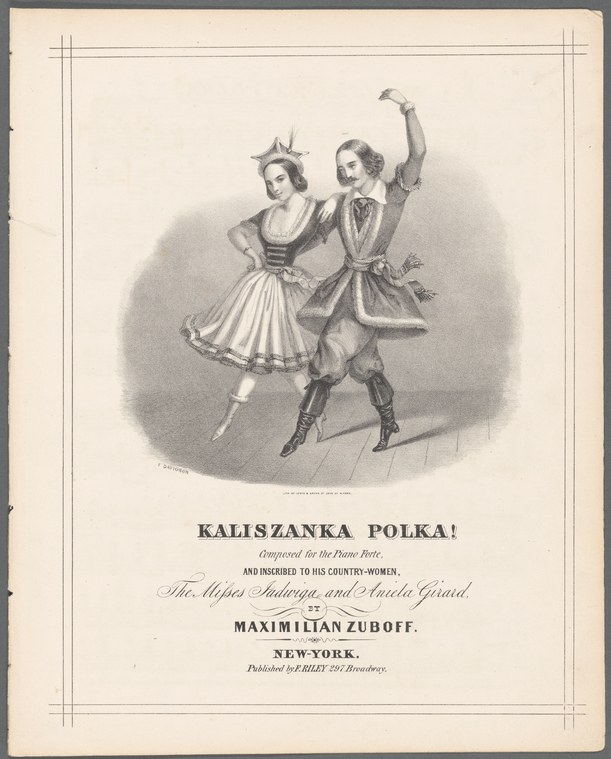
A lithographed title page for a polka composition depicts a couple in mid-dance against a plain background with subtle shading. The woman wears a white pleated skirt with decorative trim, a low-necked corset bodice with ornamental front panel, and a small crown or tiara. The man wears a dark military-style jacket with buttons and trim, light trousers, and tall boots. He has raised his right arm high and appears to be in a moment of exuberant lift or turn, while the woman is positioned at his side, her posture animated and engaged. The figures occupy the center of the composition, rendered in fine stippled and tonal work typical of mid-nineteenth-century lithography. The title appears below in bold lettering: "KALISZANKA POLKA!" followed by dedication text and publication information from New York.
The dancing
The two dancers are shown in a moment of high energy and lift. The man's extended arm and inclined posture suggest a raising movement or pivot, a characteristic gesture of the polka's spirited character. The woman leans into the turn with bent knees and engaged carriage. Both figures show the closed or near-closed positioning typical of European ballroom dance of this period, with the man as the lead. The artist has captured a split second of motion rather than a static pose, suggesting familiarity with the dance's actual performance.
The dance depicted
This is a polka, as stated in the title—specifically a "Kaliszanka polka," likely referencing Kalisz, a region in Poland. The polka was one of the most fashionable social dances of the mid-nineteenth century, spreading rapidly from Central Europe through Western Europe to America in the 1840s–1850s. It was danced by couples in closed or semi-closed position with a characteristic 2/4 hop-step pattern and a rotational, turning quality. The image shows the vigorous, springing quality for which the polka was known, and the military dress of the male dancer hints at its popularity in officers' balls and formal social settings.
How it was made
This is a lithograph, a planographic printing process that allowed for fine tonal gradation and broad distribution. The technique shows sophisticated use of stone-working: the figures are rendered in fine stippling and graduated washes to create volume and shadow, while the lettering is bold and clearly printed. As a title-page lithograph for a published musical composition, this object served multiple audiences—musicians who would buy the score, dancers seeking to learn the latest fashion, and broadsheet collectors. Lithography's relative affordability and ease of distribution made it the dominant form for dance instruction and fashion imagery in the nineteenth century.
About this work
This is a promotional lithograph accompanying a polka composition dedicated to two American women: Mrs. Lydia Salturya and Carola Giuard. The work is part of the New York Public Library's holdings and was published in New York, likely in the 1850s–1860s when the polka craze was at its height in America. It documents both the visual style of mid-Victorian ballroom dress and the physical character of one of the era's most beloved social dances. The image captures the polka's reputation for liveliness and forward momentum, showing the kind of moment—a high, energetic turn—that made it thrilling to both dancers and observers.
The work is a valuable document of transatlantic dance culture. The polka represented a democratic turn in ballroom dancing: simpler to learn than the quadrille, less formal than the waltz, and accessible to the rising middle class. This lithograph shows how the dance was visualized and marketed to American audiences, and it records the names of two women whose participation in New York's dance culture was deemed worthy of memorialization in print.
How to look at it
Observe the moment the artist chose: not a formal, still position but a moment of lift and rotation, with the man's arm raised high and both dancers' knees flexed. This captures the polka's essential quality—its bouncing, turning character. Notice the precision of the dress details: the woman's tiara, corsetry, and pleated skirt show that ballroom polka was a formal social event requiring costly clothing. The stippling technique creates volume in the cloth and subtle modeling in the faces, showing the careful attention lithographers paid to making dance images lifelike and desirable.
The artist
The artist is not recorded. The work is printed by Riley of New York (publisher attribution visible). The composition and technique are competent but not exceptional, suggesting a commercial lithographer working in the mass-market dance and musical print trade. Many dance-instruction prints of this era were produced by anonymous or semi-anonymous printmakers working to order for publishers and music dealers.
The period
The 1850s–1860s saw an explosion of polka mania in America following its arrival from Europe. The dance spread from Prague through Paris and London to New York with remarkable speed, becoming a symbol of modernity and democratic sociability. In the same period, commercial lithography had become the dominant medium for distributing music, fashion plates, and dance instruction imagery. The military dress of the male dancer reflects the polka's association with garrison towns and officers' balls in Central Europe, and its continued cachet in formal American settings. The dedication to individual women dancers records a moment when middle-class women were beginning to be named and celebrated as public performers of social dance.
Where it lives
The work is held by the New York Public Library and was accessed through their digital collections. It is a published music-related print from a New York commercial publisher, Riley, indicating it was produced for public sale as part of a music score or dance instruction series.
Dance in this work
Questions about this work
What is the Kaliszanka polka?
The title suggests it is a polka associated with Kalisz, a town in Poland. Many polkas of the nineteenth century were named after places or people. The polka itself is a Central European dance that became one of the most popular ballroom dances of the 1840s–1850s, known for its hopping, rotating motion and 2/4 meter. Hundreds of polka compositions were published in this era, often with dedications to fashionable dancers.
Why did the polka become so popular so quickly?
Compared to the quadrille, which required four couples and a caller, or the waltz, which required significant practice, the polka was relatively simple to learn and could be danced by any couple. It was perceived as modern, energetic, and slightly risqué (the close hold and hopping motion were considered lively by Victorian standards). It arrived in America during a period of rapid social change and was enthusiastically adopted by the middle class.
Who were Salturya and Giuard?
The dedication does not appear in available dance history sources, but the print itself honors them as "country-women," suggesting they were prominent dancers in New York's ballroom scene when this was published. Naming dancers on printed music and prints was a form of celebrity marketing; their participation lent prestige to the composition.
What can we learn from the clothing shown?
The woman's dress—a fitted, boned bodice with a full, pleated skirt—shows the silhouette of the 1850s–1860s. The small crown or tiara indicates formal evening wear. The man's military-style jacket was standard dress for ballroom dancing in this period, especially for officers and men of rank. Both suggest this was a formal, expensive occasion, not casual social dancing.
More Polka artwork