49 works in this view — arrow keys or swipe to move between them.
Dance in Art
Profezia per l'anno 1863 [handwritten]
Unknown artist
- Collection:
- Prints depicting dance
- Source:
- New York Public Library
- Rights:
- Public domain — free to use, share and adapt.
- Recorded as:
- Public Domain
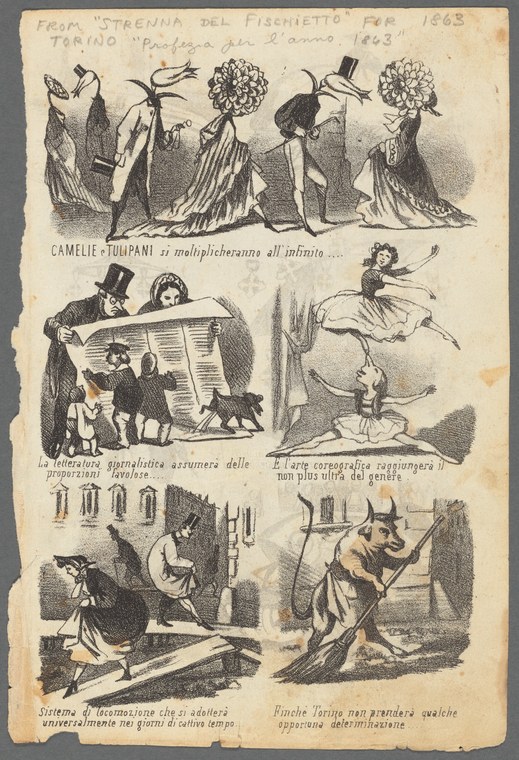
This print documents how mid-19th-century satirical culture weaponized dance and female bodies as symbols of social anxiety and absurd fashion. It reveals the deep anxieties about femininity, modernity, and bodily discipline that surrounded even recreational dance in the 1860s. For historians of dance, gender, and visual satire, it shows dance not as an autonomous art form but as a contested social and moral terrain.
What you are looking at
This is a satirical engraving organized in five separate vignettes, each depicting exaggerated and grotesque female figures engaged in absurd parodies of fashionable dance and social behavior. The top register shows five women with flower-heads, dressed in elaborate cloaks and bonnets, arranged in a line; their bodies contort in affected poses suggesting mincing promenade or affected courtship display. Below, a scene of a couple reading a newspaper surrounded by small dogs gives way to a figure performing an extreme backbend or contortion, suggesting mockery of classical dance virtuosity. The lower register depicts two figures in increasingly grotesque postures—one hunched over what appears to be a musical instrument or prop, the other in an impossible arched position. The overall composition is dense, crowded, and deliberately anti-elegant, with heavy cross-hatching and energetic line work that emphasizes the caricature.
The dancing
The figures are rendered with exaggerated, often contorted body positions that mock rather than celebrate dance movement. Several show extreme backbends, impossible arches, and strained postures suggesting parody of acrobatic or ballet virtuosity. The stance is ungainly and unsupported—bodies lean, twist, and fold in ways hostile to the gracefulness they may be intended to mock. There is no sense of trained technique or elegant positioning; instead, the bodies read as marionette-like, their proportions distorted to comic effect. The groupings are loose and satirical rather than forming coherent dance couples or ensembles.
The dance depicted
This is a satirical print attacking fashionable dance and feminine affectation, likely from a Romantic-era journal or almanac of prophecy and social satire. The handwritten annotation identifies it as a 'prophecy for the year 1863,' suggesting it was meant to ridicule the fashions, manners, or dance crazes anticipated for that year. The exaggerated flower-headed women and grotesque postures parody Romantic ballet's ethereal aesthetic and the social pretensions of urban fashion. The style is that of mid-19th-century caricature, using bodily distortion and impossible contortions as tools of satirical critique. The print does not depict actual dance practice but uses the visual language of dance—especially the ballet and social dance of the aristocratic ballroom—as the target of ridicule.
How it was made
This is a wood engraving or steel engraving, executed with fine cross-hatching and bold linear work typical of mid-19th-century print production. The technique allowed for mass reproduction and circulation in periodicals, journals, and satirical almanacs. The dense hatching creates areas of deep black shadow that heighten the caricatural distortion, and the fine line work captures grotesque detail—the flowers on the women's heads, the exaggerated bonnets, the impossible body contortions. The medium's capacity for rapid iteration and wide distribution made it ideal for topical satire tied to current fashions or social anxieties about modernity and feminine behavior.
About this work
This satirical engraving mocks fashionable dance, social affectation, and feminine bodily display through grotesque caricature. The handwritten annotation 'Prophecy for the year 1863' (Profezia per l'anno 1863) and the Italian subtitle (from *Strenna del Fischietto* or *Parodia per l'anno 1863*—a satirical almanac) place it within mid-19th-century Italian satirical print culture. The five separate vignettes ridicule not a single dance style but rather the pretension, artificiality, and social anxiety surrounding fashionable urban dance and feminine deportment. It belongs in a gallery of dance imagery precisely because it shows how dance and bodily display functioned as a lightning rod for satire about modernity, gender, and social performance.
How to look at it
Attend to the progression across the five vignettes: each escalates the grotesquerie, moving from mildly affected promenade to impossible acrobatic distortion. Notice how the artist uses backbends, arches, and twisted postures to suggest both the virtuosity and the absurdity of fashionable dance technique—the body is made to look simultaneously over-trained and ridiculous. The flower-heads and elaborate bonnets mock contemporary fashion illustration and the aestheticization of female bodies. The dense hatching and bold line work create a visual chaos that mirrors the satirical intent: to make fashionable dance look ugly, unnatural, and worthy of laughter.
The period
The work dates to the early 1860s, a period of intense European satirical engagement with fashion, femininity, and the new social mobility of the urban middle classes. Romantic ballet and fashionable ballroom dance were objects of both aspiration and ridicule—celebrated as marks of refinement, but also attacked as signs of frivolity, moral corruption, or unnatural bodily discipline, especially when practiced by women. Italian satirical almanacs and periodicals like *Strenna del Fischietto* (The Whistle Almanac) circulated such caricatures widely, using exaggeration and grotesque distortion as tools of moral and social critique. The prominence of flower-headed women and impossible contortions reflects contemporary anxieties about the unnaturalness of fashionable female display and the threat posed by urban consumer culture.
Where it lives
The print is held in the New York Public Library as part of its collection of prints depicting dance. The handwritten annotations on the print—'From Strenna del Fischietto for 1863' and 'Parodia per l'anno 1863'—indicate that it was originally published in an Italian satirical almanac or journal.
Dance in this work
Questions about this work
What dance is actually being depicted here?
No single dance style is depicted. Rather, the print parodies fashionable dance in general—especially the Romantic ballet aesthetic and ballroom social dance of the 1860s. The grotesque postures and flower-headed figures are tools of satire, not accurate representations of how dancers actually moved.
Why are the women's heads flowers?
The flower-heads are a common trope in mid-19th-century fashion satire, mocking the aesthetic pretension and artificiality of fashionable femininity. They suggest that fashionable women were treated as decorative objects rather than as human beings—and that their dance and display were part of this commodification.
What is *Strenna del Fischietto*?
*Strenna del Fischietto* (The Whistle Almanac) was an Italian satirical almanac or periodical that circulated topical jokes, caricatures, and social critique. The title refers to the 'whistle' of satire and mockery. The annotation indicates that this print was either published in or inspired by such a publication.
Why is this in a dance collection?
Because it shows how dance functioned as a social text and a site of anxiety in the 19th century. Satire directed at dance reveals what society valued, feared, or found ridiculous about bodily movement, gender, and social performance. Dance was not just an art form—it was a statement about modernity, morality, and the proper place of women in society.
More dance artwork





