49 works in this view — arrow keys or swipe to move between them.
Dance in Art
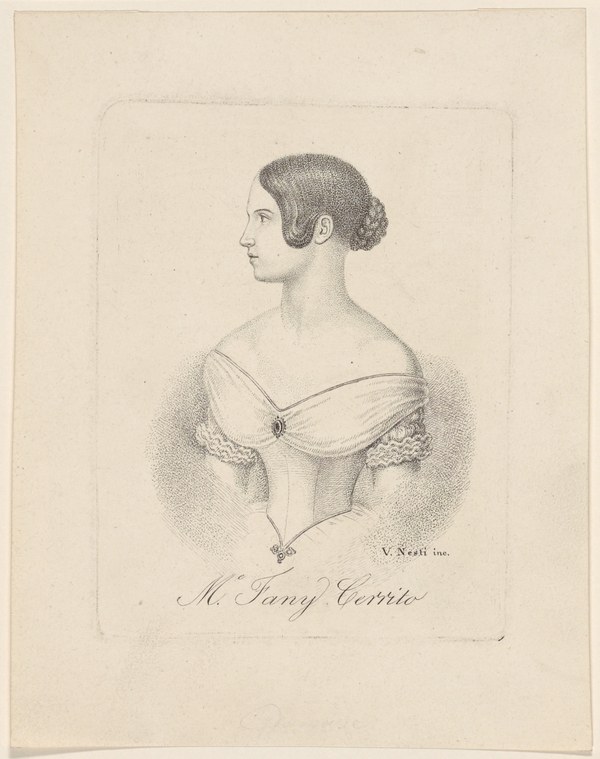
Me. Fany Cerrito
Unknown artist
- Collection:
- Prints depicting dance
- Source:
- New York Public Library
- Rights:
- Public domain — free to use, share and adapt.
- Recorded as:
- Public Domain
Fanny Cerrito was one of the four great ballerinas of the Romantic era (alongside Taglioni, Elssler, and Grisi), and this engraving is a primary document of her celebrity and her era's visual aesthetic. The image captures the exact costume and presentation style of 1840s Romantic ballet—the tulle skirt, the off-shoulder bodice, the restrained elegance—in a medium that was the mass medium of its time, making it invaluable evidence of how theatrical beauty was defined and sold in the nineteenth century.
What you are looking at
A young woman is shown in three-quarter profile, her head turned gracefully to the left. She wears an off-shoulder ball gown with a deeply scooped neckline and short sleeves trimmed with lace; the bodice is fitted and cinched at the waist, and the skirt appears voluminous beneath. Her dark hair is arranged in a smooth chignon at the nape of her neck, styled in the fashion of the 1840s. She wears a pendant on a chain at her throat. The portrait is rendered in fine stippled engraving or steel engraving on a pale cream ground, with her figure emerging from careful tonal gradation. The composition is bust-length, intimate and formal—a theatrical or operatic portrait rather than a society portrait.
The dancing
The dancer's posture is upright and dignified, with shoulders relaxed but held back. Her neck is extended and graceful, the head tilted slightly in a pose of composed elegance. No active movement or dance position is depicted; this is a portrait study rather than a scene of performance. The body is still and frontal in the lower half, with animation reserved for the face and the implied presence suggested by the costume itself.
The dance depicted
This is a portrait of a named dancer—Fanny Cerrito (1817–1909)—one of the great Romantic ballet stars of the nineteenth century. Cerrito was famous for her technical brilliance, particularly her elevation and ballon. The costume shown here—a short tulle skirt, fitted bodice, and off-shoulder neckline—is characteristic of Romantic-era ballet dress, the style worn by Cerrito in the theatre during the 1840s. However, the image itself does not depict her dancing; it is a formal portrait engraving, the kind circulated as a memento or promotional image to establish her celebrity and elegance. The costume tells us about the aesthetic of Romantic ballet, but the pose is one of composed presentation rather than performance.
How it was made
This is a steel engraving or fine line engraving, a reproductive print technique that was the dominant medium for theatrical portraiture and celebrity imagery in the nineteenth century. Steel engraving allowed for sharper detail and longer print runs than copper engraving, making it the standard format for mass-produced theatrical portraits sold to audiences and collectors. The signature 'V. Netti. Inc.' (incide, 'engraved by') indicates the engraver rather than the original artist or photographer from which it was copied. The technique's capacity for fine tonal control is evident in the subtle modelling of skin and fabric, particularly in the rendering of the neckline and the chignon.
About this work
This is a theatrical portrait engraving of Fanny Cerrito, one of the Romantic era's most celebrated ballet dancers, dating to the mid-nineteenth century. It belongs to a large class of reproductive prints that served as both merchandise and documentation: cheap enough to circulate widely to theatre-goers, yet fine enough in execution to be collectible. The engraving does not show Cerrito dancing, but rather presents her in the dress of the Romantic ballet theatre, establishing her as an icon of elegance and elevation. For a dance historian, such portraits are crucial evidence of how dancers dressed, how they styled themselves for public consumption, and how their image was manufactured and circulated in an era before photography became standard.
How to look at it
Look at the costume first: the short tulle skirt was essential to Romantic ballet, allowing the audience to see the dancer's line and footwork. The off-shoulder neckline and fitted bodice create the impression of ethereality and grace that was the Romantic ideal. Notice how the engraver has rendered the texture of the tulle through fine parallel lines, and the smoothness of the skin through subtle stippling. The pose—head turned, body still—is a formal presentation pose, not a captured moment of movement; it was the convention of the period to show a dancer 'as herself,' composed and elegant, rather than mid-gesture. This is a portrait as much as it is a record of costume.
The artist
The engraver is identified as V. Netti. The original portrait (artist unknown) was likely made from life or from a theatrical photograph; it was then translated into engraved form for mass reproduction. Cerrito's fame meant that her portrait was engraved many times and in many versions by different hands. Steel engravers of this period were skilled reproductive technicians rather than original artists; their task was to translate a painted or photographic source into the linear language of the engraving plate while preserving likeness and elegance.
The period
This engraving was made during the height of the Romantic ballet era, roughly 1840–1850, when ballet had become the dominant theatrical art form across Europe and the ballerina was the most celebrated performer in popular culture. The Romantic ballet emphasized ethereal, otherworldly femininity—otherworldly rather than athletic—and actresses like Cerrito, Taglioni, and Elssler became international celebrities whose images were reproduced and sold like modern movie stars. This was the era before photography became cheap and fast; engravings were the primary means of circulating theatrical imagery, and they were sold at theatres, in print shops, and by mail. The formal, frontal portrait pose was the standard format for such prints.
Where it lives
The work is held in the New York Public Library's collection of 'Prints depicting dance.' It is a steel engraving, one of many prints of Cerrito made during and after her performing career, and belongs to the broader archive of nineteenth-century theatrical portraiture.
Dance in this work
Questions about this work
Who was Fanny Cerrito?
Fanny Cerrito (1817–1909) was an Italian-French ballet dancer and one of the four great stars of the Romantic ballet era. She was celebrated for her technical brilliance, particularly her elevation and ability to jump (ballon), and for her beauty. She performed in Paris, London, and across Europe, and created roles in some of the most important ballets of her time. She was also one of the few dancers of her era to choreograph works for herself.
What is the difference between this engraving and a photograph?
This engraving predates or sits alongside early photography. It is a hand-made reproductive print, made by an engraver translating a painting or drawing into the linear language of the engraving plate. Engravings allowed for selective emphasis, idealization, and fine tonal control, and they were cheaper and faster to produce in quantity than early photographs. They were the standard medium for theatrical portraiture until the 1860s–1880s.
Is this Cerrito actually dancing?
No. This is a formal portrait, not a scene of performance. Cerrito is shown in the costume she wore on stage, but in a composed, still pose. Theatrical portraits of this era typically presented the dancer in costume and in a formal pose, as a way of establishing their celebrity and elegance, rather than capturing them mid-movement. The costume itself is what tells us about the dance and the era.
Why is it important to have portraits of dancers from this era?
Before film and photography became standard, engravings were the primary way that images of dancers circulated. They are crucial evidence of how dancers dressed, styled themselves, and presented themselves to the public. They also show us which dancers were considered important enough to be engraved and sold, and they allow us to trace the history of costume, beauty standards, and theatrical presentation in dance.
More dance artwork





