49 works in this view — arrow keys or swipe to move between them.
Dance in Art
L'Opéra
Unknown artist
- Collection:
- Prints depicting dance
- Source:
- New York Public Library
- Rights:
- Public domain — free to use, share and adapt.
- Recorded as:
- Public Domain
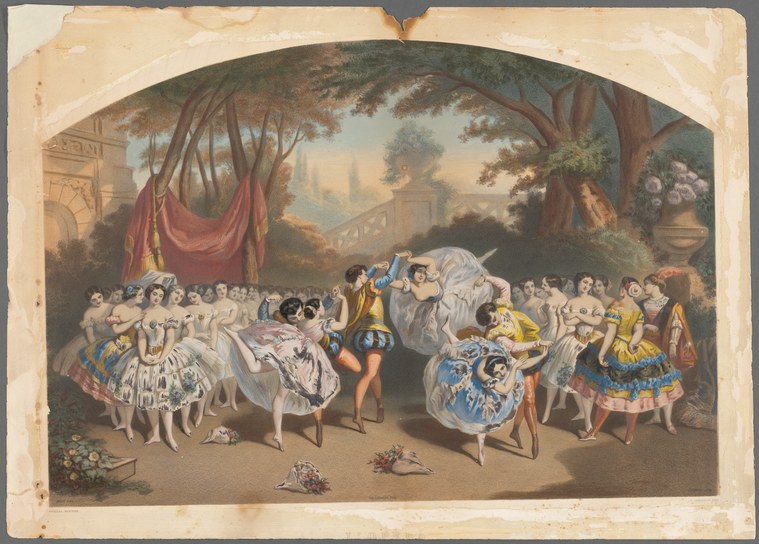
For dance historians and practitioners, this image is invaluable documentation of how Romantic-era ballet actually looked on stage: the scale of ensemble work, the relationship between costume and movement, the formal conventions of presentation, and the theatrical values that shaped the dancing. For art historians, it exemplifies the height of theatrical lithography and the role of commercial prints in 19th-century visual culture and the dissemination of performance.
What you are looking at
A grand theatrical scene set within a classical garden pavilion, framed by an arched opening. Tall trees create a shaded canopy overhead, and the middle distance shows classical architecture and landscape. In the foreground, dozens of figures in elaborate costume occupy the space: women in voluminous tutus of white, pale blue, and yellow silks with fitted bodices; men in military dress and classical attire. A group of central figures appears to be performing or being presented, with musicians or attendants in darker costumes surrounding them. The composition is deeply populated—easily 40–50 figures—arranged in a loose ensemble around what seems to be a formal presentation or pas de groupe. The lighting is warm and golden, suggesting stage lighting or sunset, and the mood is festive and ceremonial. This is unmistakably a scene from a major theatrical ballet production, captured at a moment of spectacle and ensemble participation.
The dancing
The dancers display the upright carriage, lifted spines, and turned-out positions characteristic of classical ballet technique. The women's arms are held in soft, rounded positions typical of the Romantic era—not dramatically extended but gracefully framing the body. Several figures appear to be in attitude or arabesquelike poses, weight delicately balanced on one leg. The men stand in classical contrapposto or in formal attendance poses. The enormous gathered tutus and their buoyant presentation suggest the dancers are weightless, ethereal—a signature effect of Romantic ballet. No pointe shoes are visibly detailed, though the era and style strongly suggest their use. The overall frame is one of formality and spectacle rather than dramatic narrative gesture.
The dance depicted
This depicts a scene from a major Romantic-era ballet, almost certainly a divertissement or ensemble act rather than a plot moment. The scale, the costume uniformity, the formal garden setting, and the theatrical presentation all point to a mid-19th-century production, possibly from Paris or another major European opera house. The dancing itself appears to be classical ballet in the style of the 1830s–1860s: symmetrical, ethereal, with emphasis on the beauty of line and the illusion of weightlessness. The presence of numerous identically dressed female dancers suggests this is a famous 'white act' or ensemble scene, such as one might find in ballets like *La Sylphide*, *Giselle*, or later works in the Romantic canon. The formal presentation and the mix of male and female dancers of apparently equal prominence is consistent with the spectacle ballets of the period.
How it was made
This is a hand-colored lithograph or engraving, executed with considerable technical skill. The atmospheric perspective in the background, the subtle modeling of the figures, and the careful rendering of fabrics and light effects suggest the work of a skilled printmaker working in the mid-19th century. The hand-coloring—applied to achieve the delicate pastels of the tutus and the warm golden light—required multiple passes and close coordination between the printed line and the colored wash. This technique was standard for theatrical prints of the period, which were sold to the public as souvenirs of major productions and as a means of advertising and preserving the memory of celebrated performances. The scale and quality suggest this was a significant commercial print, issued by an established print publisher to reach a broad audience of ballet enthusiasts.
About this work
L'Opéra is a hand-colored lithograph documenting a scene from a major Romantic-era ballet production, likely from the 1830s–1860s. It captures a formal ensemble or divertissement moment in a classical garden setting, populated by dozens of dancers in elaborate tutus and formal dress. The work is a record of theatrical spectacle at the height of the Romantic ballet era, when ballet productions combined narrative drama with lavish set pieces, elaborate costumes, and ensemble displays of technical skill and visual beauty.
This print serves as both a work of art and a historical document. It preserves not only the choreographic moment but also the aesthetic values of the period: the emphasis on ethereal, weightless movement, the symmetry and formality of classical ballet, the spectacle of costume and setting, and the social ritual of the theatrical occasion itself. The print was made to be circulated and consumed as a souvenir, a way for the public to relive the experience and for the theater to extend its cultural reach beyond the audience who attended in person.
How to look at it
Attend first to the scale of the scene and the way the artist has arranged dozens of figures across the canvas while maintaining compositional clarity—this tells you something about how Romantic ballet valued spectacle and ensemble beauty. Notice the uniformity of the women's costumes and poses: this is not a naturalistic rendering of individual dancers, but an idealized, almost abstracted representation of an ensemble effect. Look at the garden setting and the soft, golden light: this reflects the Romantic era's love of otherworldly, dream-like scenarios. Finally, observe the careful rendering of the fabrics and the way the tutus are presented as volumes of light and color rather than as individual garments—this was a central concern of the lithographer, who sought to convey the visual impact of the theatrical spectacle.
The period
This work belongs to the Romantic ballet era (roughly 1830–1870), when ballet moved decisively away from the rigid classicism of the late 18th century toward an aesthetic emphasizing the supernatural, the ethereal, and the dreamlike. Ballets such as *La Sylphide* (1832) and *Giselle* (1841) established the vocabulary and the visual grammar visible here: the tutu, the emphasis on verticality and weightlessness, the integration of ensemble and soloist, and the use of ballet as a vehicle for romantic fantasy and spectacle.
In the same period, lithography had become the dominant medium for theatrical documentation and advertisement. Theaters and print publishers worked together to capture and circulate images of major productions, creating a visual record that fed back into public expectation and memory. These prints were sold at the theater, in print shops, and by subscription, and they played a crucial role in creating and maintaining the cultural prestige of ballet as an art form accessible to the educated middle class.
Where it lives
The work is held in the New York Public Library's Prints Depicting Dance collection, a major archive of theatrical and dance imagery. As a commercial print from the 19th century, it was made for public circulation and consumption, and multiple impressions likely exist in other collections.
Dance in this work
Questions about this work
What ballet is this from?
The catalogue record does not identify the specific ballet or production. The image itself cannot provide a definitive answer without additional historical research. However, the style, costume, and compositional conventions strongly suggest a major Romantic-era ballet from the mid-19th century, possibly from the Paris Opéra or a similarly prestigious European house.
Why are there so many dancers in identical costumes?
This is an ensemble or divertissement scene, a formal set piece common in 19th-century ballet productions. The uniformity emphasized the visual beauty of collective movement and allowed choreographers to create large-scale, visually striking effects. Ensemble scenes like this were often the most technically ambitious and visually spectacular moments of a production.
What is the technique used to make this print?
This appears to be a lithograph—a print made by drawing on a stone or metal plate with a greasy medium, then applying ink and paper. The print was then hand-colored, a labor-intensive process that gave each impression subtle variations. This technique allowed for the subtle modeling of form, the atmospheric effects, and the delicate color rendering visible in this work.
What does this tell us about ballet at this time?
The image documents the aesthetic priorities of Romantic ballet: ethereal, weightless movement; elaborate costumes and spectacular sets; the integration of ensemble and solo work; and the use of ballet as a vehicle for fantasy and spectacle. It also shows that ballet was a major commercial and cultural enterprise, important enough to warrant high-quality theatrical prints for public consumption.
More dance artwork





