49 works in this view — arrow keys or swipe to move between them.
Dance in Art
Caroline Rousset [in pencil]
Unknown artist
- Collection:
- Prints depicting dance
- Source:
- New York Public Library
- Rights:
- Public domain — free to use, share and adapt.
- Recorded as:
- Public Domain
This print is a primary document of nineteenth-century theatrical dance costuming and the blending of drama, character work, and dance technique that defined the Romantic ballet. The survival of Caroline Rousset's name and image, along with her serious rather than decorative presentation, offers a glimpse of a working professional dancer whose larger career and repertory are now largely forgotten.
What you are looking at
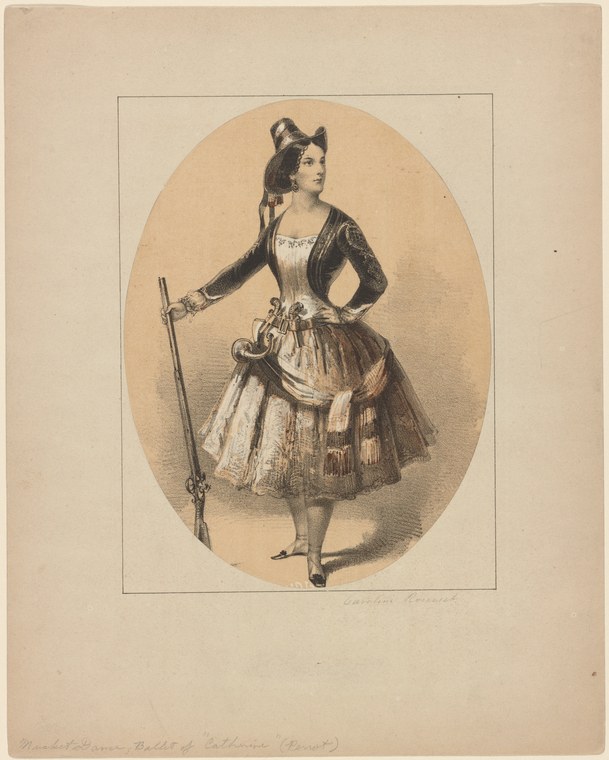
A young woman stands in three-quarter profile against a soft, warm ochre oval background, her figure emerging from the neutral tone with careful modeling in black ink. She wears the costume of a mid-nineteenth-century dancer: a fitted black jacket with long sleeves and a white chemisette at the neckline, paired with a gathered skirt of white and pale tan that falls to mid-calf. Her dark hair is styled up and back, bound with what appears to be a ribbon or fillet. She holds a long wooden staff or pike in her left hand, angled across her body, and her pose suggests alertness and readiness rather than repose—her weight appears engaged, her gaze directed to the viewer's left with a serious, almost stern expression. The staff and her confident stance suggest she is costumed for a dramatic or military-themed role rather than a ballroom or purely decorative part.
The dancing
A single female figure occupies the frame, shown in a balanced contrapposto stance with her weight subtly shifted. Her shoulders are level but her hips and legs suggest a slight rotational twist of the torso. Her right arm hangs naturally while her left, holding the staff, is raised and extended, giving the figure an active, ready quality. The modeling of her legs beneath the gathered skirt suggests defined musculature and an alert posture consistent with a trained dancer, though the clothing obscures specific footwork. The face is rendered with particular attention to expression—serious and direct rather than charming or passive.
The dance depicted
The costume, pose, and especially the staff indicate this is a theatrical dancer in a dramatic or character role, most likely from the Romantic ballet repertory of the 1830s–1850s. The combination of fitted jacket, gathered skirt, and armed stance suggests either a warrior or peasant character in a narrative ballet—possibly a role in works like La Sylphide or Giselle where secondary female characters wore similar dress. The staff might indicate a pole or pike-bearing character, or could be a dance prop used in the narrative. The image documents not purely classical ballet technique but the dramatic costuming and character work that was central to Romantic ballet's theatrical vocabulary.
How it was made
This is a carefully executed engraving or lithograph, rendered primarily in black ink on laid paper with tonal modeling achieved through fine cross-hatching and careful gradation of line weight. The oval format and warm ochre background (likely hand-colored or printed) were typical of mid-nineteenth-century theatrical portraiture and dance documentation. The precision of the line work and the way light and shadow are handled through linear technique rather than paint suggest professional studio production, likely created for publication or sale as a theatrical souvenir or costume study. The technique allowed for wide circulation and relatively affordable reproduction, making such prints accessible to dance enthusiasts beyond the theater itself.
About this work
This engraved portrait documents a dancer named Caroline Rousset in costume for a Romantic-era theatrical role, likely from the 1830s or 1840s. The print captures not a moment of pure dance technique but a character costume study—the kind of souvenir image that helped establish the visual identity of dancers and roles in the nineteenth-century theater. Rousset's serious, alert expression and the prominence of the staff distinguish this from frivolous or merely decorative costume portraiture; she is presented as a dramatic actress-dancer, a professional embodying a specific theatrical character rather than a generic sylph or muse. The work belongs in a dance collection as material evidence of how dancers, choreographers, and the public understood the relationship between theatrical character, costuming, and dance identity in the Romantic period.
How to look at it
Attend to the staff and the seriousness of Rousset's expression—the artist chose not to represent her as passive, graceful, or ornamental, but as alert and capable. The costume details matter: the fitted jacket and high waistline, the gathered skirt, the bound hair are all markers of a specific character role, not generic 'ballet dress.' Note how the engraver modeled the body beneath the skirt with anatomical conviction, suggesting a professional dancer's trained physique. The oval framing and warm background were standard conventions for theatrical portraiture, intended to elevate the subject to dignified celebrity status.
The period
The Romantic ballet era (1820s–1860s) was defined by narrative works set in supernatural or exotic worlds, in which dancers were cast as dramatic characters—sylphs, spirits, peasants, or warriors—rather than purely as ornaments of movement. The 1830s saw the rise of the ballerina as star performer: Marie Taglioni's triumph in La Sylphide (1832) established the ethereal, pointe-dancing heroine as the template. However, secondary roles remained important and required character costuming distinct from the classical tutu. Printed costume studies and theatrical portraits were a major form of dance documentation and promotion before photography; they circulated in theatrical prints and fashion magazines, creating visual records of specific dancers and their signature roles. The careful attention to fabric, silhouette, and dramatic prop in this portrait reflects the visual culture of mid-nineteenth-century theatrical celebrity.
Where it lives
The print is held in the New York Public Library's collection of prints depicting dance. The pencil inscription 'Caroline Rousset' on the mount and the notation of the artist's name (partially legible) suggest this came from an archive of theatrical documentation, likely European in origin and transferred to the library as part of a larger collection of nineteenth-century dance and theater materials.
Dance in this work
Questions about this work
Who was Caroline Rousset?
Caroline Rousset was a professional theatrical dancer active in the nineteenth century, known at least for this character role. Beyond this print and the label on the mount, little about her life and career is currently documented in accessible sources. She represents the many working dancers of the Romantic era whose individual histories have been overshadowed by the fame of ballerinas like Taglioni and Cerrito.
What is she holding and why?
She holds a wooden staff or pike, which was likely a prop or costume element of her character role. This might indicate a peasant warrior, a guard, or a figure of authority within the narrative of the ballet. The presence of the staff is unusual enough to suggest she played a specific named character rather than an interchangeable corps role.
Is this a painting or a print?
This is an engraving or lithograph, a printed image created through incising or crayon work on a prepared surface. The fine lines, cross-hatching, and printed quality visible in the image are characteristic of reproductive prints rather than drawings or paintings. The warm ochre background was likely hand-colored after printing, a common practice for theatrical portraiture.
What was Romantic ballet and why does this matter?
Romantic ballet (1830s–1860s) shifted from pure spectacle to emotionally driven narrative ballets set in fantastical worlds. Dancers were cast as characters—sylphs, spirits, mortals—and the genre blended acting, mime, and technical dance. This portrait documents a professional's costume and bearing within that world, preserving evidence of what trained character dancers looked like and how they presented themselves.
More dance artwork





