49 works in this view — arrow keys or swipe to move between them.
Dance in Art
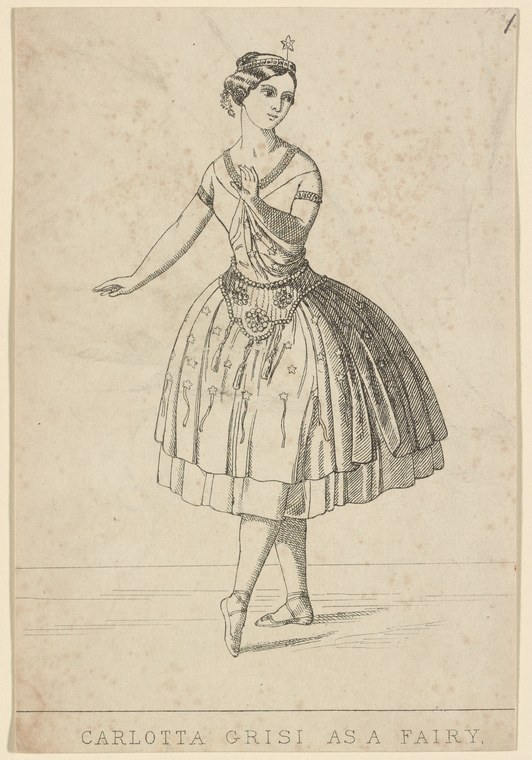
Carlotta Grisi as a fairy
Unknown artist
- Collection:
- Prints depicting dance
- Source:
- New York Public Library
- Rights:
- Public domain — free to use, share and adapt.
- Recorded as:
- Public Domain
Carlotta Grisi was the originating Giselle and one of the greatest dancers of the Romantic era. This print is a primary document of how a celebrated fairy or sylph role was costumed, posed, and visually presented to audiences—it shows the dancer's actual performance silhouette and the aesthetic ideals that made Romantic ballet revolutionary. For historians and dancers, it provides concrete visual evidence of how the ethereal, gravity-defying ideal was achieved and marketed.
What you are looking at
A young woman in full Romantic-era ballet costume is shown in a three-quarter pose against a plain background. She wears a fitted bodice with short, off-shoulder sleeves and a full skirt reaching mid-calf, decorated with small floral sprigs or stars. The skirt has a layered construction typical of the period tutu. She stands en relevé (on the balls of her feet) in a pose suggesting movement or weightlessness. A decorative headpiece or tiara sits atop her hair, styled in the mid-nineteenth-century manner. Her left arm extends gracefully downward while her right arm is bent, her gaze directed upward in a dreamy expression. The entire composition emphasizes the ethereal quality associated with fairy or sylph roles in Romantic ballet.
The dancing
The dancer stands alone in a classical ballet pose, her weight supported on the balls of her feet in a raised relevé position. Her torso is held upright with the characteristic Romantic-era carriage—shoulders back, chest open. Her arms are positioned in a soft, naturalistic manner rather than the formal épaulement of strict classical technique; the extended left arm and bent right arm create an asymmetrical, seemingly spontaneous gesture. The pose suggests the dancer captured mid-motion, floating or suspended, which was the visual hallmark of fairy roles in nineteenth-century ballet.
The dance depicted
This is almost certainly Carlotta Grisi performing in a fairy or sylph role, possibly from Giselle or another Romantic ballet of the 1840s. The title confirms the subject as 'Carlotta Grisi as a fairy.' Grisi was one of the supreme interpreters of Romantic ballet and created the title role of Giselle in 1841. The costume—short, decorated tutu; soft pointe work; weightless stance—is exactly what defined the fairy or supernatural roles that dominated Romantic ballet. The image captures the aesthetic ideal of the period: a dancer appearing to transcend gravity and materiality, a key visual and philosophical goal of Romantic choreography.
How it was made
This is an engraving or lithograph, likely a commercial print produced for circulation to a broad middle-class audience interested in theatrical performances and celebrity performers. The linear technique and fine cross-hatching are consistent with nineteenth-century engraving or wood-engraving. The precision and legibility suggest this was a reproduction for public sale—theatrical prints of this kind were common souvenirs and publicity materials. The medium allowed the artist to capture fine detail in the costume and the dancer's refined posture, while the monochromatic medium emphasizes line and silhouette over color.
About this work
This is a portrait of the Romantic-era ballerina Carlotta Grisi in costume as a fairy, likely from the 1840s. The image documents both the visual culture of mid-nineteenth-century ballet and the aesthetic ideals that defined the Romantic movement in dance: weightlessness, otherworldliness, and ethereal beauty. It is a commercial theatrical print, the kind of souvenir that allowed audiences to take home and display images of celebrated dancers and their famous roles. The work preserves the costume, pose, and performance style of one of ballet's most revered historical figures at the height of her career.
How to look at it
Observe the dancer's pose of apparent weightlessness—the raised relevé, the upward gaze, the soft arm positions—and recognize that this is the key visual innovation of Romantic ballet, a deliberate illusion of defying gravity. Notice how the costume supports this effect: the short tutu allows the legs and elevated feet to be clearly visible, while the fitted bodice emphasizes the upright, floating torso. The engraver has used line to suggest the dancer's ethereal quality; compare the delicate rendering of the figure to the stark background. This pose is not a static position but a frozen moment of apparent flight.
The artist
The artist is not recorded. This is a commercial theatrical print, likely made in Paris or London in the 1840s or shortly thereafter by a printmaker working from life observation or a painted portrait of Grisi. Such prints were produced by theater publishers and sold to audiences as affordable souvenirs and celebrity merchandise. The quality and detail suggest a professional engraver, but the work is typical of the thousands of unsigned theatrical prints made during this period.
The period
This image dates to the height of the Romantic movement in ballet, roughly 1840–1850. The Romantic era in dance was defined by a fascination with the supernatural, otherworldly, and weightless—fairies, sylphs, ghosts, and enchanted women populated the ballet stage. Giselle (1841), in which Grisi danced the title role, epitomized this aesthetic. Simultaneously, the lithographic and engraving industries were at their peak, making celebrity and theatrical imagery widely accessible. Grisi's international fame meant her image circulated across Europe and beyond; prints like this were among the primary ways non-theatergoers encountered and understood the visual language of Romantic ballet.
Where it lives
The work is held in the New York Public Library's Prints collection, a major repository of nineteenth-century theatrical imagery and performance documentation. It is catalogued as a print and is part of a large body of such celebrity and theatrical imagery from the period.
Dance in this work
Questions about this work
Who was Carlotta Grisi?
Carlotta Grisi (1819–1899) was an Italian prima ballerina and one of the greatest dancers of the Romantic era. She created the title role of Giselle in 1841 and was renowned for her technical brilliance and dramatic expressiveness. She performed throughout Europe and was celebrated for fairy and supernatural roles.
What is a fairy role in Romantic ballet?
Fairy roles were parts for ethereal, supernatural female dancers, typically in ballets with magical themes. Fairies and sylphs were meant to appear weightless and otherworldly, dancing en pointe and in the upper range of the stage. These roles defined Romantic ballet aesthetics and required exceptional technical skill and an ability to convey lightness and otherworldliness.
Why is the skirt so short?
The short tutu became standard in Romantic ballet because it allowed the audience to see the dancer's legs and feet clearly, especially the elevated relevé position that created the illusion of weightlessness. Earlier ballet skirts were longer; the Romantic tutu was a deliberate shortening to showcase technique and ethereal line.
Is this a painting or a print?
This is a print, most likely an engraving or lithograph. The linear technique, monochromatic rendering, and fine detail are characteristic of commercial theatrical prints of the 1840s. It was made for sale to audiences and theater-goers as an affordable souvenir and publicity image.
More dance artwork





