49 works in this view — arrow keys or swipe to move between them.
Dance in Art
La masquarade
Unknown artist
- Collection:
- Prints depicting dance
- Source:
- New York Public Library
- Rights:
- Public domain — free to use, share and adapt.
- Recorded as:
- Public Domain
This print documents a theatrical tradition now largely lost to us: the specific costumes, characters, and symbolic language of early modern European dance theater. The grotesque costume suggests dance was not purely about bodily virtuosity but about character, narrative, and visual spectacle, and the care taken to record and circulate such designs reveals how important costume design was to the art form itself.
What you are looking at
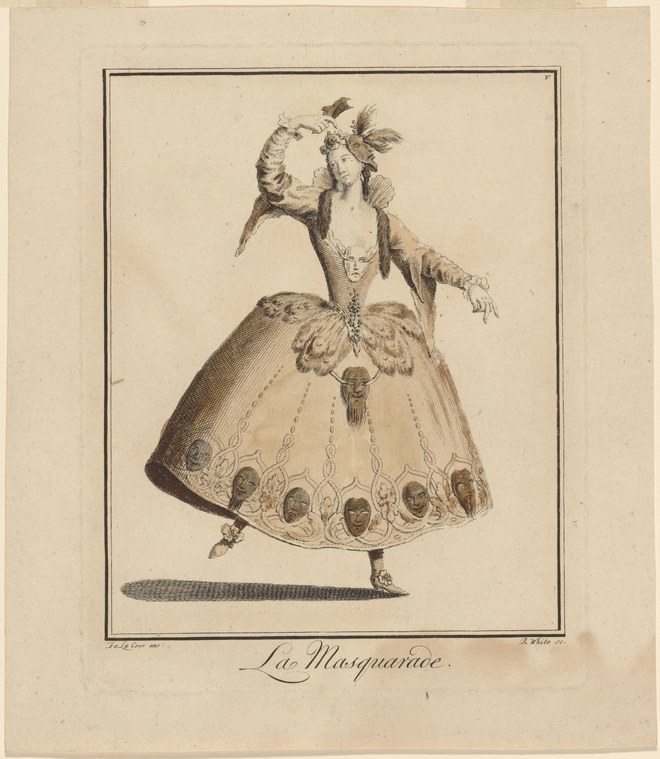
A single female dancer occupies the center of the composition, captured in a moment of theatrical performance against a plain background. She wears an elaborate costume consisting of a fitted bodice with short decorative wings or peplum, and a voluminous skirt of extraordinary construction: the skirt appears to be composed entirely of or decorated with a series of human faces or heads arranged in regular pattern across its surface, creating an unsettling and grotesque visual effect. Her arms are raised expressively—the upper arm held at shoulder height with the forearm elevated, the other arm extended downward—in a pose suggesting classical theatrical gesture. She wears what appears to be a decorative headdress or plume, and stands on one leg with the other foot visible beneath the hem. The entire figure is rendered in fine linear detail against the cream ground, suggesting a print meant for circulation and study.
The dancing
The dancer's pose is a single, held attitude rather than a captured moment of movement: the body is erect and frontal, the weight distributed as if momentarily paused. The raised arms frame the face in a classical theatrical manner, with the upper body and head composed into a vertical axis. This is not a dynamic leap or turn but a formal presentation, the kind of isolated study of a dancer in costume that was used for theatrical documentation and the circulation of designs.
The dance depicted
The work is titled *La Masquarade* and appears to document a character or theatrical role from the commedia dell'arte or French court dance traditions, most likely from the 17th or 18th century. The grotesque skirt—composed of or decorated with human heads—suggests a costume of symbolic or fantastical character rather than a realistic dancer. The formal pose and the emphasis on the costume design itself indicate this is a study of theatrical performance rather than a document of actual movement technique. The work belongs to a tradition of theatrical prints circulating designs for ballet de cour or early modern theatrical dance, where costume and character were paramount.
How it was made
This is an engraving or etching on paper, executed with fine parallel lines and careful hatching to create tonal gradation and surface texture. The technique allowed precise rendering of the elaborate costume details—the pattern of faces on the skirt, the decorative peplum, the feathered headdress—and suggests the work was intended for publication and wide circulation among theater professionals, designers, and patrons. The clean linear style and the absence of color indicate this is a print designed for reproduction, typical of theatrical documentation from the baroque and early modern period.
About this work
*La Masquarade* is a theatrical costume study, rendered as a fine engraving or etching, that documents a character from baroque or early modern French dance and theater. The dancer is presented not as a body in motion but as a vehicle for costume design; the grotesque and fantastical nature of the skirt—composed of human heads in regular arrangement—marks this as a character role of symbolic or comedic significance, likely from the commedia dell'arte or the ballet de cour tradition. The work belongs to a body of theatrical prints made for professional circulation, meant to record and disseminate designs for performance costume and character.
How to look at it
Attend first to the costume rather than the body: the skirt of heads is the subject, and the dancer is its frame. The formal frontal pose is deliberate—it presents the costume for study and record, not as a moment caught mid-performance. Look at the precision of the linear technique, which renders every face in the skirt with individual features, suggesting this is a careful design document. The raised arms and lifted gaze are classical theatrical gesture, but they are held and presented, not danced; this is a pose for the record.
The artist
The artist is not recorded. The style and technique of the engraving place it within a professional tradition of theatrical prints circulating in France or Italy in the 17th or 18th century, but without signature or attribution marks visible in the reproduction, the maker cannot be identified from the image alone.
The period
The work dates to the era of the ballet de cour and commedia dell'arte influence on European theatrical dance, when performance was a hybrid of aristocratic court dance, popular comic theater, and spectacular costume design. In this period, dance was inseparable from theater, music, and visual design; dancers were expected to embody comic or allegorical characters as much as to demonstrate technical virtuosity. The grotesque costume—the skirt of heads—suggests influence from carnival traditions and the symbolic or satirical language of commedia dell'arte, where physical exaggeration and costume transformation were central to meaning-making.
Where it lives
The work is held by the New York Public Library as part of a collection of prints depicting dance. It is catalogued only by title, with no attribution, date, or medium recorded in the available record.
Dance in this work
Questions about this work
What are those faces on the skirt?
The skirt appears to be decorated with or composed entirely of human heads arranged in a regular pattern. This grotesque or fantastical element marks the costume as symbolic or theatrical rather than realistic—likely a character from commedia dell'arte or a similar comic or allegorical tradition. The faces may represent masks, heads of conquered enemies, or simply the fantastical and exaggerated visual language of early modern theater.
Is this a real dance or costume, or an imaginary design?
It was almost certainly a real costume worn in actual performances, recorded here for circulation among theater professionals and patrons. The print is a design document: it records what was actually performed, made available for study, imitation, or reference. However, we cannot know whether performances of *La Masquarade* still took place when this print was made, or whether it documents a living tradition or a historical record.
Who performed this, and when?
Without artist attribution or date, we cannot say precisely. The style suggests a European—likely French or Italian—theatrical tradition of the 17th or 18th century, but the print may have been made long after the dance was first performed. Such designs circulated for years or decades, and were sometimes reissued or recopied.
More dance artwork





