49 works in this view — arrow keys or swipe to move between them.
Dance in Art
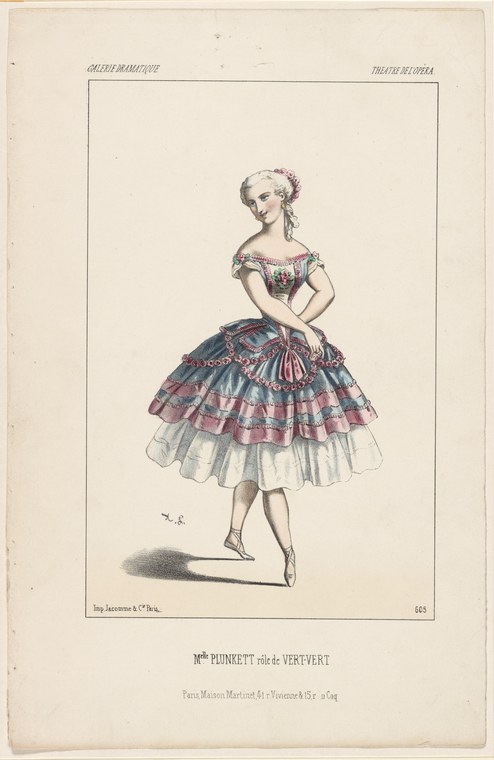
Théâtre de l'Opera. Melle Plunkett rôle de Vert-Vert
Unknown artist
- Collection:
- Prints depicting dance
- Source:
- New York Public Library
- Rights:
- Public domain — free to use, share and adapt.
- Recorded as:
- Public Domain
This print preserves a visual record of a performer and production that shaped the international language of classical ballet. Vert-Vert was influential across Europe, and images like this show how the romantic ballet look—the ethereal skirt, the off-shoulder bodice, the emphasis on lightness—became standardized and recognizable. For historians of dance, costume, and 19th-century theatrical culture, such prints are primary documents: they show us not only what dancers looked like but how they were marketed, remembered, and imagined.
What you are looking at
A single female dancer stands alone against a plain background in a three-quarter pose, her body angled to the viewer's left. She wears a white off-shoulder bodice decorated with blue and pink embroidery or braid, paired with a voluminous skirt of graduated layers: the uppermost layers in deep blue with pink striping, the middle layers in lighter blue with red accents, and the lowest layers in white gauze or muslin. The skirt is lifted at the front to reveal the layering structure and what appears to be decorated petticoats beneath. She stands on the ball of one foot in a pose suggesting arrested motion—the pose of a performer at rest but ready, not a natural standing position. Her hair is arranged in a topknot with curled tendrils. The figure casts a thin shadow beneath her feet. The entire image is rendered in hand-colored engraving or lithography, typical of 19th-century theatrical prints.
The dancing
The dancer stands in profile-to-three-quarter view with her weight forward on one leg, the other foot relaxed. Her arms hang naturally, one at her side and one curved across her body in a graceful but unstudied manner. The pose suggests the moment between actions—neither mid-movement nor fully at rest. The lifting of the skirt exposes the complex construction of the garment and suggests either a pose held for the print or the aftermath of a spin or jump. The single isolated figure and the careful attention to the architecture of the costume indicate this is a portrait of a named performer in a specific role.
The dance depicted
This is a romantic-era ballet dancer, most likely from a mid-19th-century Parisian production. The inscription reads 'Mlle Plunkett rôle de Vert-Vert'—identifying the performer and the role. Vert-Vert (first performed at the Opéra in 1851) was a popular ballet featuring exotic and fantastical elements. The costume—with its off-shoulder bodice, tiered skirt in jewel tones, and lightness of construction—is consistent with the romantic ballet aesthetic of the 1840s–1850s. The dancer's pose, weight distribution, and the emphasis on the skirt's construction all point to classical ballet technique of this period, where the skirt was both ornamental and functional, allowing the display of footwork and the illusion of weightlessness.
How it was made
This is a hand-colored lithographic or engraved print, a standard medium for theatrical publicity and souvenirs in 19th-century France. The technique allowed for rapid reproduction and distribution of images of celebrated performers to an eager public. The fine detail work visible in the costume's ornamentation and the careful modulation of the figure's outline indicate a skilled theatrical illustrator. Such prints were the primary visual record of performance in this era, as photography of dance was technically difficult; they functioned both as advertisement and as a form of dance history.
About this work
This is a theatrical portrait of a named performer, Mlle Plunkett, in the role of Vert-Vert from the Opéra ballet of the same name. The print documents both a specific moment in the history of French romantic ballet and the conventions by which dancers were represented to and remembered by the public. The careful attention to costume construction—the layering and ornamentation of the skirt—reveals how central spectacle and visual effect were to the romantic ballet aesthetic. As a printed image distributed commercially, it is also evidence of the star system and celebrity culture that had developed around ballet by mid-century.
How to look at it
Attend first to the costume's construction: the graduated layers of the skirt, the decorated bodice, and the contrast between the colored upper layers and white lower layers create an optical effect of weightlessness and movement even as the figure stands still. Notice the dancer's weight distribution—forward, on the ball of the foot—which suggests the muscular engagement of classical technique even in this posed moment. The three-quarter view and the lifting of the skirt are compositional choices that maximize the display of the garment's spectacle while also suggesting the dancer's readiness for action. This is a portrait designed to sell both the dancer and the fantasy she embodied on stage.
The artist
The artist is not recorded in the catalogue. The signature or printer's mark, if present, is not legible in this reproduction. The print itself bears the imprint of a Paris publisher (visible at the bottom left), indicating production by one of the commercial theatrical print workshops that flourished in Paris during the romantic era. Such workshops employed many anonymous lithographers and colorists who worked from designs by theatrical illustrators; the prints were sold in theatre lobbies and through print sellers.
The period
This print dates to the era of romantic ballet (approximately 1830–1860), a moment when ballet shifted from the strict neoclassical idiom toward fantastical, exotic, and supernatural themes. Degas, Taglioni, and other stars of the period became international celebrities, and their images circulated widely through such prints. The 1850s saw the height of the star system in French ballet, with celebrated dancers commanding high ticket prices and becoming fashion icons. Lithographic printing technology, perfected in the early 19th century, made theatrical imagery affordable and collectible for a middle-class audience.
Where it lives
This print is held in the New York Public Library's prints collection documenting dance iconography. It is a commercial theatrical print, one of thousands produced in 19th-century Paris and distributed internationally. Such prints are typically found in theater archives, dance history collections, and specialized print cabinets.
Dance in this work
Questions about this work
Who was Mlle Plunkett?
She was a professional ballet dancer active in Paris in the mid-19th century. Beyond her identification in this print and her performance in Vert-Vert, specific biographical details are limited. Like many dancers of her era, she is now known primarily through such theatrical prints and occasional mentions in playbills and reviews.
What was Vert-Vert?
Vert-Vert was a ballet choreographed by Joseph Mazilier with music by Adolphe Adam, first performed at the Paris Opéra in 1851. It tells the story of a parrot and features exotic and comedic elements typical of mid-19th-century romantic ballet. It was popular across European theaters for several decades.
How does this costume compare to modern ballet?
The off-shoulder bodice and tiered skirt design are characteristic of romantic-era ballet and differ markedly from both earlier neoclassical ballet costumes and modern classical ballet. The emphasis on ornamentation and the skirt's volume reflect the aesthetic priorities of the romantic period, where spectacle and ethereal beauty were paramount. Modern ballet costumes tend toward greater simplicity and closer fit.
How were these prints made and distributed?
These were lithographic or engraved prints, hand-colored after printing. They were produced in Paris by commercial workshops and sold in theater lobbies, print shops, and through subscription. A single popular performer might have hundreds or thousands of prints in circulation, making them the primary visual memory of a performance in an era before photographic documentation of dance.
More dance artwork





