49 works in this view — arrow keys or swipe to move between them.
Dance in Art
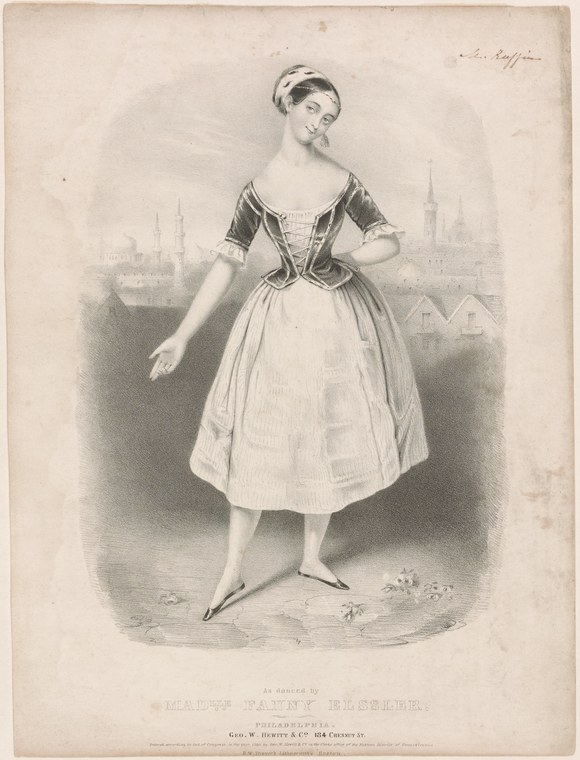
[The new smolenska] as danced by Madlle. Fanny Elssler
Unknown artist
- Collection:
- Prints depicting dance
- Source:
- New York Public Library
- Rights:
- Public domain — free to use, share and adapt.
- Recorded as:
- Public Domain
Fanny Elssler was one of the first global dance superstars, and prints like this were central to how her image and technique circulated internationally. The work documents the early commercial celebrity culture built around dancers, and the coexistence of classical ballet training with the fascination for 'national' and exotic dance forms that defined the Romantic era.
What you are looking at
A young woman in theatrical dress stands alone against a softly rendered urban background of spires and rooflines, suggesting a European city. She wears a dark velvet bodice with short puffed sleeves trimmed in white, laced across the front, with a white chemise visible beneath. Her skirt is full and pale, falling to mid-calf, gathered at the waist with careful pleats. Her posture is composed and graceful: weight rests on one leg while the other extends forward in a line of repose rather than active movement. Her gaze is lowered and contemplative. The engraving technique has rendered her in fine gray tones with delicate cross-hatching in the background; the contrast between the defined figure and the atmospheric cityscape creates a sense of the dancer as both present and distant, caught in a moment of pause between movements.
The dancing
The dancer stands in a pose of balletic composure with one leg bearing her weight and the other gently extended. Her arms are relaxed but articulate: one hangs at her side while the other is raised with a soft bend at the elbow, hand open and expressive. Her head is inclined in a posture of grace and modesty. The body alignment suggests training in the classical tradition—vertical spine, turned-out leg position, a quality of effortlessness that required years of discipline to achieve. There is no dynamic action in this moment; the artist has chosen a pause, a presentation of the dancer's trained bearing rather than a leap or turn.
The dance depicted
This is Fanny Elssler, the most celebrated European dancer of the 1830s–1840s and the subject of intense cultural devotion during her career. The inscription identifies this as 'The new smolenska as danced by Madlle. Fanny Elssler'—likely referring to a Romantic-era choreographic work in the Russian or folk-inspired idiom that was fashionable at the time. Elssler was known for her dramatic intensity, technical brilliance, and the exoticism of her roles, which extended beyond the ethereal sylph ideal of early Romantic ballet into character and national dances. The modest, composed pose shown here emphasizes the refined technique and noble bearing that made her performances legendary, though the title suggests this particular work showcased a different, perhaps more dramatic or folk-inflected style.
How it was made
This is a lithographic engraving, a medium well-suited to rapid reproduction and mass circulation—evident in the fine parallel lines and tonal gradations achieved through the printing process. The technique allowed for affordable prints that could be distributed widely to theaters, collectors, and admirers, making celebrity dancers like Elssler into internationally recognized images. The quality of the line work and the careful attention to drapery and anatomical detail suggest this was a commercial print of some ambition, not a quick souvenir. The cityscape background is rendered more loosely than the figure, a compositional choice that focused the viewer's attention entirely on the dancer's body and presence.
About this work
This is a professional theatrical portrait in print form, created during the height of Fanny Elssler's fame in the 1830s–1840s. It documents not a performance moment but a dancer in her trained, public-facing composure—the controlled body that made her one of the most influential performers of the Romantic ballet era. The work belongs to a large body of commercial imagery that built Elssler's celebrity across Europe and America, circulating her image to audiences who might never see her perform live. The Smolenska, whether a Russian folk-inspired work or a choreographic invention, was part of Elssler's repertoire of character and national dances that positioned her as both technically brilliant and dramatically daring—a departure from the ethereal, otherworldly ideal associated with other Romantic dancers.
How to look at it
Attend to the stillness of the pose: this is not a moment of action but of presentation, the dancer at rest yet fully in command of her body. Notice how the artist has balanced her weight and composure to convey trained discipline without rigidity. The modest downward gaze and the careful drapery of the skirt were conventions of the period's idealized female performer—the body on display yet not aggressive or sexualized. The faint cityscape behind her suggests a specific place (likely a reference to a production or Elssler's touring success in a particular city), anchoring the abstract grace of her pose in the world of real theater and celebrity.
The artist
The artist is not recorded. The print bears a publisher's mark (Gee. W. Henry & Co., 124 Cheapside) identifying it as a London commercial theatrical print, likely created for sale to admirers and theater-goers. The level of finish and the theatrical subject suggest a professional printmaker working in London's established trade in celebrity portraiture and theatrical imagery during the 1830s–1840s.
The period
This engraving dates to the era of Fanny Elssler's greatest fame, roughly 1835–1845. Romanticism in ballet was at its height, with sylphs and supernatural beings dominating the stage through works like *La Sylphide* (1832). Yet Elssler's career represented a counter-tradition: she was celebrated for her dramatic power, technical virtuosity, and willingness to perform character dances, folk dances, and national styles rather than remaining confined to the ethereal ideal. Her 1836–1842 tour of the Americas made her an international phenomenon and established the commercial market for theatrical prints. The lithographic portrait was the primary vehicle for circulating images of performers, and the quality of this work suggests it was aimed at affluent admirers and serious collectors of theatrical imagery.
Where it lives
This print is part of the New York Public Library's collection of prints depicting dance, a significant archive of theatrical imagery from the 19th and early 20th centuries. It represents the commercial theatrical print market that served as the primary medium for circulating images of performers to the public.
Dance in this work
Questions about this work
Who was Fanny Elssler?
Fanny Elssler (1810–1884) was an Austrian-Italian dancer who became one of the most celebrated performers of the Romantic era. She was technically brilliant, dramatically powerful, and known for her performances in character and national dances as well as classical ballet. Her 1836–1842 tour of North and South America made her an international celebrity and helped establish the modern cult of the dance star.
What is the Smolenska?
The Smolenska (or Smoliantskaya) was likely a character or national dance inspired by Russian or Eastern European traditions, popular in the Romantic ballet repertoire. The exact choreography and source are not fully documented, but such works allowed dancers like Elssler to perform exoticized national styles that contrasted with the ethereal sylph roles that dominated early Romantic ballet.
How were dancers promoted in this period?
Theatrical prints like this lithograph were the primary tool for promoting performers before photography became standard in the 1860s. Publishers in major cities produced affordable prints for sale to admirers, making celebrity dancers' images widely available. These prints circulated among theater-goers, collectors, and fans, and were often sold at performances.
More dance artwork





