49 works in this view — arrow keys or swipe to move between them.
Dance in Art
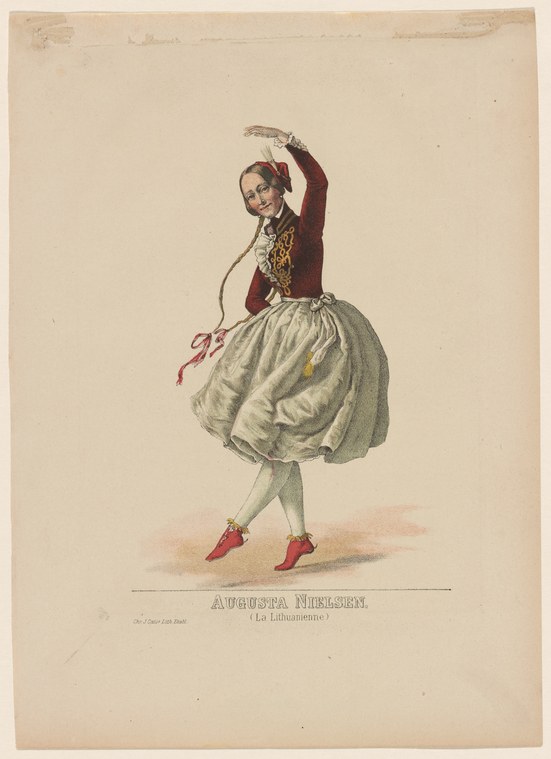
Augusta Nielsen. (La Lithuanienne).
Unknown artist
- Collection:
- Prints depicting dance
- Source:
- New York Public Library
- Rights:
- Public domain — free to use, share and adapt.
- Recorded as:
- Public Domain
This print documents a tradition of nationalist character dances within European ballet that has largely vanished from the repertory. It shows us how a real dancer—not an allegorical figure, but a named performer—inhabited and displayed these roles for paying audiences, and it preserves a moment of choreography and costuming that no written record survives to describe.
What you are looking at
A single female dancer dominates the composition, posed in a moment of balletic grace against a plain cream background. She wears a burgundy velvet jacket with gold embroidered detail across the chest, paired with a voluminous pale gray skirt that billows around her legs as though caught mid-movement. Her hair is styled close to her head with a red ribbon accent. Her right arm extends upward in an elegant arc, the hand holding what appears to be a curved ornamental object—possibly a fan or theatrical prop—while her left arm frames her body. Her weight appears to rest primarily on her right leg, with the left leg extended or bent beneath the skirt. Her posture conveys both strength and elegance, the upper body held erect and composed. Red heeled slippers peek beneath the hem. The figure is rendered with careful attention to fabric texture and body form, the artist using light wash and line to suggest volume and movement.
The dancing
The dancer stands in a striking vertical pose with a clear weight shift to one side, the supporting leg engaged and the free leg positioned to suggest forward motion or extension. The raised arm describes a graceful curve overhead, the hand holding an ornamental object—a fan, perhaps, or a theatrical accessory. The torso remains upright and stable, the opposite arm relaxed and positioned across the body in a balletic frame. The overall carriage suggests trained classical technique, with particular attention to the alignment of the upper body and the arc of the supporting arm.
The dance depicted
This is a theatrical dance number from the Romantic era of ballet, most likely from the mid-19th century. The costume—the velvet jacket, voluminous skirt, and the theatrical prop—suggests a character role or a national or exotic variation within a ballet such as *La Lithuanienne* (The Lithuanian Woman), which the caption identifies. The pose captures a moment of display or flourish characteristic of Romantic-era character dances, which often featured national or regional identities performed by European-trained ballerinas in European theatres. The dancer's classical training is evident in the carriage of the body and the controlled extension of the limbs.
How it was made
This is a hand-colored lithograph, identifiable by the combination of lithographic line work (visible in the fine details of the face and the sharp outline of the figure) with delicate watercolor wash for the modeling of fabric and skin tone. The technique allowed for broad circulation of theatrical imagery: this print format was the standard vehicle for publicizing dance performances and dancers to the theatregoing public in the 19th century. The hand-coloring, while economical compared to other processes, gives the work a refined quality and suggests it was aimed at a middle- or upper-class audience interested in theatrical novelty.
About this work
This is a theatrical souvenir print documenting a character dance performed in the Romantic era, most likely in the 1840s–1860s. It records not the ballet itself but a famous dancer performing a solo number—likely Augusta Nielsen in the role of a Lithuanian woman, a national character variation set within or adjacent to a larger ballet production. The print circulated as a memento for theatre-goers and as publicity for the dancer and the company. It belongs in a dance history collection as evidence of how national identity, female virtuosity, and theatrical spectacle intersected in 19th-century ballet, and as a record of a specific performer and a specific moment of choreography that would otherwise leave no trace.
How to look at it
The artist has chosen to freeze the dancer at a moment of display—not the deepest point of a movement, but a held pose that allows the viewer to admire both the dancer's body and her costume. Attend to the balance and control in the figure: the raised arm is not wild or momentary but composed and architectural, and the weight of the body is visibly organized around a vertical axis. The voluminous skirt is rendered to suggest motion (it appears to billow outward as though the dancer had just spun or has just ceased spinning), but the upper body is calm and commanding. This is the grammar of Romantic ballet: the display of the dancer's agency and artistry through a pose that is both natural and carefully composed.
The artist
The artist is not recorded in the catalogue. The print is unsigned or the signature is not legible in the surviving impression. Lithographic dance prints of this era were often produced in series and distributed by theatres or music publishers; they might be credited to the lithographer or left anonymous. The quality of observation and the refinement of the coloring suggest a professional theatrical lithographer working for a major European print house, most likely in France or England.
The period
This print dates to the heyday of Romantic ballet in Europe, roughly 1840–1870, when the ballerina had become the central attraction of theatrical dance and when character dances—solos showcasing a particular national, ethnic, or exotic identity—were a standard feature of ballet performances. The taste for such dances reflected both the nationalist movements of the 19th century and a colonial appetite for the exotic, mediated through the bodies of European-trained dancers. Augusta Nielsen was a prominent Copenhagen-trained dancer who performed throughout Europe; the label *La Lithuanienne* may reference a solo or variation within a larger work, or it may be a standalone number created to showcase her technique and to capitalize on the vogue for national character pieces.
Where it lives
The print is held by the New York Public Library's collection of prints depicting dance. It is a single-sheet theatrical souvenir, likely one of dozens or hundreds printed and distributed to theatre patrons. Such prints were inexpensive and were often discarded, making surviving examples valuable documentary evidence of specific performances and performers.
Dance in this work
Questions about this work
Who was Augusta Nielsen?
Augusta Nielsen was a Danish dancer trained in Copenhagen who performed throughout Europe in the mid-19th century. She was known for character roles and national dances, which were a staple of Romantic ballet. This print documents her in one such role, though detailed biographical records of her performances are sparse. She represents a class of prominent European ballet dancers of the era whose work has been largely forgotten because it was never recorded in notation or film.
What is a character dance in ballet?
A character dance (or danse de caractère) was a solo or small-group choreographed number performed within or adjacent to a full-length ballet, designed to showcase a dancer's technique and dramatic presence while embodying a specific national, regional, or exotic identity. These dances were enormously popular with 19th-century audiences and were a standard feature of ballet evenings. They often featured distinctive costumes and props, as visible in this print.
How do we know this is a lithograph?
The image shows the characteristic combination of lithographic line work (the fine, consistent line of the figure's outline and facial features) with hand-applied watercolor wash for modeling and color. Lithography was the dominant print technique for theatrical publicity in the 19th century because it was economical to produce in quantity while allowing for elegant linear detail and hand-finishing.
More dance artwork





