49 works in this view — arrow keys or swipe to move between them.
Dance in Art
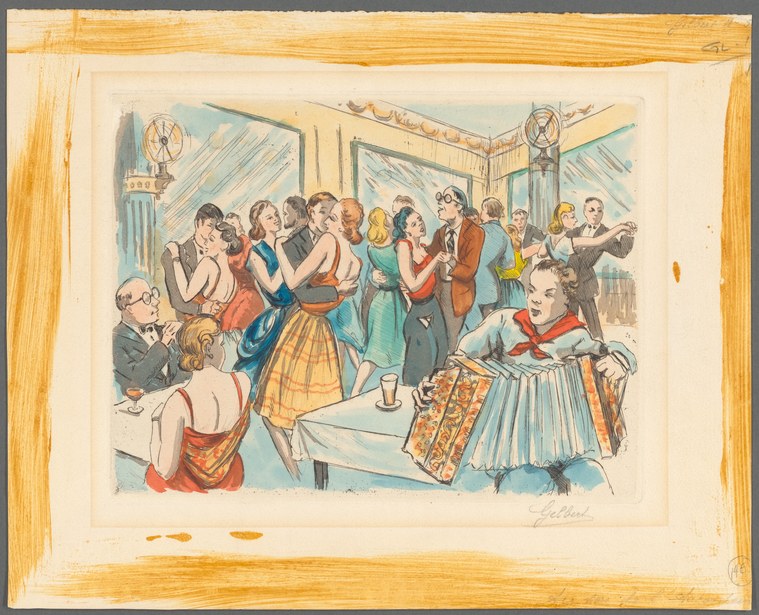
Air [illegible] de l'accordion
Unknown artist
- Collection:
- Prints depicting dance
- Source:
- New York Public Library
- Rights:
- Public domain — free to use, share and adapt.
- Recorded as:
- Public Domain
This is a rare visual record of the lived experience of social ballroom dancing in a period before television and film dominated popular culture. The emphasis on the accordion—a folk and popular instrument often overlooked in histories of ballroom dance—reveals the instrumental and class dimensions of dance hall culture that formal records obscure.
What you are looking at
A crowded, animated ballroom or dance hall in what appears to be the early-to-mid 20th century, rendered in watercolor with hand-colored touches. The scene is packed with couples and solo figures in various states of motion, many in embraces or mid-pivot. The setting has the architectural markers of an indoor venue: a decorative column on the left, a clock mounted on the wall showing the time, and tall windows with geometric patterning suggesting Art Deco or Modernist design. The lighting is soft and yellowish, suggesting evening or artificial light. At the right foreground, a woman in a pale dress sits playing an accordion—the apparent subject of the title—while observers cluster around her. The other figures wear fashionable 1930s–1940s dress: women in bias-cut gowns with puffed or draped sleeves in jewel tones and pastels, men in dark suits or brown jackets. The composition is deliberately crowded and overlapping, with figures at varying depths creating a sense of energetic social space rather than staged performance.
The dancing
The majority of visible figures are in closed ballroom hold—man's right hand on woman's back, woman's left hand on his shoulder, free hands connected—though several couples are mid-turn with skirts flaring. Weight appears to be on the balls of the feet; hips are mobile and the posture upright. One woman in the left foreground has her head tilted back in apparent enjoyment. The accordion player occupies a seated, stationary position, her posture formal and focused on the instrument. The figures are rendered with simplified anatomy but recognizable articulation of the hip and shoulder; the artist has clearly observed social ballroom dancing rather than theatrical technique.
The dance depicted
This depicts social ballroom dancing, most likely the Waltz or Foxtrot, the dominant partner dances of the interwar and immediate postwar period in European and North American dance halls. The accordion—a folk and popular instrument—suggests this is not a formal concert or competition ballroom context but a public or semi-public venue for casual social dancing, possibly a café or working-class hall. The crowded, relaxed atmosphere and the presence of the live accordion player (rather than a jazz band) indicate popular ballroom culture rather than elite ballroom sport. The title references the accordion explicitly, suggesting the work documents the instrumental accompaniment to social dance.
How it was made
This is a hand-colored print, most likely a lithograph or chromolithograph, with watercolor or gouache applied by hand over a printed underlay. The soft color palette, the slightly irregular contours, and the characteristic bloom of watercolor are visible throughout. This technique—combining lithographic reproduction with selective hand-coloring—was economical and allowed for multiple copies with variation, common for popular genre scenes and commercial illustration in the 1920s–1940s. The signature visible at lower right appears to be in a single hand, suggesting this may be a unique or limited hand-colored impression rather than a mass-produced print.
About this work
A hand-colored print depicting a crowded social ballroom scene, dominated by couples in closed embrace executing the turning figures of Waltz or Foxtrot, with an accordion player seated in the foreground. The work documents the material and social reality of popular ballroom dancing in the interwar or early postwar period—the crowded hall, the live instrumental accompaniment, the fashionable dress, the democratic mix of age and social type. The accordion, emphasized in the title, marks this as working-class or café ballroom culture rather than elite competition dancing. The work belongs in a gallery of dance in art as documentary evidence of how social ballroom dancing was understood and valued in the early twentieth century.
How to look at it
Observe the repeated closed-hold posture and the executed turns: the woman's skirt flares in a way consistent with the centrifugal force and hip action of Waltz or Foxtrot. Notice the seated accordion player in sharp focus at right—she is clearly the organizing principle of the composition, despite being stationary. The crowded, overlapping bodies create a strong sense of social space and community rather than individual performance; this is not a competition or show, but a social event. The soft, warm palette and the cheerful expressions convey the leisure and pleasure of the occasion.
The period
The 1920s–1940s saw the apotheosis of social ballroom dancing in Europe and North America. The Waltz, Foxtrot, Tango, and Quickstep were codified into both competitive forms and simplified social versions. Dance halls, cafés, and public ballrooms proliferated in cities and towns; live accordion, piano, and small jazz ensembles provided music. This period also saw the rise of affordable color printing and hand-colored commercial prints as a mass medium for recording social life and leisure. The watercolor and lithographic tradition of genre illustration remained vital for documenting working-class and middle-class recreation.
Where it lives
The work is held in the New York Public Library's Prints collection, described as depicting dance. The catalogue record provides no artist attribution, date, or medium specification; these have been inferred from the image.
Dance in this work
Questions about this work
What instrument is being played?
An accordion, a portable reed instrument popular in European folk music, café music, and working-class dance hall contexts. The title references the accordion explicitly, indicating it is central to the work's subject and meaning.
When was this made?
The catalogue record does not supply a date. Based on the style of dress (bias-cut gowns, 1930s–1940s cuts and colors), the Art Deco architectural details, and the technique (hand-colored lithograph), the work likely dates to the 1930s or 1940s.
What dance are they doing?
Most likely Waltz or Foxtrot, the dominant ballroom partner dances of the period. The closed hold, the turning posture, and the flared skirts are consistent with both. Without music or more precise footwork detail, either is plausible.
Who is the artist?
The catalogue record does not identify the artist. A signature is visible at the lower right of the work, but it is not legible in reproduction. The work may be a commercial print or popular genre illustration produced by a designer or studio rather than a named fine artist.
More dance artwork





