49 works in this view — arrow keys or swipe to move between them.
Dance in Art
Fanny Elsler [facsimile signature]
Unknown artist
- Collection:
- Prints depicting dance
- Source:
- New York Public Library
- Rights:
- Public domain — free to use, share and adapt.
- Recorded as:
- Public Domain
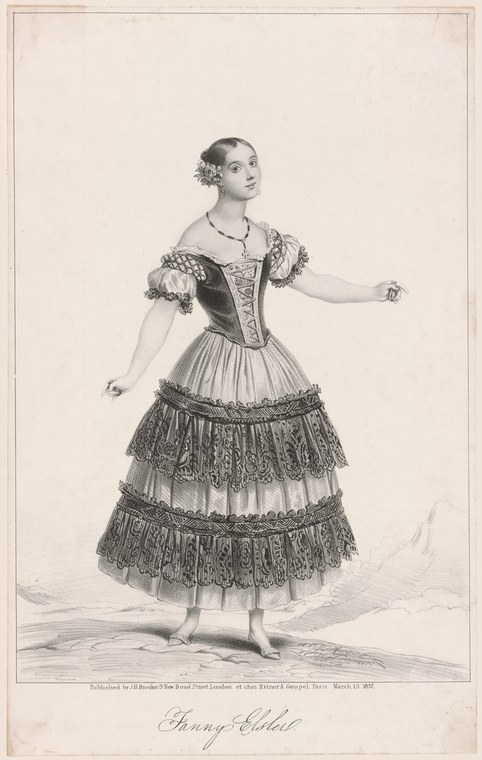
Elsler was one of only two ballerinas capable of drawing comparable audiences and critical attention in the 1830s–1840s, and this image captures the public face she cultivated during her international fame. For historians and dancers, the print preserves both the factual details of Romantic-era costume—the tiered lace skirts, the proportions of the bodice, the fitted sleeves—and the aesthetic values of the period: verticality, ethereality, the upward gaze. The engraving's circulation in multiple cities across Europe and North America makes it evidence of how dance imagery was distributed, consumed, and used to build celebrity before photography.
What you are looking at
A young woman in Romantic-era theatrical dress stands in a three-quarter pose against a plain background, her body angled to the right while her gaze lifts upward and away. She wears a fitted corseted bodice with short, puffed sleeves trimmed in lace, and a voluminous skirt composed of two deep tiers of lace flouncing that fall to mid-calf, revealing the lower leg and ballet slippers. Her left arm extends gracefully outward in an open, welcoming gesture; her right hangs loosely at her side. A simple necklace and floral wreath in her dark hair complete the costume. The engraving's fine crosshatching and delicate linework render the texture of the fabrics with precision, particularly the intricate pattern of the lace. Her posture suggests a moment of poised stillness—neither mid-movement nor resting, but rather the kind of presentation pose used for theatrical promotion.
The dancing
A single female figure stands in a graceful, open contrapposto with her weight primarily on her right leg. Her left leg appears slightly bent and forward, a position consistent with ballet training. Both arms are held at approximately shoulder height—the left arm extended in a gentle arabesque-like line, the right relaxed. Her torso is upright but not rigid, and her head is turned upward with the chin slightly raised, creating a sense of lyrical yearning characteristic of Romantic ballet. The positioning suggests lightness and ethereality rather than grounded, earthy movement.
The dance depicted
This is a portrait of Fanny Elsler, the celebrated Austrian ballerina of the Romantic era (1810–1884). The image commemorates her as a theatrical star rather than capturing her in performance; the posed, presentation quality is typical of promotional engravings used to advertise dancers to audiences and circulate their image beyond the theatre. Elsler was one of the two dominant ballerinas of her time—rivaling Marie Taglioni—and was known equally for dramatic intensity and technical precision. The Romantic tutus and corseted bodice shown here were her standard stage costume across multiple roles and periods of her career.
How it was made
This is an engraving, identified by its fine parallel hatching, lack of color, and the precision of the line work. The date of publication appears in the inscription at the base (March 13, 1837), indicating this was a commercial print produced for wide distribution—relatively inexpensive compared to original paintings, and affordable to theatregoers and dancers themselves. Engravings of this type were the primary means by which dance images circulated in the 19th century, reaching fans across Europe and America and serving as both promotional material and keepsakes. The technical skill required to render the lace and fabric textures through engraving alone speaks to the value placed on such portraits.
About this work
This engraving presents Fanny Elsler at the height of her fame as a Romantic ballet star, captured in a formal portrait pose rather than mid-performance. The image functions as both a theatrical advertisement and a record of how Elsler presented herself and was presented to the public during the 1830s—a crucial decade of her career when she was reshaping the idea of what a ballerina could be. It belongs in a dance art collection because it documents not just costume and silhouette, but also the codified pose and bearing that constituted a ballerina's public identity in the Romantic era. The signature at the bottom indicates this was an authorized portrait, likely produced with Elsler's involvement or approval, making it a primary document of how the dancer herself wished to be remembered.
How to look at it
Observe the precision with which the engraver rendered the two tiers of lace—each tier is distinct in pattern, suggesting different lace widths and techniques, and the overall silhouette is characteristic of the mid-1830s tutu, wider and shorter than earlier court dress but not yet the stiff tutus of the classical era. Notice the uplifted gaze and the relaxation of the arms: this is not a pose of exertion or narrative drama, but of lyrical reverie, the pose that would be seen in Romantic ballets of yearning and supernatural encounters. The standing position, with no clear narrative context, emphasizes the body itself as the subject—the engraver's task was to present the dancer's form and bearing as the advertisement.
The artist
The engraver is not recorded in the catalogue, but the inscription indicates professional commercial production by a London firm (printed at 12 Brydges New Bond Street, London). The style and quality suggest a competent theatre print workshop of the 1830s–1840s, when such firms were major producers of performer likenesses. The signature "Fanny Elsler" in the lower margin is the dancer's own facsimile signature, a common feature of promotional prints to assert authenticity and the subject's approval of the portrait.
The period
This engraving dates to 1837, during the first full flourish of Romantic ballet in Europe. Marie Taglioni had premiered La Sylphide in Paris in 1832, establishing the aesthetic that dominates this image—the ethereal, otherworldly ballerina in a tulle skirt, pointe shoes, and uplifted gaze. By 1837, Elsler had begun her own ascent to rival Taglioni's dominance, and promotional prints like this were essential to building her reputation across the continent and preparing audiences for her performances. The theatrical engraving was a standard technology of cultural promotion, preceding photography as the mass-reproducible image of performers. Elsler would later tour North America (1840–1842), and images like this prepared American audiences for her arrival.
Where it lives
This engraving is held by the New York Public Library as part of a dance prints collection. The inscription identifies it as published in London on March 13, 1837, and bears a facsimile signature of Fanny Elsler herself, indicating it was an authorized portrait used for theatrical promotion and sale to the public.
Dance in this work
Questions about this work
Why is Fanny Elsler important in dance history?
Elsler (1810–1884) was one of the two pre-eminent ballerinas of the Romantic era, rivaling Marie Taglioni in fame and technique. She was celebrated for both her technical virtuosity and her dramatic intensity, and brought Romantic ballet to audiences across Europe and North America. Her career helped establish the ballerina as a star performer and cultural celebrity.
What is a Romantic tutu and why does it matter?
The Romantic tutu, visible in this image, is a mid-calf-length skirt made of multiple tiers of tulle or lace, designed to create an ethereal, weightless silhouette. It became the signature costume of Romantic ballet after Marie Taglioni wore it in La Sylphide (1832), embodying the era's fascination with otherworldly, supernatural female characters. The costume is as important to understanding Romantic ballet as pointe shoes.
How were dance images distributed before photography?
Theatrical engravings like this were the primary mass-reproducible images of performers in the 19th century. They were printed in quantities and sold to theatregoers, circulated in newspapers and journals, and distributed internationally. Engraving was cheaper and faster than oil painting, allowing theatres to capitalize on a performer's fame by producing portraits for sale and promotion.
What does the facsimile signature tell us?
The signature "Fanny Elsler" at the bottom of the engraving is a facsimile—a reproduction of the dancer's actual signature. This was a common feature of authorized promotional prints, assuring buyers that the portrait was authentic and approved by Elsler herself, much as modern celebrity endorsements work today.
More dance artwork





