49 works in this view — arrow keys or swipe to move between them.
Dance in Art
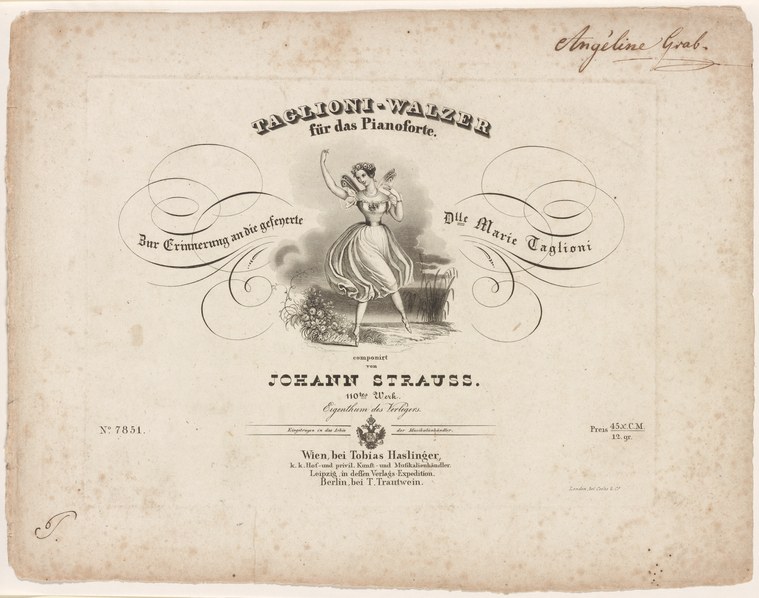
Taglioni-Walzer für das Pianoforte: Zur Erinnerung an die gefeyerte Dlle. Marie Taglioni. Componirt von Johann Strauss. 11tes Werk
Unknown artist
- Collection:
- Prints depicting dance
- Source:
- New York Public Library
- Rights:
- Public domain — free to use, share and adapt.
- Recorded as:
- Public Domain
Marie Taglioni was the dominant figure in romantic ballet, and this work is evidence of how her fame extended beyond the theater into the commercial musical world—any literate pianist in the German-speaking lands could own a copy and perform a tribute to her. The engraved image preserves the visual archive of romantic ballet aesthetics: the tutu, the pointe shoe, the classical port de bras, the ethereal pose—all the formal language that Taglioni herself established and that became the visual definition of ballet for generations.
What you are looking at
This is a title page for a piano waltz composed by Johann Strauss in honor of the celebrated dancer Marie Taglioni. The composition is called the "Taglioni-Walzer" and is labeled his eleventh work (Op. 11). At the center of the page is an engraved vignette showing a single female dancer in a romantic-era tutu and pointe shoes, captured mid-pirouette or sustained turn with her arms raised in classical ballet port de bras. She wears the characteristic costume of the 1840s–50s romantic ballet: a fitted bodice, a bell-shaped skirt of considerable length, and pointe shoes. The figure is positioned against a simple ground with light landscape elements behind her. The page is framed with ornamental flourishes and scrollwork typical of mid-nineteenth-century printed music. German text identifies it as a waltz for pianoforte ("für das Pianoforte") and notes it was composed by Johann Strauss, with publication information at the base indicating the work was engraved and printed in Berlin by T. Trautsein.
The dancing
The dancer is shown in an elevated, ethereal pose characteristic of romantic-era ballet—likely a sustained turn or pirouette on pointe, with the free leg extended or lifted and both arms positioned in a graceful classical frame. The bodily weight is clearly on the supporting leg, with the torso upright and elongated. The lifted arms and the set of the head suggest the serene, weightless quality that defined romantic ballet technique. There is only one figure, and the pose emphasizes verticality, balance, and the illusion of effortless elevation rather than any sense of earthbound movement.
The dance depicted
This is a commemorative musical composition for piano waltz, not a depiction of a dance being performed, but rather a visual tribute to one of the nineteenth century's most celebrated ballerinas. Marie Taglioni (1804–84) was the defining dancer of romantic ballet, most famous for her role in La Sylphide (1832), and her name became synonymous with the romantic ideal itself. The engraved figure here shows her in the costume and pose that defined her art—the pointed toe, the ethereal tutu, the classical arms. Strauss composed this work as a tribute to her fame and influence, treating the waltz (a ballroom dance) as the vehicle for honoring a theatrical ballet tradition. The work demonstrates how waltz music and ballet fame were intertwined in nineteenth-century Vienna and Berlin.
How it was made
This is an engraved title page for published sheet music, printed in Berlin in the mid-nineteenth century (circa 1840s–50s based on the engraving style and Taglioni's period of greatest fame). The engraving technique allowed for fine detail in both the musical notation and the ornamental framing, and it was the standard means of reproducing music for the commercial market. The vignette of the dancer is rendered in fine linear engraving, which permitted the subtle modeling of the figure and fabric while maintaining the crisp, reproducible line required for printing. This format—titled composition with an engraved portrait vignette—was common for pieces celebrating famous performers and served as both musical score and commemorative image, circulating to pianists and music lovers across the German-speaking world.
About this work
This is a commemorative waltz for solo pianoforte by Johann Strauss, published in mid-nineteenth-century Berlin as a tribute to Marie Taglioni, the legendary romantic ballerina. The title page bears an engraved vignette showing Taglioni in her signature pose: a single figure on pointe in the ethereal tutu and classical frame that defined romantic ballet. The work conflates ballroom music (the waltz) with theatrical ballet (Taglioni's domain), making a cultural statement about the intersection of social dance and theatrical performance in nineteenth-century Vienna. It survives as both a musical artifact and an image record of how Taglioni's fame transcended the theater and entered the domestic musical culture of the period. For a dance historian, it documents not only the visual language of romantic ballet but also the economies of celebrity and tribute that surrounded the great performers of the age.
How to look at it
Attend first to the pose: the dancer is caught in a moment of suspended elevation, the supported leg straight and strong beneath her, the lifted leg extended, the arms framing the head in the classical position. This is not a moment of active stepping or traveling movement, but rather a pose of stillness and balance—the romantic ideal of the weightless sylph. The engraver has chosen to capture her in this moment of apparent effortlessness, which was the defining aesthetic of Taglioni's art. Notice too the costume: the fitted bodice, the long bell-shaped skirt, and especially the pointe shoes, which by the 1840s had become the visible signature of ballet technique. The ornamental framing of the page—the scrollwork, the oval surround—elevates the dancer's image to the status of a commemorated celebrity, treated with the same reverence as a portrait of a great musician or statesman.
The artist
Johann Strauss I (1804–49), the "Waltz King," was the dominant composer of dance music in Vienna and the German-speaking world during the 1830s and 1840s. He composed hundreds of waltzes, polkas, and quadrilles for orchestral performance in ballrooms and concert halls, and his works were published in piano reductions for domestic use throughout Europe. Strauss was deeply embedded in Viennese musical culture and had direct access to the major performers and celebrities of his era. The composition of this waltz in honor of Taglioni demonstrates the close cultural relationship between ballroom music and theatrical ballet in the period—composers like Strauss understood themselves as part of a broader dance culture.
The period
This work dates to the height of the romantic ballet era (circa 1840s–50s), when Marie Taglioni's fame was at its peak following the enormous success of La Sylphide (1832) and subsequent tours across Europe. The romantic period saw a shift in ballet aesthetics toward weightlessness, ethereality, and the representation of supernatural or fantastical female characters—a shift in which Taglioni was the central figure and innovator. In the ballroom, the waltz was the dominant social dance, and composers like Strauss supplied an endless stream of waltzes for aristocratic and middle-class dancing. This work sits at the intersection: a waltz (social dance) honoring a ballerina (theatrical performer), suggesting the cultural permeability between these two forms and the celebrity status of great dancers.
Where it lives
This is a music title page from the New York Public Library's collection of prints depicting dance. The work was published by T. Trautsein in Berlin, a significant music publisher of the period. It is a printed sheet music cover, one of thousands of such commemorative dance compositions circulated commercially in the mid-nineteenth century.
Dance in this work
Questions about this work
Who was Marie Taglioni?
Marie Taglioni (1804–84) was a Swedish-born dancer trained in the Paris Opera Ballet who became the defining figure of romantic ballet. Her 1832 performance in La Sylphide established the aesthetic and technical vocabulary of romantic ballet—ethereal movement on pointe, supernatural narratives, and the visual image of the weightless, otherworldly female dancer. She was the most celebrated and highest-paid dancer of her time.
Why did Strauss compose a waltz for a ballerina?
Taglioni's fame was so enormous that her name and image had transcended the theater and entered popular and commercial culture. Composers honored celebrated performers by writing pieces for them; a waltz in her name would be purchased and played by pianists across Europe, keeping her celebrity alive in the domestic sphere. It was both an homage and a commercial strategy.
What does the pose tell us about romantic ballet?
The sustained, weightless pose on pointe in the ethereal tutu is the visual signature of romantic ballet. Unlike earlier classical ballet, which emphasized complex footwork and active movement across space, romantic ballet valued moments of apparent effortlessness and stillness—the illusion that the dancer was barely touching the ground. This pose exemplifies that ideal.
Is this a score or a picture?
It is both. This is the title page of a published piano reduction of a waltz composition. It contains both the musical notation (visible at the bottom) and a commemorative engraved vignette of the dancer. Such pages were designed to sell the music to pianists while also serving as a portrait and tribute to the celebrated subject.
More dance artwork





