49 works in this view — arrow keys or swipe to move between them.
Dance in Art
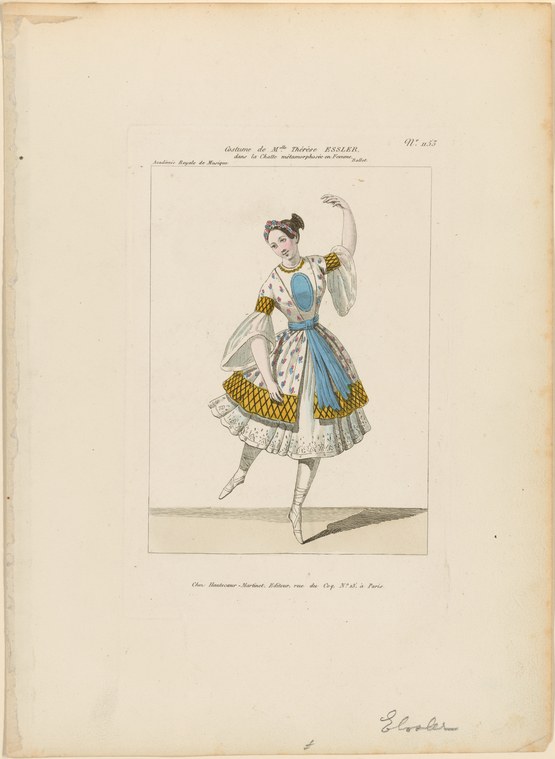
Costume de Melle Thérèse Essler [sic] dans La chatte metamorphosée en femme.: Ballet. Académie Royale de Musique
Unknown artist
- Collection:
- Prints depicting dance
- Source:
- New York Public Library
- Rights:
- Public domain — free to use, share and adapt.
- Recorded as:
- Public Domain
This print is a rare documentary record of an actual early Romantic ballet dancer, named and placed in a specific work and institution. Few such detailed costume studies survive with attribution to the dancer rather than the choreographer; this image directly captures how a professional female dancer was trained, dressed, and presented to audiences in Paris during the height of ballet's cultural prestige. The precision of the hand-coloring and the care taken to render the garment's ornament and structure reveal how much technical knowledge of ballet costuming and body carriage was embedded in theatrical visual culture.
What you are looking at
A single female dancer is depicted in a three-quarter stance against a plain background, captured mid-movement in a moment of elegant repose. She wears an elaborate theatrical costume: a fitted white corseted bodice with a pale blue panel at center front, short puffed sleeves trimmed in gold brocade, and a tiered skirt of white linen or cotton with gold-patterned panels alternating with white gathered sections. The skirt reaches mid-calf, revealing white stockings and heeled shoes. Her dark hair is styled up in the fashion of the early 19th century. She holds a feathered fan or plume prop in her raised right hand, and her left arm hangs naturally at her side. Her weight is distributed lightly on one leg, the other appearing to lift slightly, suggesting the suspended quality of a pose from classical ballet technique. The figure casts a shadow on the ground beneath her, emphasizing the three-dimensional illusion. The rendering is meticulous: the gold detailing is hand-colored with precision, and the fabric textures are differentiated through fine line work.
The dancing
A single dancer shown in profile-to-three-quarter view, poised in a posture of elegant balance. Her torso is held upright and composed, the shoulders level and relaxed. The raised right arm, holding the decorative fan, extends gracefully above shoulder height; the left arm is positioned naturally downward. Her stance suggests a turned-out leg position characteristic of ballet, with the weight lifted and forward through the body, as though captured between steps or in a held pose. The overall frame is that of a trained theatrical dancer, with an emphasis on verticality and controlled, refined movement.
The dance depicted
This is a costume study for a named dancer, Thérèse Essler (note the spelling variance in the catalogue record), performing in the ballet *La chatte métamorphosée en femme* (The Cat Transformed into a Woman) at the Académie Royale de Musique in Paris. The work is almost certainly from the Romantic ballet era of the early 19th century, when such costume designs were circulated as prints. Thérèse Essler was a professional dancer of the period; her sister was the celebrated ballerina Fanny Essler. The pose and costume—the short skirt, the heeled slippers, the turned-out carriage—are consistent with the classical ballet vocabulary of that era. The feathered prop is characteristic of early 19th-century ballet iconography.
How it was made
This is a hand-colored engraving or aquatint, identifiable by the fine parallel line work establishing form and shadow, combined with watercolor or gouache applied selectively to heighten the costume details. The gold brocade passages on the sleeves and skirt have been rendered in metallic paint or gold leaf, adding textural richness. This technique—reproductive printmaking with applied color—was the standard method for circulating costume designs and theater imagery in the early 19th century. Such prints served both as theatrical documentation and as fashionable prints for the domestic market, distributed to audiences, dancers, and patrons of the opera.
About this work
This is a costume design or study for Thérèse Essler in a specific ballet role, rendered as a hand-colored engraving intended for circulation among Paris's opera-going public. The work documents both the appearance of an early Romantic ballet and the precise aesthetic ideals of the period: the lightness, verticality, and refined ornamentation that defined theatrical dancing for the elite audience of the Académie Royale de Musique. It belongs in a dance archive as evidence of early 19th-century ballet practice, training, and spectacle—a record not just of what was worn, but of what the body was asked to do and how that body was valued and represented. The inscription identifying the dancer and theater grounds the work in a specific historical moment and venue.
How to look at it
Observe the tension between stillness and movement: the pose is held and composed, yet the weight distribution and the lift of the leg suggest potential motion—this is the suspended instant characteristic of Romantic ballet technique. Note the precision of the costume: every seam, pleat, and ornament is rendered; the hierarchy of materials (silk, linen, metallic trim) is made visible through line and color. The feathered fan and the raised arm create a rhythmic uplift that echoes the dancer's own vertical carriage. The artist has chosen a moment of poise rather than vigorous action, reflecting the Romantic period's aesthetic preference for ethereal, weightless femininity.
The artist
The artist is not recorded in the catalogue. The work is likely a professional theatrical print by a Parisian engraver working for the publishing house associated with the Opéra, or a freelance theater chronicler. Such prints were often unsigned or attributed only to the printer, and the focus was on accurate representation of costume and character rather than artistic invention. The hand-coloring may have been done by a separate specialist, a common division of labor in theatrical print production of the period.
The period
This work dates to the early Romantic era of ballet, roughly 1830–1845, when the art form had become the dominant theatrical spectacle in Paris. Ballets with fantastical or mythological themes—such as a cat transformed into a woman—were characteristic of the period. The Académie Royale de Musique (the Paris Opéra) was the center of European ballet innovation, and dancers like the Essler sisters were international celebrities. The fashion for detailed costume prints reflected both the popularity of ballet and the emergence of a mass market for theatrical imagery. Female dancers, increasingly, were the primary attraction, and their bodies and costumes were rendered with a particularity that elevated them to objects of aesthetic study and desire.
Where it lives
The print is held in the New York Public Library's collection of prints depicting dance. Such theatrical costume prints were originally distributed through Parisian publishers and booksellers, and many were collected by theater enthusiasts and dance aficionados; this example's presence in an American archive suggests it was acquired either as part of a 19th-century collection of European theatrical material or through a later scholarly acquisition focused on dance history.
Dance in this work
Questions about this work
Who was Thérèse Essler?
Thérèse Essler was a professional ballet dancer performing in Paris in the 1830s–1840s. She was the sister of the more celebrated Fanny Essler, who was one of the great international ballet stars of the Romantic era. Thérèse performed at the Académie Royale de Musique (Paris Opéra) and appeared in ballet roles that required both technical skill and dramatic presence. This print is among the few surviving records of her as a named performer.
What was *La chatte métamorphosée en femme*?
This was a ballet performed at the Paris Opéra in the Romantic period. Its title translates as *The Cat Transformed into a Woman*. The plot and choreography are not well documented, but the title suggests a fantasy or mythological theme typical of early 19th-century ballet. The detailed costume—the ornate skirt, the fanciful trimming—hints at a character that was both human and animal, or perhaps magically transforming.
What does this print tell us about ballet training and bodies?
The dancer's posture—the turned-out legs, the lifted spine, the controlled arm placement—shows the physical vocabulary that was being taught and valued in professional ballet of this period. The costume itself was designed to display this training: the short skirt revealed the legs and feet, allowing the audience to see the technical work; the fitted bodice emphasized the upright carriage and the lightness of the upper body. The hand-colored finish and the care taken to render every detail of fabric and ornament show that both the costume and the body were understood as high art.
More dance artwork





