49 works in this view — arrow keys or swipe to move between them.
Dance in Art
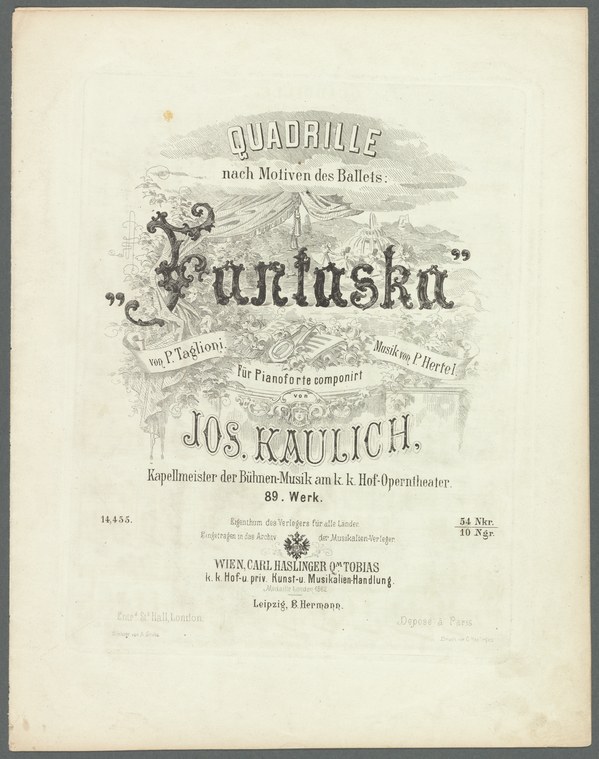
Quadrille nach Motiven des Ballets Fantaska: von P. Taglioni, Musik von P. Hertel
Unknown artist
- Collection:
- Prints depicting dance
- Source:
- New York Public Library
- Rights:
- Public domain — free to use, share and adapt.
- Recorded as:
- Public Domain
This object shows how 19th-century composers and publishers monetized and distributed dance music across different contexts—from the theater to the ballroom to the home—using the same melody and tune but different arrangements and formats. It is evidence of the commercial infrastructure and professional networks that sustained dance as both a theatrical and social practice. For historians, it reveals the names, dates, and circulation routes of dance music that is otherwise heard only as abstract composition, separated from the choreography it originally accompanied.
What you are looking at
This is a title page for a published piano score, not a depiction of dancers in performance. The design is ornamental and typographic rather than pictorial. At the top, the word "QUADRILLE" appears in large outlined letters above the subtitle "nach Motiven des Ballets" (based on motifs from the ballet). Below this, "Fantaska" is rendered in an elaborate decorative script, surrounded by a vignette of theatrical scenery—a stage set with classical architectural elements and drapery. The composition is framed within a rectangular border typical of 19th-century music publishing. Publication details appear at the foot: the composer P. Taglioni and arranger P. Hertel are credited, along with the publisher Carl Haslinger of Vienna and the Leipzig distributor B. Herrmann. Edition and work numbers (89. Werk, 14.353) are printed at the bottom left, with pricing in different currencies at the bottom right. The overall aesthetic is elegant and formal, designed to advertise the music to the middle-class home market.
The dancing
No human figures are depicted in this image. It is a typographic and ornamental design for a music cover rather than a scene showing dancers or choreography.
The dance depicted
The print advertises a quadrille—a social dance in four sections, typically performed by four couples arranged in a square—composed by P. Taglioni and arranged for solo pianoforte by P. Hertel. The quadrille was a staple of 19th-century ballrooms and social gatherings. This particular composition is described as "nach Motiven des Ballets Fantaska," indicating it was derived from themes or music from a theatrical ballet of the same name, likely by the same Taglioni. The reduction to piano score made such music accessible to amateur musicians for home performance and informal social dancing, rather than requiring the full orchestra of the theater.
How it was made
This is a lithographed title page for a published music score, a standard format for 19th-century sheet music distribution. Lithography allowed for fluid line work in the ornamental vignette and precise typography, making it both economical for mass production and visually appealing. The theatrical vignette—the stage set with drapery and architectural elements—was likely drawn directly on the lithographic stone by a commercial artist or printer's designer rather than being a reproduction of an actual scene. The format and presentation indicate this was a commercial publication aimed at middle-class musicians and dancers across Europe (note the multiple publishers and the distribution network across Vienna, Leipzig, London, and Paris).
About this work
This is a title page for a published piano score of a quadrille, a social ballroom dance that was one of the most popular choreographic forms of the 19th century. The composition draws on themes from a theatrical ballet called "Fantaska," suggesting a crossover between the concert stage and the ballroom that was common in the period: successful ballet music was adapted and published as quadrilles and other social dances for home and salon use. The lithographed design, with its theatrical vignette and formal typography, was a standard way of marketing music to an educated middle-class audience who both attended the theater and danced socially.
The work exemplifies an important but often overlooked category of dance-related visual culture: the commercial music publishing industry that connected theatrical choreography to social dancing. Quadrilles themselves appear rarely in visual art (dancers are more often shown waltzing or in narrative scenes), but these printed covers document the scale and reach of the dance trade and the economics of how choreographic innovation moved from the stage to the ballroom.
How to look at it
Observe the dual address of this cover: the theatrical vignette at the top (with stage, drapery, and architectural setting) signals the ballet origin, while the prominence of "QUADRILLE" and the pianoforte arrangement address the domestic consumer. The ornamental script and framing are conventions of mid-19th-century commercial design, meant to make the product appear elegant and worth the investment. The multiple publisher imprints and edition numbers reveal how music publishing worked as a distributed, international business. Look at the price points at the bottom: these tell you who could afford to buy such music—the middle class, not the aristocracy and not the poor.
The artist
The composers and arrangers are named: P. Taglioni (composer) and P. Hertel (arranger for pianoforte). Taglioni is likely a member of the prominent Taglioni ballet family, among the most celebrated dancers and choreographers of the Romantic era; multiple Taglioni family members composed and choreographed. The publishers—Carl Haslinger (Vienna) and B. Herrmann (Leipzig)—were established commercial music houses. The work was distributed across Vienna, Leipzig, London, and Paris, indicating it was a successful commercial product with international reach.
The period
The quadrille reached the height of its popularity in the 1840s–1870s and remained a fixture of ballroom dancing well into the 20th century. It was the dominant social dance of the Victorian and Edwardian era, replacing the cotillion in formal rank. Simultaneously, the Romantic ballet (1830s–1870s) was at its peak, with works like "Giselle" and "La Sylphide" creating an international appetite for ballet music. The adaptation of ballet themes into quadrilles was a common commercial strategy: successful theatrical choreography provided ready-made melodies that dance musicians could arrange for the ballroom or home. The printing and distribution infrastructure shown here—multiple publishers and distribution centers across major European cities—reflects the rapid commercialization of entertainment in the industrial 19th century.
Where it lives
This is a title page from a published sheet music score held in the New York Public Library's collection of prints depicting dance. Such objects are catalogued as ephemera—commercial products not originally thought to be collectible—but they are valuable historical documents of how dance was produced, distributed, and consumed.
Dance in this work
Questions about this work
Who was Taglioni?
Taglioni was the surname of a celebrated European ballet family of the 19th century. The most famous was Maria Taglioni (1804–1884), the Italian-Swedish prima ballerina who created the role of the sylph in "La Sylphide" (1832) and became the exemplar of Romantic ballet. Several family members were dancers and choreographers. The 'P. Taglioni' credited here as composer is likely Paolo Taglioni (1808–1884), Maria's brother, who was a choreographer and composer in his own right.
What is a quadrille?
A quadrille is a social dance for four couples (eight dancers) arranged in a square formation. It consists of five sections or 'figures,' each with its own music and choreography. Popular from the 1830s onward, the quadrille was the dance of choice for formal balls and was considered both accessible to amateurs and impressive when well executed. Composers created hundreds of quadrilles, often based on popular melodies or theatrical music.
What does 'nach Motiven des Ballets' mean?
It means 'based on motifs from the ballet.' This quadrille was arranged using music or themes taken from a theatrical ballet called 'Fantaska.' This was a standard commercial practice: successful ballet music would be extracted, simplified, and republished as quadrilles or other social dances for use in ballrooms and at home.
Why are there multiple publishers listed?
Carl Haslinger was the main publisher (Vienna), and B. Herrmann was the distributor for the Leipzig territory. This reflects how music publishing was organized: a composer or publisher in one major city would contract with distributors in other cities to handle local sales and distribution. The presence of London and Paris addresses suggests the work was available in those cities as well, indicating it was commercially successful across Europe.
More dance artwork





