49 works in this view — arrow keys or swipe to move between them.
Dance in Art
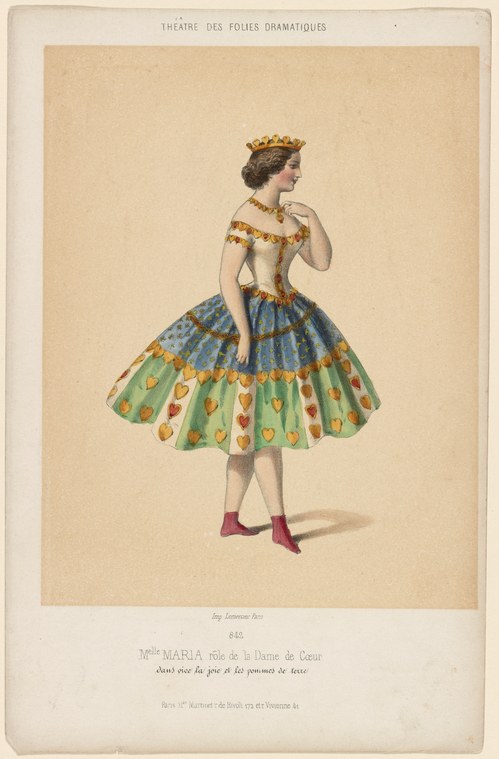
Théâtre des Folies Dramatiques. Melle Maria rôle de dame de coeur dans Vive la joie et les pommes de terre
Unknown artist
- Collection:
- Prints depicting dance
- Source:
- New York Public Library
- Rights:
- Public domain — free to use, share and adapt.
- Recorded as:
- Public Domain
This print preserves evidence of how costume, color, and visual spectacle functioned in nineteenth-century popular theater, a realm often dismissed as ephemeral but which shaped how dancers and audiences understood the relationship between dress and movement. The emphasis on the exaggerated skirt and the elaborate heart-patterned decoration shows how theatrical dance of this era relied on novelty, color, and visual wit rather than formal technique—a lineage that connects to later music-hall and vaudeville traditions.
What you are looking at
A young woman stands in a three-quarter pose against a pale cream background, her body angled to the right with her head turned to look over her shoulder toward the viewer. She wears a golden crown and a short, sleeveless tunic in cream or pale gold, decorated across the chest with a jeweled or embroidered band in gold and red. The tunic's skirt is the focal point: it billows outward in a wide, theatrical silhouette, constructed in tiers of pleated or gathered fabric in alternating shades of blue and green, with a dense pattern of red and orange heart shapes scattered across the green sections. Her feet, visible below the hem, are clad in burgundy heeled boots that anchor the composition. The figure is isolated on the neutral background with no setting or supporting cast, suggesting a costume study or theatrical portrait rather than a narrative scene. The style is a chromolithograph or hand-colored print, with careful attention to the jewel tones and the play of light on the layered skirt.
The dancing
A single standing figure, stationary rather than captured mid-movement. The dancer's weight appears evenly distributed, with the body held upright in a formal, presentational pose. Her arms rest at her sides, relaxed, with the left arm just slightly forward. The head is tilted slightly, a modest gesture of engagement toward the viewer. There is no suggestion of active dancing—the figure is posed for display, as if for a costume photograph or a theatrical portrait.
The dance depicted
This is a costume study for theatrical performance, most likely for a nineteenth-century operetta or music-hall production. The title references *Vive la joie et les pommes de terre* (*Long Live Joy and Potatoes*), a comical French piece, and identifies the wearer as Mlle. Maria in the role of the Queen of Hearts. The costume is fantastical and whimsical rather than historically grounded—the heart motifs play on the card-suit iconography of the Queen of Hearts, a character likely borrowed from French theatrical traditions rather than from Lewis Carroll (whose *Alice* was still relatively new in 1865). The wide, exaggerated skirt and the theatrical proportions suggest a dancer in a spectacle or revue rather than narrative ballet, designed for visibility and visual impact from the theater auditorium.
How it was made
This is a color lithograph or chromolithograph, a technique that allowed multiple colors to be printed in sequence from separate stones, enabling the vivid jewel tones and precise color separation visible here. The hand-coloring is skillful and restrained, with careful attention to the gradation of hues in the skirt's tiers. The technique was well-suited to theatrical costume documentation and publicity, allowing theaters and impresarios to circulate images of their productions and star performers to potential audiences and critics. This print would have been part of a series documenting the Théâtre des Folies Dramatiques' productions—a record of both the spectacle itself and the commercial machinery of Parisian theater.
About this work
This is a nineteenth-century French theatrical costume study, a chromolithograph documenting the dress of Mlle. Maria as the Queen of Hearts in a comic operetta or music-hall revue at the Théâtre des Folies Dramatiques in Paris. The print belongs to the tradition of theatrical portraiture and costume documentation that flourished in the mid-to-late 1800s, when prints of performers and their spectacular costumes were distributed as promotional material and collected as souvenirs. The work captures both the fantasy and the commercial spectacle of French popular theater, where dancers and singers wore increasingly elaborate and fantastical costumes designed for visual impact rather than historical or narrative verisimilitude. This is not a depiction of a specific moment of dancing, but rather a costume portrait—a document of theatrical dress and the aesthetics of mid-century Parisian entertainment.
How to look at it
Attend first to the costume's construction: the contrast between the fitted, classical tunic and the wildly exaggerated, multi-tiered skirt. This imbalance is deliberate—it emphasizes the lower body and creates visual comedy. The heart motifs scattered across the skirt are not random decoration; they are the costume's punchline, transforming the Queen of Hearts from a playing-card character into a figure of visual abundance and absurdity. The formal, stationary pose and the meeting of the eye across the space of the page is typical of theatrical portraiture of the era, where the performer addresses the viewer directly, as if acknowledging applause. The color of the boots—a burgundy that echoes the red of the hearts—suggests that even the smallest details were carefully coordinated for theatrical impact.
The period
The Théâtre des Folies Dramatiques was a major venue in Paris for operetta, comic theater, and spectacle during the Second Empire and early Third Republic. The mid-nineteenth century saw an explosion in costume design and theatrical innovation, driven by gas lighting, industrial printing techniques, and an expanding middle-class audience hungry for novelty and entertainment. Chromolithography made it possible to produce colorful, detailed costume studies quickly and cheaply, allowing theaters to market their productions and their stars. The fashion for increasingly elaborate and fantastical costumes in comic theater reflected both technological change and shifting attitudes toward the body on stage—the wide, exaggerated silhouettes seen here would have been nearly impossible to dance in by classical ballet standards, but in music-hall and comic operetta, the costume itself became part of the spectacle, sometimes even the joke.
Where it lives
This print comes from the New York Public Library's collection of theatrical prints and costume designs. It is part of a body of French theatrical documentation from the mid-nineteenth century, likely originally distributed by or sold through the theater itself as promotional material or souvenir.
Dance in this work
Questions about this work
What is the Théâtre des Folies Dramatiques?
A major Parisian theater of the nineteenth century known for operetta, comic theatrical spectacles, and popular entertainment. The theater was a center of innovation in costume design and visual spectacle, serving a broad middle-class audience. The venue was active from the 1850s through the early 1900s and featured some of the most celebrated performers and designers of the era.
Is this a real historical costume or a fantastical design?
It is fantastical, invented specifically for theatrical effect. The Queen of Hearts costume is designed for visual impact and comedy, not historical accuracy. The exaggerated proportions of the skirt and the densely patterned heart motifs are meant to be striking from the auditorium and to make the audience smile. The costume sacrifices practicality for spectacle.
What technique was used to make this print?
Chromolithography, which allowed printers to achieve bold, saturated colors by printing multiple colors from separate stones in sequence. This technique was well-suited to theatrical costume documentation and was widely used in the mid-to-late nineteenth century to create promotional and souvenir prints of stage productions and performers.
How do we know Mlle. Maria danced this role?
The inscription on the print itself reads 'Mlle. Maria rôle de la Dame de Coeur,' identifying her by name and role. This is a theatrical costume study, likely distributed as a souvenir or promotional material during the run of the production, and would have been recognized by contemporary Parisian audiences as a portrait of a specific performer in a specific role.
More dance artwork





