49 works in this view — arrow keys or swipe to move between them.
Dance in Art
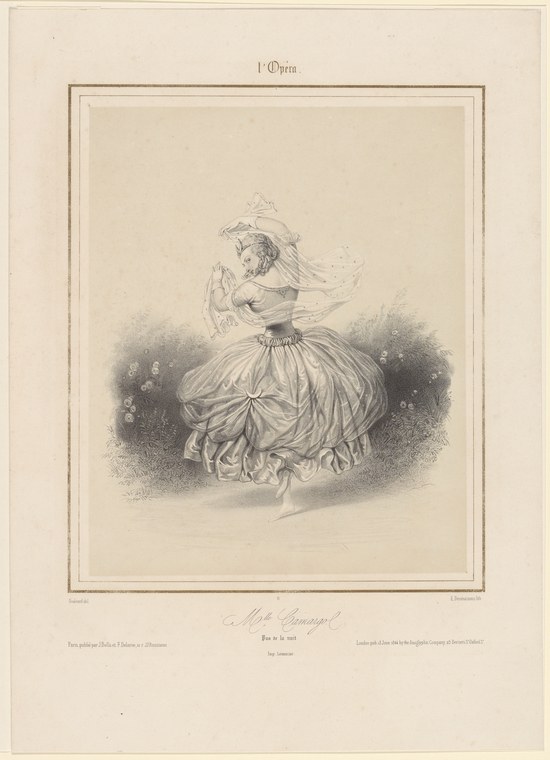
Mlle. Camargo. Pas de la nuit
Unknown artist
- Collection:
- Prints depicting dance
- Source:
- New York Public Library
- Rights:
- Public domain — free to use, share and adapt.
- Recorded as:
- Public Domain
Marie-Camargo was a defining figure of Romantic ballet, and this print is primary visual evidence of how that ballet was performed and presented to audiences in the mid-19th century. The image documents the costume, body line, and theatrical framing conventions that shaped Romantic ballet aesthetics. For historians and dancers, this is not merely a portrait but a technical and cultural record of how a celebrated solo was executed and understood by its contemporary audience.
What you are looking at
A solo female dancer stands in a graceful, suspended pose against a softly shaded background that suggests theatrical lighting. Her body is captured mid-movement, weight lifted and arms positioned in an open, expressive frame typical of Romantic-era ballet. She wears an elaborate ball gown with a voluminous skirt composed of deep, symmetrical pleats that radiate from the waist, creating the silhouette of a flower or bell—the skirt extends fully to the floor and dominates the composition. The bodice is fitted and adorned, and her hair is dressed with what appears to be a tiara or ornamental crown. The soft shading that surrounds her figure, darker at the edges and fading toward the center, creates an ethereal, spotlight effect. The inscription below identifies her as "Mlle. Camargo" and notes "Pas de la nuit" (night step or dance).
The dancing
The dancer's posture is balletically refined: her upper body leans slightly forward in a graceful inclination, arms are open and extended in a soft, welcoming frame suggesting a moment of suspended elevation or controlled descent. Her legs are not fully visible beneath the voluminous skirt, but her stance appears to be on or near the balls of the feet, typical of ballet technique. The single figure is isolated against the stage space, with no partners or ensemble visible—this is a solo performance moment. The overall line of the body is elongated and elegant, with particular attention paid to the curve of the arm and the tilt of the head, conveying both technical control and romantic sentiment.
The dance depicted
This is a Romantic ballet solo from the mid-19th century. Marie-Camargo was one of the most celebrated ballet dancers of her era, and the "Pas de la nuit" (night dance or step) would have been a featured solo in a theatrical ballet production. The image captures the aesthetic hallmarks of Romantic ballet: the emphasis on lightness and ethereality, the voluminous white or pale skirt (likely a tutu or gown), and the execution of a moment of apparent weightlessness. The specific title "Pas de la nuit" suggests this was a nocturnal or dramatic scene, possibly from a ballet narrative—this kind of solo typically appeared in the second act of Romantic ballets, often representing a magical or fantastical episode. The pose and carriage are consistent with the ballet vocabulary of the period, though footwork specifics cannot be determined from the image alone.
How it was made
This is a lithograph or engraving, executed in grayscale with careful attention to tonal gradation and the effects of theatrical lighting. The technique allows for the soft, atmospheric background that suggests stage lighting and theatrical space—the shading around the figure creates a halo or spotlight effect that would be difficult to achieve in other media. The fine detail in the costume and the delicate rendering of the dancer's pose suggest this was made for circulation as a theatrical souvenir or print for audiences and collectors. The inscription below in a formal script is typical of mid-19th-century performance prints. The quality and finish indicate this was a commercial, reproducible work of art rather than a unique drawing, suggesting wide distribution and audience appreciation for this particular dancer and performance.
About this work
This is a Romantic-era ballet portrait documenting a celebrated solo performance by Marie-Camargo in a work titled "Pas de la nuit." The image functions as both a record of a specific dancer's artistry and a document of mid-19th-century ballet aesthetics and stagecraft. Camargo was a major figure of the Romantic ballet movement, and this print preserves the visual memory of her performance practice—the costume, the pose, the theatrical presentation—at a moment when photography was still not the dominant medium for recording dance. The work belongs in a gallery of dance because it captures not just the static image of a dancer, but the theatrical and technical conventions of an entire era of dance-making.
How to look at it
Observe the moment the artist has chosen: not a violent or dramatic step, but a moment of apparent suspension and grace—the dancer caught in a pose that seems to hover between descent and elevation. Notice how the voluminous skirt is rendered with precise radiating pleats that create a geometric, almost sculptural form, emphasizing the silhouette and the line of the body. The soft shading around the figure is key—it is not merely a shadow but a theatrical effect that isolates the dancer from the background and suggests the focused light of the stage. The dancer's face and upper body are rendered with anatomical precision, while the lower body dissolves into the geometry of the skirt, a convention of the period that prioritized the romantic silhouette over anatomical completeness.
The period
This work dates to the height of the Romantic ballet era in France, roughly the 1840s–1850s, when ballet was dominated by the cult of the ballerina and the aesthetics of lightness, otherworldliness, and emotional expression. Marie-Camargo was one of the most technically accomplished and celebrated dancers of this period, known for her elevation, speed, and dramatic presence. Lithographic and engraved portraits of celebrated dancers were major commercial products in 19th-century France, distributed to audiences as souvenirs and to collectors as records of theatrical performance. The "Pas de la nuit" would have been a feature solo within a larger ballet narrative, typical of the era's dramatic and often supernatural storytelling. The image reflects the period's fascination with capturing and commodifying the evanescent art of dance performance through the permanent medium of the print.
Where it lives
This print is held in the New York Public Library's collection of prints depicting dance. It is a commercial theatrical souvenir from the mid-19th century, one of thousands produced to capitalize on the popularity of celebrated dancers and to preserve the memory of specific performances for audiences and collectors.
Dance in this work
Questions about this work
Who was Marie-Camargo and why is she important?
Marie-Camargo (1822–1910) was a French prima ballerina and one of the most celebrated dancers of the Romantic era. She was known for her technical virtuosity, particularly her elevation and speed, and she danced leading roles in major works of the period. She was a major figure in popularizing ballet and in defining the visual and technical aesthetic of Romantic ballet.
What does 'Pas de la nuit' mean and what kind of dance was it?
"Pas de la nuit" translates to "night step" or "night dance." In Romantic ballet, it was typically a solo performed in a nocturnal or magical scene, often representing a supernatural or dreamlike moment. These solos were feature showcases for a ballerina's technical and dramatic abilities, usually placed in the second act of a multi-act ballet.
Why is this print important as a dance document?
Before photography became standard in documenting dance (late 19th century), lithographs and engravings like this were the primary visual record of how celebrated dancers performed and how their costumes and poses appeared on stage. This image preserves technical and aesthetic information about Romantic ballet practice—the posture, the costume, the framing—that would otherwise be lost.
How does the artist convey the sense of 'lightness' that was key to Romantic ballet?
The artist uses the pose itself—the lifted carriage, the open arms, the tilted head—to suggest elevation and weightlessness. The soft, atmospheric shading around the figure creates a theatrical glow that isolates the dancer from earthly space, reinforcing the sense of floating or suspension. The rendering of the skirt as radiating pleats emphasizes the silhouette and makes the figure appear delicate and ethereal.
More dance artwork





