49 works in this view — arrow keys or swipe to move between them.
Dance in Art
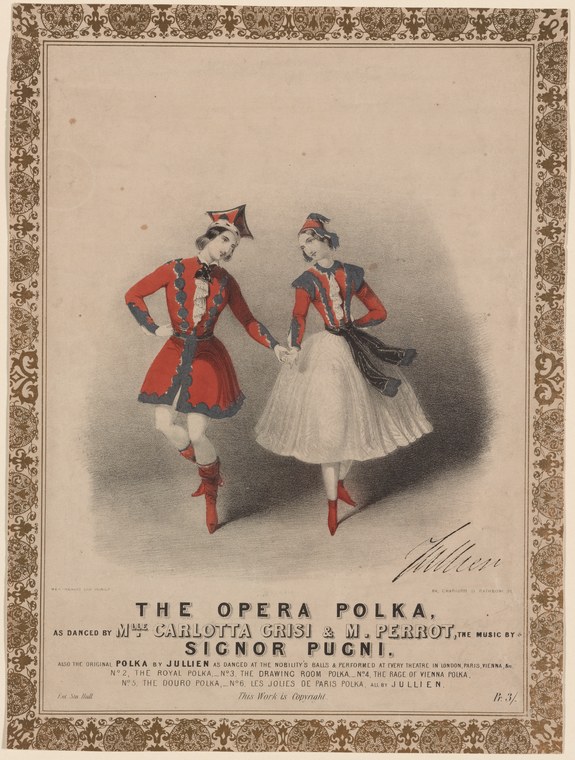
The opera polka, as danced by Mlle. Carlotta Grisi & M. Perrot, the music by Signor Pugni
Unknown artist
- Collection:
- Prints depicting dance
- Source:
- New York Public Library
- Rights:
- Public domain — free to use, share and adapt.
- Recorded as:
- Public Domain
Grisi and Perrot were stars of international caliber whose partnership defined the aesthetic of romantic ballet in the mid-nineteenth century. This print is primary evidence of how a celebrated choreographic work was costumed and presented to audiences, and it documents the visual identity of two of the era's dominant artists. The polka—a character dance of fashionable novelty—reveals the range of work these dancers performed beyond their tragic Romantic roles.
What you are looking at
Two dancers in romantic-era theatrical dress stand in a three-quarter pose against a neutral background with soft shadow modeling. The figure on the left wears a red military-style jacket with dark blue trim, a matching tall hat or plume, and red stockings—costume evoking both Hussar and theatrical uniform traditions. The figure on the right wears a white gathered skirt of calf length, a fitted red jacket matching the left figure's cut, and also a military-styled hat. Both dancers stand in an attitude of spirited engagement: the left figure poses with one hand on hip in a commanding stance, while the right figure appears lighter and more lyrical in bearing. The composition is intimate and frontal, as if presenting the figures for the viewer's inspection. The ornate decorative border framing the entire image—a delicate rococo-style pattern in sepia—suggests this is a published dance print, likely a lithograph or hand-colored engraving made for circulation among theater audiences and dance enthusiasts.
The dancing
Both dancers stand upright in a relatively static frontal presentation rather than captured mid-movement. The left figure's weight seems planted, with hip engaged and arm akimbo in a confident, even swaggering posture. The right figure shows a lighter, more delicate frame—the classic theatrical opposition of the male and female dancer in romantic ballet, even though the gender presentation is ambiguous. Neither figure displays the turned-out legs or pointed feet of pure classical ballet technique; the stance is more theatrical and narrative. The composition reads as a costume presentation as much as a movement study.
The dance depicted
The work is titled *The Opera Polka* and documents the choreography danced by the celebrated ballet artists Carlotta Grisi and Jules Perrot, with music composed by Cesare Pugni. This is a theatrical polka—a character dance of the nineteenth century, distinct from the social ballroom polka of the same era. The military costume worn by both dancers, the titled reference to 'opera,' and the pairing of Europe's leading romantic-era dancers all confirm this as a professional theatrical entertainment. The Polka was a fashionable novelty in the 1840s-1850s, often staged as divertissement within longer ballets or operas. Grisi and Perrot's partnership was one of the defining relationships of romantic ballet; this work documents one of the lighter, more playful pieces in their repertory, a contrast to their famous tragic roles.
How it was made
This is a hand-colored lithograph or chromolithograph, a medium that allowed rapid production and mass circulation. The sepia ornamental border and the refined rendering of fabric and silhouette suggest professional theatrical printing of the mid-nineteenth century, likely issued as a souvenir or advertisement for performance. The technique permitted both fine detail in the faces and costumes and a softness in the background shadow that emphasizes the figures. Such prints were standard merchandise in opera and ballet houses of Paris, London, and continental Europe, distributed to fans and collectors of dance.
About this work
This is a record of one of the most glamorous and influential partnerships in nineteenth-century dance: Carlotta Grisi and Jules Perrot in *The Opera Polka*, a work by the preeminent ballet composer Cesare Pugni. The image captures the dancers in their theatrical costumes—a playful military-romantic pairing that epitomizes the character dances that punctuated romantic-era ballets. Rather than presenting a single moment of virtuosity, the print documents the performers themselves and their onstage personas, functioning as both artistic record and theatrical merchandise. The work sits at the intersection of theatrical documentation, fan culture, and the print trade that made ballet dancers into celebrities of the nineteenth century.
How to look at it
View this image as a theatrical advertisement and souvenir rather than a movement study. The artists are presented in their costumes and personas, posed to be recognized and collected. The military jackets, the asymmetry of their presentation (one confident and planted, one delicate and yielding), and the overall decorative framing all work to make the dancers themselves into the subject. The polka itself—as a sprightly character dance—is evoked through costume and attitude rather than captured in action. Notice how the ornate border transforms the image from a simple figure study into a precious object, a commodity for fans.
The artist
The artist is unknown. The print carries a signature that reads 'Willson' or similar, but this may indicate the lithographer rather than the original painter or designer of the costume study. Such theatrical prints in the nineteenth century often attributed work to the lithographer or publisher rather than the costume or figure artist, making attribution difficult.
The period
This work dates to the mid-nineteenth century, when the romantic ballet was at its peak (approximately 1840s-1850s based on the dancers and composer involved). Carlotta Grisi was the creator of *Giselle* (1841) and a reigning prima ballerina; Jules Perrot was choreographer, dancer, and partner to the era's greatest dancers. Cesare Pugni was the principal ballet composer in Paris and Europe during this period. The theatrical polka was a commercial success and fashionable entertainment, capitalizing on the novelty of the social dance form while importing it into the ballet theater. Lithographic prints of dancers and opera singers were a thriving commerce; such images appeared in shop windows and were collected by theater devotees.
Where it lives
This work is held in the New York Public Library's collection of prints depicting dance. It is a theatrical dance print of the mid-nineteenth century, likely issued for public sale as a souvenir of a Paris, London, or other European premiere.
Dance in this work
Questions about this work
Who were Carlotta Grisi and Jules Perrot?
Carlotta Grisi (1819–1899) was an Italian prima ballerina and creator of the role of Giselle; she danced across Europe and was one of the most celebrated dancers of the romantic era. Jules Perrot (1810–1894) was a French dancer, choreographer, and partner; he was also one of the era's greatest male dancers and a prolific creator of ballets. Their professional partnership and the works they created together—both tragic and comic—were legendary.
What is a theatrical polka?
The polka was a social ballroom dance that became a fashionable novelty across Europe in the 1840s. Composers and choreographers quickly adapted it for the stage as a character dance—a lighter, often humorous divertissement within longer ballet or opera productions. A theatrical polka could appear in multiple acts and often showcased virtuosity, wit, and ensemble work rather than the intimate partner hold of the social dance.
Why is the male dancer wearing a dress?
What appears to be a dress is a military-inspired theatrical jacket and skirt, part of a romantic-era costume convention. Male dancers in character roles or theatrical divertissements wore skirts, breeches, and costume jackets as part of their role. The 'opera' in the title suggests this polka was part of a larger theatrical narrative, and both dancers' costumes reflect that staging.
What does the ornate border around the image mean?
The decorative border indicates this is a published lithographic print, likely issued for sale as a theatrical souvenir. Such borders were standard on mid-nineteenth-century dance and opera prints; they transformed the image into a precious, collectible object and signaled that this was a professional, high-quality production worthy of display and collection.
More dance artwork





