49 works in this view — arrow keys or swipe to move between them.
Dance in Art
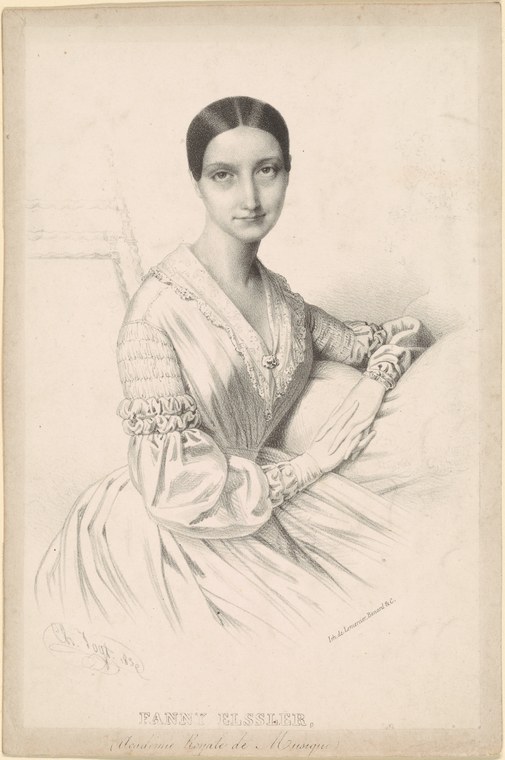
Fanny Elssler, Academie royale de musique
Unknown artist
- Collection:
- Prints depicting dance
- Source:
- New York Public Library
- Rights:
- Public domain — free to use, share and adapt.
- Recorded as:
- Public Domain
Fanny Elssler was one of the first international superstars of theatrical dance, and her likeness was circulated widely across Europe and America in the form of prints like this one. The image documents the visual identity of Romantic ballet at its peak—the costume, the physical type, the composed dignity expected of a leading dancer. For historians and dancers, this print is a primary record of how a canonical figure was actually dressed and presented to her public.
What you are looking at
A three-quarter-length portrait of a young woman in an elegant white gown, seated and turned slightly toward the viewer. She wears a fitted bodice with puffed sleeves gathered at the wrists, and a voluminous skirt that pools around her in soft folds. Her dark hair is parted in the center and pulled back smoothly. She holds what appears to be a small object—possibly a fan or handkerchief—in her right hand, resting on her lap. The background is plain and neutral, rendered with light stippling that suggests depth without distraction. The work is a finely detailed graphite drawing or engraving, executed with careful attention to the play of light across fabric and skin. The woman's gaze is direct and composed, her expression poised and dignified.
The dancing
A single seated figure, shown in a relaxed but formal pose. The upper body is upright and turned, the arm resting naturally on the lap. The posture and dress suggest no active dance movement; this is a portrait of a performer at rest, not in motion. The clothing is theatrical—the elaborate construction and scale of the skirt indicate stage costume rather than street wear. The arm and hand position convey neither a dance frame nor an active port de bras, but rather the formal stillness of a portrait sitting.
The dance depicted
This is a portrait of Fanny Elssler, the celebrated dancer of the Romantic era. The inscription identifies her as principal dancer (Première danseuse) of the Académie Royale de Musique—the Paris Opéra. The garment she wears appears consistent with Romantic-era ballet costume, and her status as a leading dancer of the 1830s–1840s places her at the height of Romantic ballet. The portrait does not depict her dancing, but rather documents her as a public figure and star performer. The costume and formal presentation suggest this is a souvenir image made to circulate her likeness among her admirers.
How it was made
This is a lithographic print or fine engraving, executed in black ink on paper, likely a reproduction of a drawing or painting. The technique shows sophisticated tonal modeling through fine parallel lines (hatching and cross-hatching), creating volume and shadow without heavy ink. The work's clarity and finish suggest it was created as a commercial print—relatively inexpensive to produce and distribute, made to be sold or collected by the opera-going public. The medium and presentation indicate this is one of many similar portraits of famous dancers published in the nineteenth century as collectible prints.
About this work
This is a celebrity portrait print of Fanny Elssler, made and circulated during the height of her fame as a leading ballerina of the Romantic era. The work documents both her status as an international star and the visual conventions of Romantic-era ballet costume—the white tulle skirt, fitted bodice, and refined carriage that defined the aesthetic of classical ballet on the theatrical stage. As a printed portrait, it represents the machinery of mid-nineteenth-century celebrity: the creation and distribution of the dancer's image to fans and the public. While not a dance scene, it is essential evidence of how Romantic-era dancers were seen, marketed, and remembered.
How to look at it
This is a formal portrait, not a dance image, but it contains crucial visual information about Romantic ballet costume and the ideal physical type of the era. Attend to the construction of the skirt: the fullness, the length (just below the knee), the fine muslin or tulle fabric that suggests lightness and ethereality. Note the arm and hand, relaxed but graceful—the posture that was considered refined and balletic off-stage. The direct gaze and composed expression reflect the public dignity expected of a leading performer. Compare this portrait with contemporary images of dancers in other theatrical traditions to see how distinctively ballet codified the appearance of its performers.
The artist
The artist is not recorded in the catalogue. The inscription at the bottom of the print suggests the work was created as a commercial lithograph or engraving, likely produced by a Parisian print house during the height of Elssler's career (1830s–1840s). Many such prints were made of famous opera and ballet performers and sold to the public as souvenirs and collectibles. The quality and finish suggest the work was produced by a skilled printmaker with access to professional studios at the Opéra or a major publishing house.
The period
The Romantic era (roughly 1830–1850) saw the rise of ballet as a major form of theatrical entertainment and celebrities as international figures. Fanny Elssler, an Austrian dancer, achieved unprecedented fame during this period, touring Europe and America and commanding enormous audiences. Her success generated a vast market for her image—prints, lithographs, engravings, and painted portraits that were sold and collected by the public. This portrait was made during or shortly after the peak of her career, when demand for images of the great Romantic ballerinas was at its highest. The garment shown here—the white romantic tutu, fitted bodice, and puffed sleeve—became the iconic costume of mid-nineteenth-century classical ballet.
Where it lives
The print is held in the New York Public Library's collection of prints depicting dance. The catalogue record identifies it as part of the holdings but does not record the artist, date, or printing technique. The inscribed text at the bottom confirms the subject and her official title at the Opéra.
Dance in this work
Questions about this work
Was Fanny Elssler famous?
Yes. Elssler was one of the first international celebrity dancers, achieving fame across Europe and America in the 1830s–1840s. She was a principal dancer at the Paris Opéra and performed leading roles in the canonical Romantic ballets. Her success made her one of the most celebrated performers of her era.
What does the costume tell us about Romantic ballet?
The white tulle skirt, fitted bodice, and puffed sleeves are the canonical costume of Romantic ballet. This silhouette was designed to emphasize the body's lightness and grace, to suggest ethereality and otherworldliness. The length (just below the knee) allowed visibility of the legs and footwork—essential for ballet. This costume became so iconic that it is still recognized as 'classical ballet' today.
Why was this portrait made and sold?
Prints of famous performers were commercial products, sold to admirers and the general public much like theater programs, fan magazines, or celebrity photographs today. They allowed people who could not see Elssler perform to own an image of her, and they promoted her fame and the Opéra's productions. Elssler's image was valuable intellectual property.
Is this a drawing or a print?
This is a print—most likely a lithograph or engraving—made from a drawing or painting. The technique shown here (fine parallel lines creating tone) is typical of nineteenth-century commercial printing. This allowed the image to be reproduced in multiple copies for sale, making it far more affordable and widely distributed than a unique oil painting would be.
More dance artwork





