49 works in this view — arrow keys or swipe to move between them.
Dance in Art
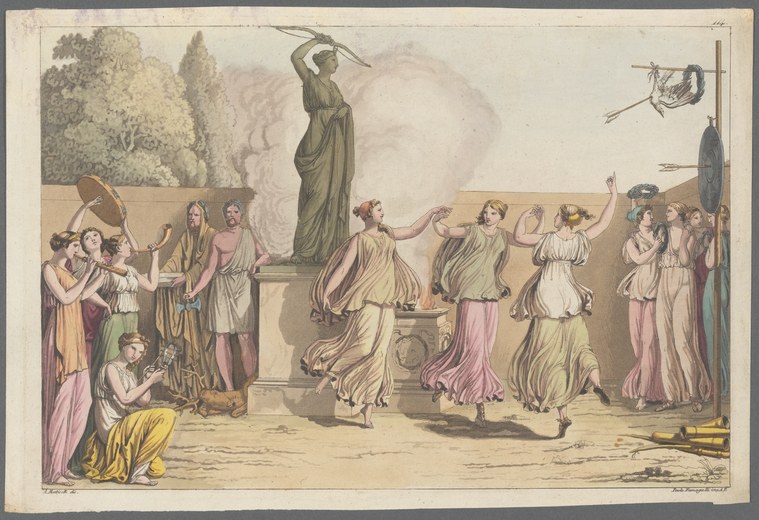
Ritual dance before a statue of the goddess Diana
Unknown artist
- Collection:
- Prints depicting dance
- Source:
- New York Public Library
- Rights:
- Public domain — free to use, share and adapt.
- Recorded as:
- Public Domain
For historians of dance in art, this print is valuable evidence of neoclassical ideology: the belief that ancient dances were expressions of refined taste and spiritual reverence, and that modern dancers (especially women) should aspire to their supposed simplicity and nobility. For scholars of theatrical design and operatic spectacle, it documents the visual language available to late 18th-century designers imagining classical scenes. The work shows how prints circulated ideas about movement, grace, and the female body long before photography.
What you are looking at
A group of women in classical drapery perform a ritual dance before a monumental statue of Diana. The goddess stands elevated on a pedestal, her right arm raised with a hunting bow, her left holding an arrow, dressed in flowing robes. The dancers move in loose formation across a paved ground, their bodies in varied attitudes of reverence and movement—some with arms raised or extended, others in profile or three-quarter view, suggesting a processional or circular motion around the shrine. The composition is deeply theatrical: trees frame the left side, architectural elements suggest a temple or sacred precinct, and the statue dominates the middle distance, bathed in pale light that emphasizes its sculptural form. The dancers wear high-waisted classical gowns in pale pinks and whites, some with flowing sleeves, their hair long and loose or loosely bound. The engraving technique allows fine detail in the folds of fabric and the play of light, creating a scene of solemn ceremony with an undercurrent of graceful movement. A ship's ornament or votive object hangs in the upper right, reinforcing the religious context.
The dancing
The dancers display open, expressive body positions suited to a processional or votive ritual rather than a closed-form partnered dance. Arms are frequently extended upward, outward, or held at shoulder height in gestures of supplication or offering. The weight shifts from figure to figure suggest movement in progress—some appear to be stepping forward or turning, others pausing in contemplation. No dancers touch or hold each other; the group moves as individuals within a shared sacred space, united by proximity and common purpose rather than by partnering. The varied heights and overlapping positions create spatial depth and suggest a crowd rather than an organized line.
The dance depicted
This is almost certainly a neoclassical or late 18th-century reconstruction of Greco-Roman religious ritual, not a living dance tradition. The work imagines how ancients might have danced in homage to Diana, the huntress goddess. The movement is interpretive rather than codified—the artist emphasizes decorum, grace, and the lifting of the body toward the divine object of worship. Women are the dancers; men do not appear. The dance serves a religious and social function, marking a moment of collective devotion. The print likely documents a theatrical or operatic vision of classical antiquity rather than an ethnographic observation.
How it was made
This is a hand-colored engraving or etching on paper, recognizable from the fine linear hatching that creates shadow and tone, the crisp outlines of the figures, and the delicate color wash applied by hand afterward. The medium was ideal for wide circulation among educated audiences—this is a print meant for collection, study, and display in parlors and libraries rather than a unique artwork. The technique allowed the artist to create clarity of form and narrative legibility while the subtle color heightens the theatrical and romantic mood. The print format suggests this was either a theater design, an illustration to a classical text, or a collector's print of a fashionable neoclassical subject.
About this work
This is a neoclassical engraving depicting an imagined ancient Greek or Roman ritual dance before a statue of Diana. The scene captures the late 18th-century Enlightenment fascination with classical antiquity and the belief that studying ancient aesthetics—including movement and gesture—could refine modern manners and taste. The print belongs in a gallery of dance imagery because it documents not a historical dance, but a visual fantasy about how dance functioned in classical religion and society: as an expression of collective piety, performed by gracefully moving bodies, in service of a sacred purpose. It reveals what neoclassical artists believed dance ought to be, and how they imagined its role in an idealized past.
How to look at it
Notice how the artist uses the raised statue as a focal point toward which all the dancers' gestures orient, even when their bodies move in other directions. The statue's stillness and elevation contrast with the dancers' fluid, varied poses, creating a visual hierarchy: the divine object is fixed, the human response is motion. Observe the hands especially—they are the primary vehicle of expression, reaching upward, opening outward, gesturing toward the shrine. The artist has frozen a moment that is supposed to feel ceremonial but not rigid: the women are respectful but animated, moving with grace rather than military precision. This reflects neoclassical taste: dignity without severity, emotion without passion, beauty as the highest form of reverence.
The artist
The artist is not recorded in the catalogue. The style and execution suggest a trained engraver working in the neoclassical idiom, likely German, Austrian, or Swiss, active in the late 18th century. The refinement of the line work and the evident knowledge of classical iconography (the attributes of Diana, the temple architecture) point to an academically trained printmaker, possibly one who illustrated classical literature or produced designs for theatrical use. The hand-coloring suggests either a print sold in a commercial edition or a bespoke commission for a patron interested in neoclassical taste.
The period
This work emerges from the late 18th-century neoclassical movement, a moment when educated Europe turned to Greco-Roman sources for aesthetic and moral guidance. In dance, this meant ballet was becoming increasingly theatrical and allegorical: the ballet d'action was developing, and choreographers like Jean-Georges Noverre were arguing that dance should tell stories and express emotion through noble, naturalistic movement derived from classical principles. In visual art, neoclassicism dominated elite taste from the 1750s onward; printmakers and painters competed to produce classical scenes that combined historical fantasy with contemporary ideals of beauty and virtue. Opera and spoken drama also drew heavily on classical subjects, and theatrical design prints like this one were major conduits of visual culture, widely collected and discussed.
Where it lives
The work is held in the New York Public Library's Prints collection, a major repository of European theatrical and artistic prints from the 18th and 19th centuries. It is catalogued as a print depicting dance, though with minimal identifying information. Its presence in NYPL suggests it was acquired as part of a broader collecting effort around dance imagery and neoclassical subject matter.
Dance in this work
Questions about this work
Is this a real ancient dance or a modern invention?
This is a neoclassical fantasy. It imagines how ancient Greeks and Romans might have danced in religious ritual, but there is no historical record of this specific dance. The artist drew on classical literary descriptions, vase paintings, and contemporary ideas about grace and decorum to create a plausible-looking scene. Many late 18th-century theatrical designs worked this way: they combined research, imagination, and present-day aesthetic values to visualize the past.
What is Diana's pose meant to communicate?
Diana stands as the eternal huntress: poised, armed, watchful. Her raised arm and bow suggest both readiness and protection. The dancers' ritual before her acknowledges her power and seeks her blessing. The statue is not human or moving; it is the fixed object of devotion. This visual relationship—living bodies honoring a perfect, unchanging image—was a favorite neoclassical device.
Why are the dancers all women?
The choice reflects both the literary tradition (priestesses of Diana in classical texts) and neoclassical aesthetic ideology. Women's bodies were seen as naturally graceful and suited to expressive, reverent movement. Their long gowns and bare feet emphasized elegance and spiritual purity. This image participates in a long history of imagining women's bodies as vessels for beauty and virtue rather than as agents of their own will.
How was this print made and distributed?
It is an engraving—a technique in which an image is cut into a metal plate with a fine tool, then inked and printed. The hand-coloring was applied afterward, either by the printmaker's workshop or by hand-colorers who worked in series. Prints like this were sold individually to collectors, bound into albums, used as illustrations in books, and sometimes pasted into scrapbooks or used as interior decoration. They were a major form of visual communication about art, theater, and taste.
More dance artwork





