49 works in this view — arrow keys or swipe to move between them.
Dance in Art
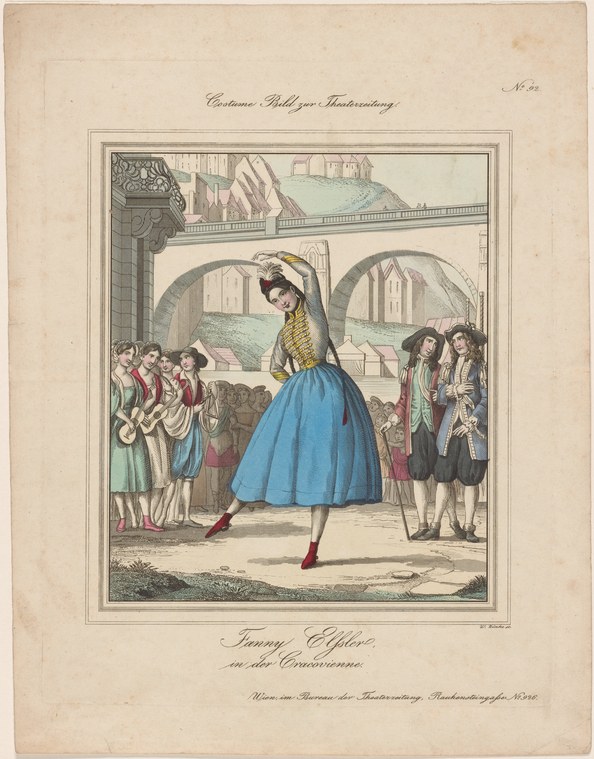
Fanny Elssler, in der Cracovienne
Unknown artist
- Collection:
- Prints depicting dance
- Source:
- New York Public Library
- Rights:
- Public domain — free to use, share and adapt.
- Recorded as:
- Public Domain
Fanny Elssler was one of the dominant figures of 1830s–40s ballet and a rival to Marie Taglioni in the public imagination; this image is evidence of how her fame was manufactured and distributed. The Cracovienne was one of her signature roles, and this portrait crystallizes a key moment in how national character dances were absorbed into the Romantic ballet vocabulary and presented as vehicles for virtuosity.
What you are looking at
A woman in a vibrant blue full skirt and yellow bodice stands in the center of an arched neoclassical colonnade, caught mid-pirouette with one leg extended and arms raised in a pose of balletic grace. She wears a white feathered bonnet and red heeled shoes. On either side of her, arranged in loose groups against the columns, stand figures in Regency dress—men in dark coats and women in pale muslin gowns—watching intently. The setting appears to be an Italian arcade or palace courtyard, with architectural detail sketched lightly in the background. The composition is framed by a printed border and captioned below in German script identifying the subject as "Fanny Elssler in der Cracovienne." The hand-coloring is clean and restrained, with particular attention to the brilliant blue of the dancer's skirt, which dominates the composition.
The dancing
Elssler's body is lifted and elongated, with a lifted turnout and extended leg characteristic of early Romantic ballet technique. Her arms are raised in a soft, rounded frame. The stance suggests a moment of elevation or sustained balance rather than ground-level character dance—the body is vertical and weightless, not earthy. The grouped onlookers are static and observant, creating a clear distinction between performer and audience that marks this as a theatrical moment, not a social one.
The dance depicted
This is a portrait of Fanny Elssler performing the Cracovienne (also Krakowiak), a Polish folk-derived character dance that became a signature vehicle for Romantic-era ballerinas. The Cracovienne was typically performed as a solo or featured variation within a larger ballet, showcasing a dancer's technique and national character work. Elssler was famous for this role, and the print likely documents or commemorates a celebrated performance. The image presents it as a balletic spectacle—refined, elevated, theatrical—though the title gesture toward its folk origins.
How it was made
This is a hand-colored engraving or lithograph, evidenced by the fine linear work defining the architectural setting and the uniform tonal blocks of color applied afterward. The technique allows for sharp definition of the figures and setting while the hand-coloring provides immediacy and specificity—the brilliant blue is essential to identifying the dancer and her costume. This method of reproduction was standard for theatrical celebrity portraiture in the 1830s–40s, allowing wide circulation of images of famous performers to their admiring public.
About this work
This is a theatrical celebrity portrait documenting Fanny Elssler, one of the most celebrated ballerinas of the Romantic era, in a dance that epitomized her fame: the Cracovienne. The print combines the language of Romantic ballet—lifted body, ethereal frame, theatrical setting—with the documentary purpose of a performer's portrait, naming her explicitly and capturing a moment of her artistry. Such prints were essential to the star system of nineteenth-century dance, circulating the image of the virtuoso to audiences who might never see her perform live. The work sits at the intersection of theatrical record and commercial celebrity merchandise, part of a vast trade in images of famous dancers that shaped how audiences understood and remembered performance.
How to look at it
Notice the moment the artist chose: the dancer lifted and turning, not on the ground, not in repose. This freezes the impression of weightlessness and control that was the goal of Romantic ballet technique. The onlookers are statues—their immobility makes the dancer's movement read more sharply. The brilliant blue skirt is not incidental; color was a tool of theatrical spectacle and celebrity, and the hand-coloring emphasizes what a live viewer would have seen in the theater. Look at the shoes: they are heeled, not pointed—a reminder that this is still a performance of the 1830s–40s, before the pointe shoe became standard.
The period
This print dates to the height of the Romantic ballet era, when the ethereal, pointe-dancing ballerina became the central figure of ballet spectacle. Fanny Elssler (1810–1884) was a contemporary of Marie Taglioni but represented a contrasting style—more earthy, playful, and technically showy, with a gift for character dancing. The Cracovienne and similar national dances (the cachucha, the tarantelle) became fashionable vehicles for Romantic ballerinas to display both technical command and a kind of ethnographic exoticism. The architecture depicted—neoclassical, ordered, Italian—situates the dance in the realm of high art, not folk practice. Such prints were produced in large numbers and sold to the middle-class audiences who followed ballet through the press and through such images as much as through live performance.
Where it lives
The work is held in the New York Public Library's collection of prints depicting dance. The German inscription and the style of hand-colored reproduction suggest German or Central European origin or distribution, though the English and French names used for Elssler indicate it circulated widely across language borders.
Dance in this work
Questions about this work
Who was Fanny Elssler?
Fanny Elssler (1810–1884) was an Austrian ballet dancer and one of the most celebrated performers of the Romantic era. She was a virtuoso technician and a gifted actress, known for her gift for character dancing and her earthy, spirited performance style. She was frequently compared—and often contrasted—with her contemporary Marie Taglioni, and she achieved enormous fame across Europe and in the United States.
What is the Cracovienne?
The Cracovienne (or Krakowiak) is a Polish folk dance that became fashionable in Romantic ballet as a character dance and virtuosic solo vehicle. It typically featured footwork derived from folk practice but performed within the balletic frame—on a lifted body, with turned-out legs, and within a theatrical setting. Elssler's performance of it became so famous that it was one of her signature roles.
Why were prints like this made?
Theatrical prints served multiple purposes: they documented celebrated performances, they functioned as souvenirs for fans, they advertised upcoming performances, and they fed the public appetite for images of famous performers. The print trade was enormous in the nineteenth century, and images of stars like Elssler were among the best-selling subjects. Fans collected them, pasted them into albums, and used them to follow the careers and appearances of their favorite dancers.
How can you tell this is Romantic ballet and not folk dance?
The lifted, vertical carriage of Elssler's body; her turnout and extended leg; the balletic frame of her arms; the theatrical setting and costume; the distinction between performer and audience—all of these mark this as theatrical ballet, not social or folk dance. The folk dance has been translated into the language of Romantic ballet spectacle, which was the whole point: to showcase Elssler's artistry within a balletic frame.
More dance artwork





