49 works in this view — arrow keys or swipe to move between them.
Dance in Art · 2015
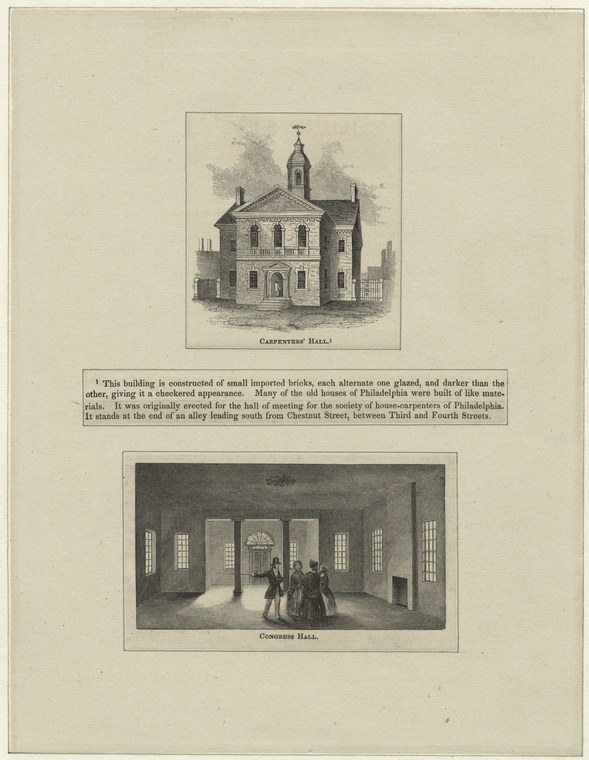
Carpenter's Hall ; Congress Hall.
Unknown artist
- Medium:
- Source:
- New York Public Library
- Rights:
- Public domain — free to use, share and adapt.
- Recorded as:
- public_domain
These buildings are foundational to American political history and would have been sites of formal social dancing and ceremonial gatherings in the late 18th and early 19th centuries. The images document the physical spaces in which elite social dance, benefit balls, and public celebrations occurred during the early republic, even though they do not show dance itself.
What you are looking at
Two architectural engravings stacked vertically on a single sheet, each depicting an important civic building in Philadelphia's early history. The upper image shows Carpenters' Hall, a two-story brick structure with a pitched roof and cupola, rendered in fine detail with atmospheric shading behind it; the building stands isolated against a plain background, emphasizing its architectural prominence. The lower image depicts Congress Hall's interior—a large rectangular assembly room with high windows admitting bright light, a coffered ceiling, and a semi-circular window or fanlight above a doorway at the far end; three small human figures in period dress stand in the floor space, their scale emphasizing the room's grandeur and public function.
The dancing
The figures in the Congress Hall interior are rendered at a very small scale relative to the architecture—they appear to be standing casually in ordinary posture rather than in any dance formation or movement. Their clothing suggests late 18th-century dress. No dance is depicted; the figures serve primarily as spatial reference points to convey the room's scale and function as a public assembly space. There is no evidence of choreography, partnering, or organized movement.
The dance depicted
This work does not depict dance. The figures in Congress Hall are shown as static inhabitants of the space, not as participants in any dance or choreographed movement. The inclusion of figures appears to be an architectural convention of the period, intended to show human scale and the social function of these public buildings rather than to document any actual performance or social dance.
How it was made
The work is a wood or copper engraving, likely from the 19th century, employing fine parallel lines and careful cross-hatching to create tonal depth and architectural detail. The technique allowed precise rendering of architectural features and was the standard method for reproducing building documentation in printed form. The two scenes are framed separately on a single sheet, suggesting this is part of a larger illustrated historical or architectural publication about Philadelphia's civic structures.
About this work
These are paired architectural engravings documenting two significant buildings in early American Philadelphia: Carpenters' Hall, built 1770–1773, and Congress Hall, completed 1787. Both buildings played crucial roles in the American Revolution and the founding of the republic—Carpenters' Hall housed the First Continental Congress in 1774, while Congress Hall served as the seat of the U.S. Congress from 1790 to 1800. The images are not primarily about dance but rather about the architectural legacy of American democracy, yet they belong in a dance archive because the buildings themselves were venues for public assembly, civic ceremony, and social gathering where dance would have taken place.
How to look at it
Examine the architectural detail in the upper image—the precise rendering of brickwork, fenestration, and the cupola—to understand the engraver's technical skill and the importance placed on accurate documentation. In the lower image, note how the three small figures provide a human measure for the room's scale while remaining subordinate to the architectural space itself; this compositional choice reflects how the Enlightenment-era public building was conceived as a stage for civic function rather than for individual display.
The artist
The artist is unrecorded in the catalogue. The style and technique are consistent with commercial architectural engravings produced in 19th-century America for historical and civic publications, often unsigned or credited only to the publisher. Such works were typically created by professional engravers working from drawings or surveys of the buildings.
The period
The engraving was created well after the buildings themselves (1770s–1790s), likely in the early to mid-19th century as part of a surge of antiquarian and patriotic interest in American Revolutionary sites. By the time these prints were made, both buildings had already acquired historical significance and were subjects of local pride and documentation. The period saw increased publication of illustrated histories and architectural records of early American cities.
Where it lives
The work is held by the New York Public Library and was digitized as part of their collection access program. It is catalogued as a print, likely part of a larger publication or portfolio on Philadelphia's historic buildings, though the specific source publication is not noted in the available record.
Questions about this work
Why is this in a dance archive if there's no dancing?
These buildings were important venues for social and ceremonial dance in early America. Congress Hall and Carpenters' Hall hosted formal balls, celebrations, and public gatherings where dancing took place. Understanding the architecture and social function of these spaces helps contextualize where and how dance was performed in the early republic.
What were Carpenters' Hall and Congress Hall used for?
Carpenters' Hall, built by the Carpenters' Company of Philadelphia, first served as a meeting place for that guild but became famous as the site of the First Continental Congress in 1774. Congress Hall was purpose-built as the seat of the U.S. Congress and housed the federal government from 1790 to 1800. Both buildings hosted formal receptions and civic celebrations.
How can I tell this is an engraving and not a drawing or painting?
The parallel lines and careful hatching visible throughout, especially in the shaded areas and architectural details, are characteristic of line engraving. The precision, the consistency of line weight, and the way tone is built through systematic cross-hatching rather than brushwork all confirm this is an engraved print rather than a drawing or painting.
More dance artwork