49 works in this view — arrow keys or swipe to move between them.
Dance in Art
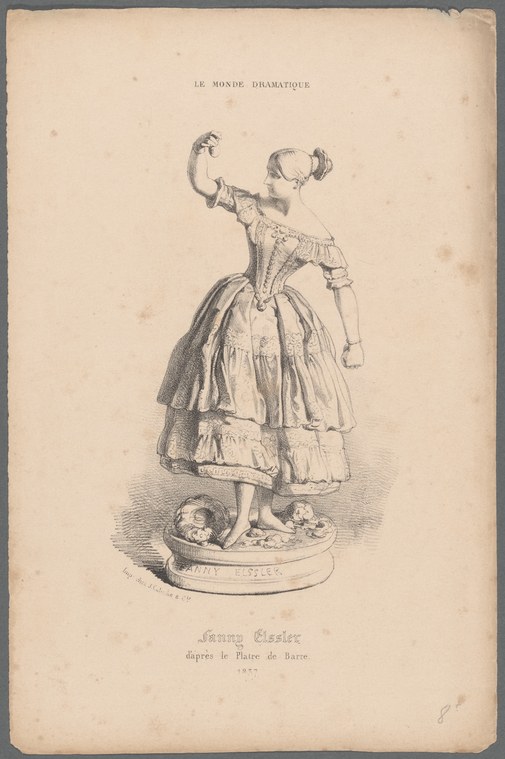
Fanny Elssler dancing the cachucha
Unknown artist
- Collection:
- Prints depicting dance
- Source:
- New York Public Library
- Rights:
- Public domain — free to use, share and adapt.
- Recorded as:
- Public Domain
Fanny Elssler's cachucha was one of the most famous and influential dance performances of the Romantic era, and this print captures the exact pose and costume that made her celebrated across Europe and America. The image is primary evidence of how a major star of the 1840s was pictured and marketed, and of what theatrical dance looked like outside the narrowing aesthetic of classical ballet. For historians and dancers, this work documents a moment when a woman performer could be a virtuoso of character and personality, not merely a symbol of abstract beauty.
What you are looking at
A woman in mid-nineteenth-century dress stands alone on a pedestal or stage base, captured in a dynamic pose characteristic of theatrical performance. She wears a layered, full-skirted dress with what appears to be a fitted bodice and multiple ruffled tiers to the skirt, typical of 1840s fashion. Her arms are raised asymmetrically—the right arm bent and held higher, the left extended more to the side—in a pose of vivacity and flourish. Her head is tilted back, and her expression suggests joy or exertion. The engraving is rendered in fine lines with careful attention to the fall and volume of fabric; the skirt dominates the composition, billowing around her legs. At the base of the pedestal are small sculptural elements, possibly putti or ornamental details. The background is plain, focusing all attention on the figure and her movement.
The dancing
A single female dancer occupies the entire composition. Her weight appears to be supported on one leg, with the other possibly lifting or in mid-step, creating a sense of elevation and momentum. The raised asymmetrical arms—one high and inward, one extended sideways—suggest a vocabulary of arms distinct from classical ballet's closed positions. The tilt of her head and the overall carriage convey exuberance and a theatrical, outward projection toward an audience. The scale and isolation of the figure suggest this is a portrait of a specific dancer's celebrated moment rather than a scene of social dancing.
The dance depicted
This is identified in the title as Fanny Elssler dancing the cachucha. Elssler (1810–1884) was an Austrian dancer who became celebrated for her performances of Spanish and character dances, particularly the cachucha, a lively Hispanic-influenced social dance of the 1830s–40s. The cachucha is characterized by a brisk tempo, rhythmic footwork, and a playful, flirtatious character quite distinct from the ethereal romanticism of classical ballet. The pose shown here—with its exuberant arm positions, the energetic tilt of the head, and the emphasis on the mobility and swirl of the skirt—is consistent with the character and showmanship the cachucha demanded. Elssler's performance of this dance was a defining role in her career and helped establish her reputation as a dancer of dramatic range beyond the classical vocabulary.
How it was made
This is an engraving, a technique suitable for wide distribution and reproduction in the nineteenth century. The fine, careful linework creates definition in the fabric folds and the bodice while maintaining the overall silhouette. Engravings of this kind served multiple functions: as documentation of celebrated performances, as souvenirs for theatregoers, and as publicity for dancers. The medium allowed for precise rendering of costume detail and gesture, making it a favored choice for dance portraiture. The formal composition and attention to decorative elements suggest this was a fine-art print, likely sold independently or in collections of theatrical prints, rather than a crude advertisement.
About this work
This engraving documents Fanny Elssler performing the cachucha, a dance that became her signature vehicle and a landmark moment in the history of theatrical dance. The cachucha represented a departure from the weightless, ethereal ideals of Romantic ballet, offering instead a grounded, energetic, and character-driven performance that showcased Elssler's technical skill and dramatic personality. The print commemorates not just a dance step but a star and a turning point in what kinds of movement and theatricality European stages would celebrate. Elssler's success with this role helped establish the modern notion of the dancer as a multi-talented performer rather than an ethereal corps member, and it marked the beginning of the dancer's long association with Spanish and character dance that would persist in European ballet.
How to look at it
The viewer should attend to the asymmetry and energy of the arm positions, which are far removed from the closed, symmetrical positions of classical ballet. Note how the skirt is rendered to show motion and volume—the artist has chosen a moment of peak elevation or turn, not a static pose. The tilt of the head and the slight twist of the torso communicate personality and directness to the audience, a hallmark of character dance. The pose is frozen, but the lineweight and the composition suggest vigorous movement; this is a portrait of a dynamic moment, not a static beauty.
The artist
The artist is not recorded. The engraving's style and the theatrical subject suggest a Parisian or London workshop of the 1840s, where dance prints were a commercial staple. Such prints were often produced rapidly following a celebrated performance, sometimes with input from the dancer or theater management regarding costume accuracy and pose. The lack of attribution is typical for commercial theatrical prints of this period, where the subject—the dancer—was the draw, not the printmaker.
The period
This print was created during the height of the Romantic ballet era, a period when classical ballet was being defined and codified by figures like Marie Taglioni, yet when character dances and national dances retained significant appeal and prestige on the theatrical stage. The 1830s and 1840s saw a boom in the theatrical dance market in Europe, with rival dancers and rival national schools competing for audiences. Fanny Elssler, born in Vienna and trained in the Austrian tradition, represented an alternative to the Paris Opéra's dominance; her success with the cachucha and other Spanish and Hungarian dances asserted the legitimacy of non-classical movement vocabulary in high theatrical contexts. The period was also one of intense interest in folk and national character, and the cachucha's exotic (or exoticized) associations made it commercially and artistically desirable.
Where it lives
The print is held in the New York Public Library's collection of prints depicting dance. Such prints were typically sold singly or in bound series of theatrical portraits, making them accessible to a broad audience of theatergoers and dance enthusiasts. The NYPL's collection preserves them as a major primary source for the history of nineteenth-century dance.
Dance in this work
Questions about this work
Who was Fanny Elssler?
Fanny Elssler (1810–1884) was an Austrian dancer and one of the most celebrated stage performers of the Romantic era. She trained in Vienna and became famous across Europe and America for her performances of classical ballet and, especially, character dances such as the cachucha, the tarantella, and the cracovienne. She was known for her technical brilliance, dramatic personality, and ability to command an audience. She was often positioned as a rival to the French dancer Marie Taglioni, and she represented the Austrian and Hungarian tradition of dance in competition with the French.
What is the cachucha?
The cachucha is a lively, rhythmic couple or solo dance with Spanish associations, performed in 2/4 time with a brisk tempo. It features quick footwork, playful arm gestures, and a flirtatious, energetic character. It became fashionable in European ballrooms and theaters in the 1830s and 1840s. Elssler's theatrical version of the cachucha was a tour de force of virtuosity and personality, quite different from the social dance version, and her performance became one of the most famous dance roles of the nineteenth century.
Why would a dancer perform a Spanish dance in a European theater?
The nineteenth century saw intense European interest in folk culture, national character, and the exotic. Spanish dance, like Hungarian, Italian, and Russian dances, was seen as colorful, authentic, and dramatically rich—a contrast to the ethereal, otherworldly ideals of classical ballet. Performers like Elssler capitalized on this interest, and character dances became a major part of theatrical repertoire. The cachucha in particular was fashionable and commercially successful, and it allowed dancers to display personality, technical skill, and dramatic range in ways that classical ballet did not always permit.
How is this different from classical ballet?
Classical ballet emphasized ethereal, weightless movement, closed arm positions, turned-out legs, and an ideal of impersonal beauty. The cachucha, by contrast, is grounded, energetic, rhythmically precise, and openly theatrical. The dancer's personality and virtuosity are on display; the goal is not to transcend the body but to celebrate what it can do. This print shows asymmetrical, open arm positions and a dynamic, engaged carriage that are far removed from the classical vocabulary. Character dances like the cachucha gave dancers—especially women—a way to be soloists, virtuosos, and personalities, not just ephemeral symbols.
More dance artwork





