49 works in this view — arrow keys or swipe to move between them.
Dance in Art
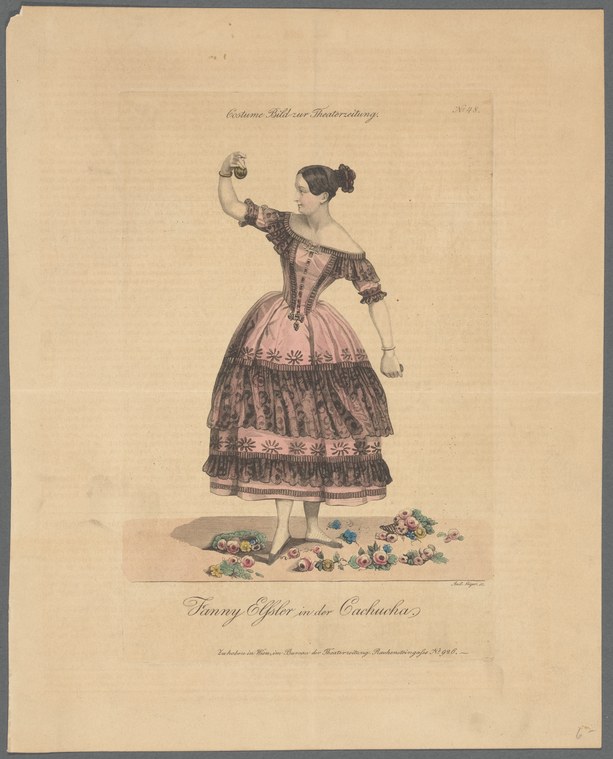
Fanny Elssler dancing the cachucha
Unknown artist
- Collection:
- Prints depicting dance
- Source:
- New York Public Library
- Rights:
- Public domain — free to use, share and adapt.
- Recorded as:
- Public Domain
Fanny Elssler's Cachucha was one of the defining roles of the Romantic era and a major event in dance history; her performances of this Spanish dance traveled to London, Paris, and America, making her a star whose fame rivaled that of Marie Taglioni. This engraving is visual proof of how that fame was packaged and circulated—as a souvenir, a record of costume, and an advertisement for future performances. For dance historians, it documents the aesthetic and technical identity of an influential 19th-century role and the commercial machinery of theatrical celebrity.
What you are looking at
A young woman in mid-19th-century dress stands alone against a pale ground, one arm raised to hold a pair of castanets aloft while the other rests at her side. She wears a corseted bodice in deep purple or black, lavishly trimmed, over a voluminous skirt of similar hue with horizontal bands of decorative embroidery or appliqué. The skirt is gathered in the fashionable silhouette of the 1840s, with defined tiers. At her feet, scattered across the ground, lie clusters of small flowers—roses, carnations, and other blooms—suggesting either offerings or the aftermath of a triumphant performance. The figure is rendered in hand-colored engraving, with subtle washes of pink in the skirt and delicate shading throughout. The woman's posture is poised and theatrical: her body turns slightly, her gaze directed toward the castanets, her weight appears balanced and controlled. The title below identifies her as Fanny Elssler performing the Cachucha.
The dancing
A single female figure dominates the composition. Her raised arm holds the castanets at shoulder height in a gesture of display and performance; the other arm hangs loosely, creating an asymmetrical but controlled silhouette. Her torso is upright and slightly twisted, showing the corsetry of the period. Her weight appears centered, and her legs are hidden beneath the voluminous skirt, making detailed footwork assessment impossible from the image alone. The pose suggests a moment of arrest within the dance—a held position between movements that allows the viewer to admire the line and the instrument.
The dance depicted
The Cachucha was a Spanish solo dance in triple meter, popular in European theaters during the 1830s and 1840s as an exotic, sensual display piece. Fanny Elssler (1810–1884), an Austrian dancer of the Romantic era, became famous across Europe and America for her interpretation of this role, which contrasted with the more ethereal, otherworldly persona of her rival Marie Taglioni. The dance was characterized by rapid footwork, sharp hip and torso articulation, and the prominent use of castanets. This image captures the theatrical presentation of the Cachucha as a vehicle for a virtuoso performer rather than the movement itself, emphasizing costume, bearing, and the romantic fascination with Spanish culture that pervaded 19th-century European art and entertainment.
How it was made
This is a hand-colored engraving, a reproductive print technique that allowed theatrical imagery to circulate widely and affordably among the theater-going public and collectors. The engraving is finely executed, with careful attention to the delicate pleating and embroidery of the costume; the hand-coloring—particularly the pink and purple tones of the skirt and the subtle flesh tones—was applied after printing, likely by workshop assistants. The technique was standard for dance documentation in the 1840s, allowing theaters and performers to distribute iconic images of celebrated roles and to preserve a record of costume and presentation for audiences who had or might attend performances.
About this work
This is a theatrical print from the 1840s documenting the Cachucha as performed by the celebrated dancer Fanny Elssler. The engraving captures not the dance in motion but a posed, canonical moment: the performer in full costume, holding the castanets in a gesture of proud display, surrounded by the floral tributes of admirers. It is a record of stardom and of the romantic fascination with Spanish exoticism that shaped early 19th-century European dance and visual culture. The work belongs in a gallery of dance imagery as evidence of how dancers were promoted, remembered, and celebrated in the pre-photographic era—as costume, bearing, and presence rather than as moving bodies.
How to look at it
Focus on the held moment: this is not a snapshot of the dance in progress but a posed, heraldic portrait of the performer as star. The raised arm with the castanets is the key gesture—it is a display of mastery and ownership of the role. Notice the voluminous skirt and its careful articulation through embroidery; in performance, this skirt would have created visual spectacle through rapid turns and swirling. The scattered flowers at her feet are a theatrical convention: they represent the admiration of the audience and the triumph of the performer. The engraving's clarity and finish suggest this was a prestigious commission, intended to be framed or pasted into albums—a keepsake of a celebrated evening.
The artist
The artist is not recorded on the print held at NYPL. The engraving is unsigned or the attribution has been lost. The style and execution are consistent with commercial theatrical portraiture of the 1840s, likely produced by a theater publishing house or professional engraving workshop in Paris, London, or Vienna, cities where Elssler's performances drew major crowds. Such prints were often unsigned, made by workshops rather than individual artists, and designed for rapid circulation rather than lasting artistic reputation.
The period
The 1830s and 1840s were the height of the Romantic ballet era, when European and American audiences were captivated by exotic, sensual, and dramatic dance on the theatrical stage. While classical ballet, exemplified by Taglioni's La Sylphide (1832), emphasized ethereal weightlessness and otherworldly grace, Elssler's style—showcased in vehicles like the Cachucha and La Voleur d'un baiser—emphasized earthiness, technical brilliance, and the seductive appeal of Spanish and Italian folk material. The period saw intense competition between performers and a thriving trade in theatrical prints, lithographs, and engravings that documented celebrated roles and circulated images of star performers to a public hungry for visual reminders of performances they had witnessed or wished to attend.
Where it lives
This print is held in the NYPL's collection of prints depicting dance and is catalogued as a hand-colored engraving. It is part of the Library's broader holdings of 19th-century theatrical imagery and represents the type of commercial dance ephemera that survives in institutional collections, valued as evidence of performance history and visual culture rather than as fine art.
Dance in this work
Questions about this work
Who was Fanny Elssler?
Fanny Elssler (1810–1884) was an Austrian dancer and one of the greatest stars of the Romantic ballet era. She was known for her technical brilliance, dramatic presence, and interpretation of exotic and sensual roles, particularly the Cachucha, a Spanish solo that became her signature piece. She performed to great acclaim across Europe and America, rivaling the ethereal style of Marie Taglioni.
What is the Cachucha?
The Cachucha is a Spanish solo dance in triple meter, traditionally danced with castanets. In the 1830s–1840s, it was adapted for the theatrical stage as a vehicle for virtuoso female dancers, combining rapid footwork, expressive torso and hip movement, and the percussive accent of the castanets. For Elssler, it became an iconic role that defined her style and reputation.
Why are there flowers at her feet?
The scattered flowers are a theatrical convention representing the admiration and applause of the audience. In the 19th century, admirers would throw flowers onto the stage after acclaimed performances—a gesture of praise that was then memorialized in prints and portraits of celebrated performers as a symbol of their success and popularity.
How is this print made?
This is a hand-colored engraving, a reproductive technique in which the image was first incised into a metal plate and printed, then colored by hand with watercolor or tinted washes. The technique allowed multiple copies to be made and distributed affordably, making theatrical imagery accessible to a wide audience and allowing performers to promote themselves through circulating prints.
More dance artwork





