49 works in this view — arrow keys or swipe to move between them.
Dance in Art
Nymph
Unknown artist
- Collection:
- Prints depicting dance
- Source:
- New York Public Library
- Rights:
- Public domain — free to use, share and adapt.
- Recorded as:
- Public Domain
This image documents the visual language through which Romantic ballet was circulated and consumed in the nineteenth century. For dancers and historians, it exemplifies how the ideal of the ethereal, weightless ballerina—the nymph or sylph—was constructed and disseminated through widely distributed prints, shaping both performance and public imagination. The etching's emphasis on the leap, the arched back, and the upward extension reveals what Victorian audiences saw as the essence of Romantic ballet beauty.
What you are looking at
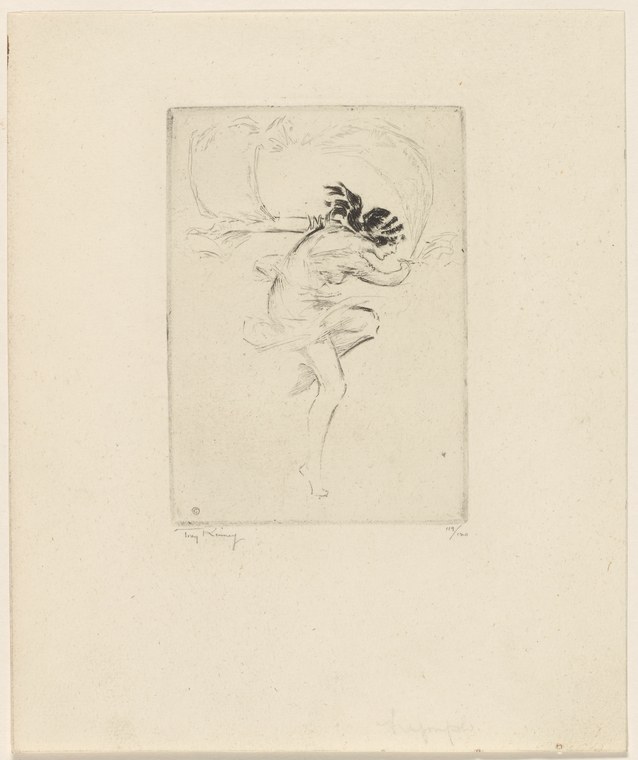
This etching depicts a single female figure in a moment of dynamic, weightless movement against a loosely sketched background of curved lines suggesting drapery or natural forms. The dancer is captured mid-leap or mid-turn, her body angled sharply forward with one leg extended behind and the other bent beneath her, her torso twisted with apparent momentum. Her arms are raised and bent, framing her head, which is tilted back. The figure wears what appears to be a short classical tunic or chiton, and her hair is bound or styled close to the head. The etching technique creates a sense of immediacy and spontaneity: the background is barely indicated through loose, gestural marks, leaving the figure to float in undefined space. The print has the quality of a study or sketch translated into line, with careful attention to the articulation of the limbs and torso but less concern with setting or narrative context.
The dancing
The dancer is solitary, her body articulated to suggest weightless flight rather than grounded movement. The extended back leg, flexed supporting leg, and upraised arms with hands near the head create the silhouette of a classical leap or suspension—possibly a jump with the body arched backward. The pose is balletic in its line and aspiration: the body forms an elongated curve from the extended leg through the arched torso. The head is thrown back, and there is a sense of abandon or ecstasy in the posture rather than controlled precision, suggesting Romantic rather than strictly Classical ballet vocabulary.
The dance depicted
This appears to represent a moment from Romantic ballet, likely depicting a nymph or sylph—mythological female spirits often portrayed in mid-nineteenth-century dance. The ethereal, weightless quality of the pose, the classical drapery, and the emphasis on upward extension and curved lines are consistent with the visual language of Romantic ballet as it was represented in prints and illustrations of the 1830s–1850s. The title 'Nymph' supports this reading. The pose itself—a high, arched leap with the body seemingly defying gravity—captures the ideal of the ballerina as a supernatural being rather than a human performer, which was central to Romantic aesthetics.
How it was made
This is an etching, a intaglio print technique in which an image is incised into a copper plate, inked, and printed. The delicate linework and the freedom of the background handling are characteristic of etching's expressive possibilities: the artist could work with a fine needle directly into the plate's surface, allowing for spontaneity and variation in line weight. The loose, sketchy treatment of the background—barely more than gestural marks—is typical of etching studies and suggests this may have been a working drawing or study rather than a finished, formal composition. Etchings were widely circulated in the nineteenth century and accessed by a broad educated public, making them an important medium for disseminating images of dance and theatrical life.
About this work
This etching is a study of a single dancer—a nymph or sylph—captured in a moment of Romantic-era ballet vocabulary. The figure is suspended in a high, arched leap that emphasizes weightlessness and otherworldly grace, central ideals of the Romantic ballet movement. The etching technique's delicate linework and sketchy background create a sense of immediacy, as if the artist were recording a fleeting moment of performance or an ideal vision of the dancing body. The work belongs to a substantial tradition of nineteenth-century prints documenting the stars and styles of theatrical dance, and it speaks to the profound influence of Romantic aesthetics on how dancers' bodies were represented in visual culture.
How to look at it
Look closely at the pose: the extended back leg, the arched torso, and the raised arms create a silhouette that suggests upward flight. This is the visual signature of the Romantic leap—a moment of suspension in which the dancer appears to defy gravity. Notice how the artist has minimized the background (mere gestural marks of drapery or landscape) to keep all attention on the body. The sketch-like quality of the etching gives the figure an air of immediacy and spontaneity, as though capturing a fleeting vision rather than a static monument. Consider what this emphasis on weightlessness and upward extension reveals about nineteenth-century ideals of female beauty and dance.
The period
This work dates to the Romantic era of ballet, approximately 1830–1860, when the ethereal female dancer—often portrayed as a supernatural being (sylph, nymph, spirit, or ghost)—dominated the European and American stage. Works like 'La Sylphide' (1832) and 'Giselle' (1841) established the aesthetic ideal. Prints and lithographs of named ballerinas and scenes from celebrated ballets were widely produced and sold; they served as souvenirs, advertisements, and records of performance. The etching technique allowed for fine detail and expressive linework, making it a preferred medium for artists documenting the grace and elevation prized in Romantic choreography.
Where it lives
This etching is held in the New York Public Library's prints collection focused on dance depictions. The collection preserves a significant record of how dance was documented, circulated, and consumed in visual culture from the Renaissance forward, with particular strength in nineteenth-century theatrical imagery.
Dance in this work
Questions about this work
Who was the artist and when was this etching made?
The artist is not recorded in the catalogue. The style and subject matter suggest a date in the Romantic era of ballet, likely 1830–1860, but this cannot be confirmed without further research or documentation.
Who is the dancer depicted?
The catalogue does not name a specific dancer. The title 'Nymph' indicates a type or character rather than an individual identity, and without additional inscription or documentation, we cannot identify the performer represented.
What is the difference between an etching and a lithograph?
An etching is an intaglio print (the image is incised into a metal plate), while a lithograph is a planographic print (the image sits on a flat stone or plate surface). Etchings allow for finer linework and more expressive variation in line weight, while lithographs could achieve broader tonal areas and were often cheaper to produce in large quantities.
Why is this pose called a 'leap' if the dancer appears suspended?
The pose captures a moment in the trajectory of a jump—the apex of a high leap or the illusion of sustained flight. In Romantic ballet, dancers trained to achieve maximum height and the appearance of effortless suspension, and artists often chose to depict this weightless moment rather than the takeoff or landing.
More dance artwork





