49 works in this view — arrow keys or swipe to move between them.
Dance in Art
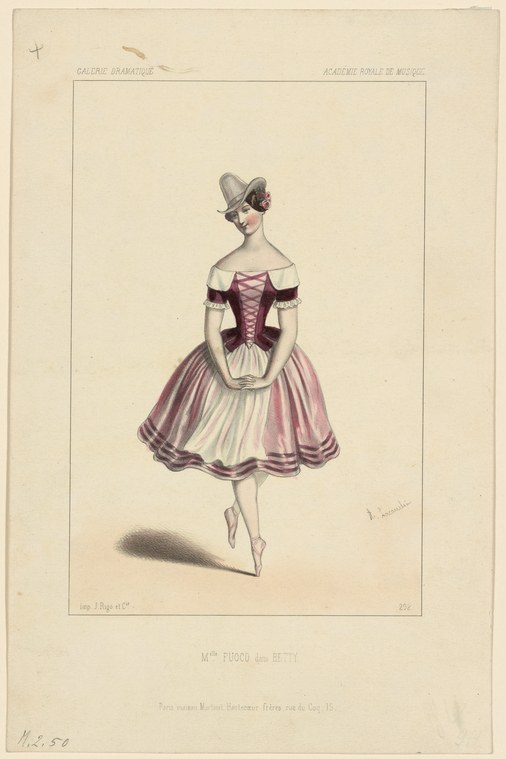
Melle. Fuoco dans Betty, Académie royale de musique
Unknown artist
- Collection:
- Prints depicting dance
- Source:
- New York Public Library
- Rights:
- Public domain — free to use, share and adapt.
- Recorded as:
- Public Domain
This is a primary-source document of Romantic ballet performance in its moment, naming a specific dancer (likely Giuseppina Fuoco, an Italian dancer active in Paris in the 1840s) and her role. The work shows what the Romantic tutu actually looked like in performance, how it was worn, and how a celebrated dancer held her body—evidence that historians of dance technique cannot find elsewhere.
What you are looking at
A single female dancer in a romantic tutu is posed in profile facing left, captured mid-movement in a studio or stage setting rendered in soft, warm tones. She wears a fitted purple bodice with off-shoulder sleeves and a voluminous skirt in pale pink with darker purple horizontal stripes or bands, the skirt caught in a swirl around her legs. Her hair is styled up with an ornate headpiece or tiara. She stands on her toes in a balletic pose, one leg supporting her weight while the other is engaged in the movement of the turn. Her posture is upright and graceful, with arms positioned to frame her body. The figure is rendered in delicate colored pencil or lithographic technique with fine shading, particularly visible in the shadow cast by her body on the ground and the volumetric modeling of the skirt.
The dancing
The dancer stands in a classical ballet stance, supported on the ball of one foot with her working leg engaged in what appears to be a pirouette or controlled turn. Her frame is vertical and elongated, her arms positioned lower than the contemporary ballet norm—one arm appears to curve gracefully across her body. The pose suggests a moment near the completion of a turning phrase, when the dancer recovers her center. The proportions are idealized and the anatomy simplified in the manner of 19th-century theatrical illustration.
The dance depicted
This is a romantic ballet, almost certainly from the 1840s Paris Opéra repertoire. The style of tutu—short, gored, and worn at the hip—the purple and pink color scheme, and the theatrical headpiece all point to romantic ballet of the Romantic era. The inscription references 'Melle. Fuoco dans Betty' (Miss Fuoco in Betty), which identifies this as a portrait of a specific dancer in a specific role. The pose demonstrates the technical vocabulary of pointe work and pirouette that defined Romantic ballet performance.
How it was made
This is a hand-colored lithograph or colored engraving, executed in a technique that allows for soft tonal transitions and delicate color work. The medium was standard for theatrical dance portraiture in the 1830s–1850s, allowing artists to capture the costume and pose of a celebrated dancer with enough precision and flattery for commercial circulation to audiences who attended the Opéra. The hand-coloring—applied over a printed base—gives the work a luminous quality appropriate to stage lighting.
About this work
This is a theatrical dance portrait documenting a specific performance by a named dancer in the early Romantic ballet period. It belongs to a substantial body of commercially produced lithographic prints that served both as souvenirs for opera-goers and as a form of celebrity publicity. The work is valuable as material evidence of how a particular dancer was marketed, how her costume was constructed and presented, and what the technical and aesthetic norms of Romantic ballet technique looked like in performance. The portrait-like inscription—naming both dancer and role—makes it a historical record of the work itself, since many ballets of this period survive now only in visual and literary documentation.
How to look at it
Look at the angle of the dancer's body and the position of her supporting foot—the artist has frozen a moment of rotation, not a static pose. Notice how the skirt swings and swirls around her, catching light and shadow to suggest movement even in stillness. The headpiece and costume are rendered with specificity that suggests they were copied from life or from a careful study. The soft ground shadow and the tonal modeling of the fabric are where the artist's skill shows—this is not a simple outline but a work of considerable technical control.
The period
This portrait was created during the dominance of Romantic ballet in Western European dance, a period of roughly 1830–1860 when the Opéra in Paris set the standard for all European ballet. The role of 'Betty' is not immediately identifiable in standard ballet histories, but the date and format suggest it belongs to the floruit of short-lived ballets created for specific dancers during this era. The commercial production of colored lithographs of celebrated dancers was a booming industry in Paris during the 1840s, feeding demand from an urban middle-class audience that attended the Opéra and collected prints of their favorite performers.
Where it lives
This is part of the New York Public Library's collection of prints depicting dance, a holding of theatrical and dance-related prints and engravings accumulated from 19th and early 20th-century sources. The print is catalogued without attribution to an artist, which was common for theatrical commercial prints of the period.
Dance in this work
Questions about this work
Who was Melle. Fuoco?
The inscription identifies her as 'Melle. Fuoco' (Miss Fuoco), likely the Italian dancer Giuseppina Fuoco, who was active in Paris during the 1830s–1840s and performed at the Opéra. Without additional research in French operatic records, we cannot be certain of the exact identity or career details, but the professional format of this print suggests she was a celebrated dancer of her time.
What is the ballet called Betty?
The ballet titled 'Betty' is not widely documented in surviving histories of Romantic ballet. This print may be one of the only visual records of this work. Many ballets from the Romantic era were performed only briefly or only for a particular dancer, and records of them survive only in prints, playbills, and reviews.
Why is she en pointe?
By the 1840s, pointe work was standard in ballet performance, though it was still relatively new technology. The dancer wears soft pointe shoes (now called soft ballet slippers), not the rigid pointe shoes of the 20th century. The pose demonstrates the technical achievement of Romantic ballet dancers, whose training in turning and sustained rising on the ball of the foot was central to the style.
What does the costume tell us?
The short tutu, fitted bodice, and bare shoulders are signature elements of Romantic ballet costume. The purple and pink color combination was chosen for its visual impact on the gas-lit stage of the Opéra. The headpiece suggests a character role—not a sylph or spirit, but a human character in a narrative ballet.
More dance artwork





