49 works in this view — arrow keys or swipe to move between them.
Dance in Art
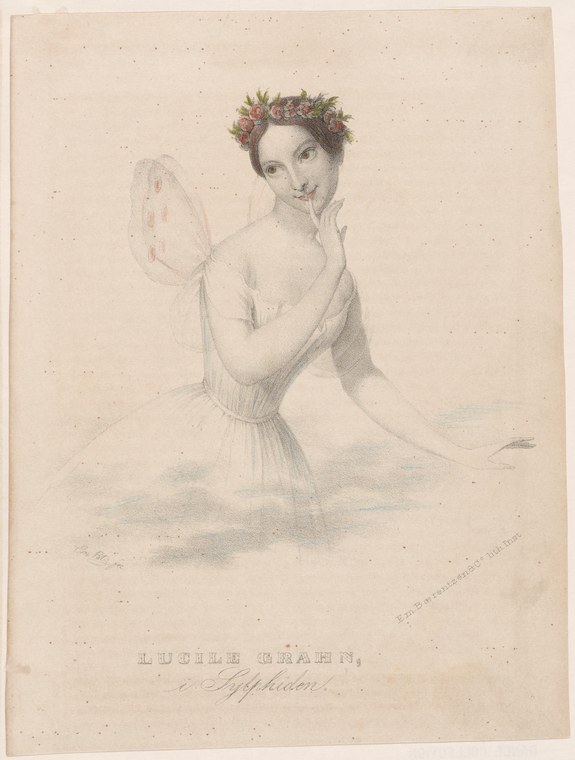
Lucile Grahn, i Sylphiden
Unknown artist
- Collection:
- Prints depicting dance
- Source:
- New York Public Library
- Rights:
- Public domain — free to use, share and adapt.
- Recorded as:
- Public Domain
Lucile Grahn was one of the four greatest ballerinas of the Romantic era, yet she is less well-remembered than her contemporaries. This print is rare visual evidence of her artistry and star status. For historians of ballet, it confirms that the Romantic sylph was performed across Scandinavia as well as continental Europe, and shows how the role was adapted and promoted in different theatrical contexts.
What you are looking at
A young woman in Romantic-era dress floats barefoot above a cloudy ground, her body angled in a graceful arabesque or attitude position. She wears a fitted bodice and long, filmy skirt in pale tones, and her dark hair is crowned with flowers and foliage. In her right hand, held at shoulder height, she carries a translucent butterfly or moth wing—a gossamer prop that catches the light. Her gaze is directed downward and to the side in a dreamy, inward expression. The background is soft and atmospheric, rendered in pale washes, with no solid ground or scenery to anchor her—she hovers weightless, ethereal, in the upper register of the composition.
The dancing
The dancer's body is held in a classic Romantic ballet port de bras: one arm extended with the prop, the other curved at the side, shoulders back and chest lifted. Her legs are fully extended in a balletic line, with the supporting leg straight and the working leg open behind or to the side—a position requiring turned-out hips and control from the torso. Her bare feet emphasize the delicacy of the limbs. The single figure commands the entire composition; there is no partner, no ensemble, only this solitary aerial presence.
The dance depicted
This is a portrait of the Romantic ballet *La Sylphide* (or *Sylphiden* in Scandinavian variants), the signature role of the sylph—a supernatural spirit of air and desire. The inscription confirms this is Lucile Grahn, the Danish-Norwegian ballerina who created and performed this role. The butterfly prop and hovering pose directly reference the sylph's otherworldly nature and the famous scene in which the heroine appears to the male protagonist as a vision. The bare feet, the flower crown, and the weightless suspension all underscore the Romantic ballet idiom in which human dancers portrayed sylphs, undines, and spirits rather than courtly nobles.
How it was made
This is a hand-colored engraving or lithograph on laid paper, likely a commercial theatrical print distributed after Grahn's performances. The technique—fine line work for the drapery and face, selective tinting in pale greens, pinks, and flesh tones—allowed rapid reproduction and wide circulation among theatre-goers and collectors. The delicate stippling and careful hatching suggest an engraver's hand rather than a lithographer's crayon. Such prints were standard publicity for celebrated dancers and were collected as souvenirs of famous performances.
About this work
This is a commemorative portrait of Lucile Grahn, a Romantic-era prima ballerina, in her celebrated role as the Sylph in *La Sylphide*. The work documents both the visual spectacle of Romantic ballet and the particular artistry of a dancer whose performances spanned Copenhagen, Paris, and London. Grahn was one of the four great sylphs of the 1840s—the others being Marie Taglioni, Fanny Cerrito, and Carlotta Grisi—and this image preserves her interpretation of the role in the form of a commercial theatrical print. The work belongs in a gallery of dance art because it is both a document of a legendary performance and a snapshot of how the Romantic ballet ideal—weightlessness, grace, and supernatural beauty—was visualized and marketed to the public.
How to look at it
Notice the artist's choice to render the dancer in isolation, floating rather than planted on the ground—a visual choice that emphasizes the supernatural status of the character. Observe the careful attention to the drapery: the tulle skirt is rendered with delicate parallel lines and shading that suggest transparency and movement. The flower crown and butterfly prop are not incidental; they signal the Sylph's connection to nature and the non-human world. The downward gaze and demure, inward expression were key to Romantic ballet aesthetics—the dancer's inner life and emotional depth, not technical display, were what mattered.
The artist
The catalogue record does not identify the engraver or lithographer. The print bears no visible signature. Based on the style, it is likely a professional theatrical print house or commercial publishing firm working in Copenhagen or another Scandinavian city in the 1840s, producing promotional portraits for the stage. Such prints were standard products of theatrical publishing and were sold in the foyer or by subscription among subscribers to the ballet season.
The period
This print dates from the height of Romantic ballet, roughly 1830s–1850s, when *La Sylphide* (choreographed by Filippo Taglioni in 1832) became the template for supernatural female characters in ballet. The 1840s saw an intense rivalry among the great ballerinas—Taglioni, Cerrito, Grahn, and Grisi—each claiming signature roles and drawing devoted followings. Grahn's interpretation of the Sylph in Copenhagen was celebrated as one of the era's finest interpretations of the role. The floating, weightless, ethereal body ideal of Romantic ballet is on full display here: the dancer as spirit rather than human, the flight rather than the ground.
Where it lives
The work is part of the New York Public Library's collection of prints depicting dance. It was likely acquired as part of the library's theatrical collections or print-collecting efforts in the 20th century. The object type is a commercial theatrical portrait print, distributed during or shortly after Grahn's performances in the 1840s.
Dance in this work
Questions about this work
Who was Lucile Grahn?
Lucile Grahn (1819–1907) was a Danish and Norwegian ballerina who rose to international fame in the 1840s. She was one of the era's four greatest dancers and a celebrated interpreter of the Sylph in *La Sylphide*. She performed in Copenhagen, Paris, London, and other European cities and was known for her grace, elevation, and dramatic presence. She later became a respected ballet teacher.
What is *La Sylphide*?
*La Sylphide*, choreographed by Filippo Taglioni in 1832, is one of the foundational works of Romantic ballet. It tells the story of a young man who falls in love with a sylph—a beautiful spirit of the air—and is destroyed when he tries to possess her. The ballet established the archetype of the Romantic heroine: weightless, ethereal, supernatural, dancing en pointe in a long diaphanous skirt.
Why is she shown floating and not on the ground?
The floating pose is a visual convention for representing supernatural or fairy characters in Romantic ballet. It emphasizes that the Sylph is a spirit, not a mortal woman, and evokes the illusion of flight that was created on stage through the use of wires and lighting effects. The artist chose to render her in this hovering, weightless state to capture the essence of the character.
What is the butterfly prop?
The butterfly or moth wing held in the dancer's hand is a characteristic prop of the Sylph role, signaling her connection to nature and the insect world. In some versions of the ballet, the Sylph is associated with natural spirits and creatures; the prop reinforces her otherworldly, non-human status and adds a whimsical, delicate visual note to the image.
More dance artwork





