49 works in this view — arrow keys or swipe to move between them.
Dance in Art
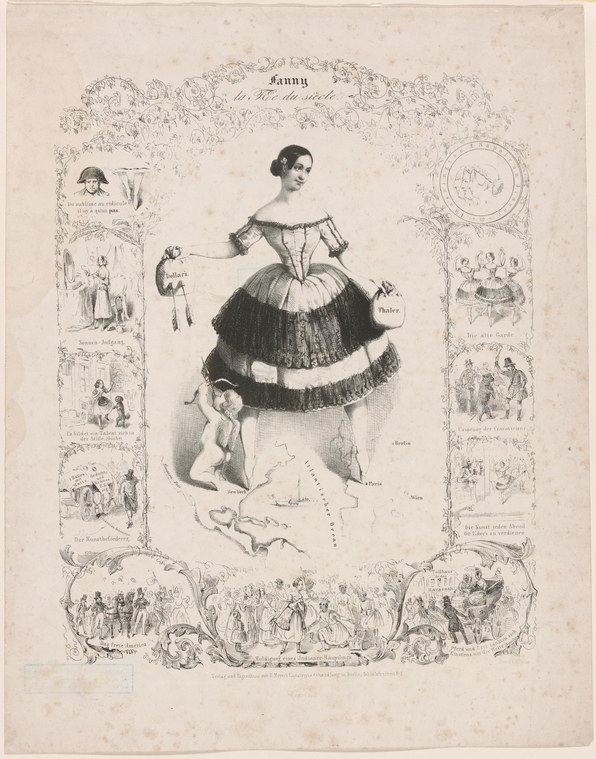
Fanny la F E'e du siècle
Unknown artist
- Collection:
- Prints depicting dance
- Source:
- New York Public Library
- Rights:
- Public domain — free to use, share and adapt.
- Recorded as:
- Public Domain
This work documents the intersection of Romantic ballet aesthetics (visible in the costume and pose) with popular theatrical celebrity and fashion culture in the mid-19th century. It reveals how stage performers became public figures whose bodies and dress were circulated, satirized, and consumed through mass-produced prints—a phenomenon that shaped the visibility and social status of dance and theater. The image shows how a single dancer's fame could generate elaborate narrative and decorative commentary, indicating the cultural weight of theatrical performance in this era.
What you are looking at
A woman in elaborate mid-19th-century dress is the central figure of this satirical composite engraving. She wears an off-shoulder ball gown with a dramatically voluminous skirt composed of multiple tiers of ruffles or flounces, rendered in bold black hatching that creates sharp tonal contrast. The skirt extends so far that it dominates the composition, filling much of the lower half of the frame. She strikes a theatrical pose with one arm extended, the other positioned near her body, looking over her shoulder. Her hair is styled in the fashionable ringlets of the era, adorned with what appears to be a small headdress or ornament.
The central figure is surrounded by an ornamental border of vignettes and decorative scenes. The border comprises numerous small sketched episodes arranged around the margins—social gatherings, street scenes, dramatic moments, and character studies—all rendered in the light, sketchy manner of 19th-century satirical journalism. At the top is a decorative banner with the title "Fanny / de la F E'e du siècle." These surrounding scenes create a narrative context suggesting this is a portrait of a specific public figure, likely a dancer or performer of the period, whose fame and social presence the vignettes humorously document.
The dancing
The central figure stands in a quasi-balletic pose—weight appears to rest on one leg while the other is subtly positioned, the torso twisted slightly to display the voluminous skirt. The arm positions are theatrical rather than balletic in the academic sense: extended and gestural, suggesting theatrical presentation or social display rather than classical line. The figure's posture conveys elegance and showmanship. The numerous smaller figures in the border scenes show varied attitudes—some in conversation, some in motion, some observing—but lack the refined technique or formal positioning that would mark them as trained dancers. The scale and isolation of the central figure emphasizes performance and display.
The dance depicted
This appears to be a caricatural or satirical portrait of a mid-19th-century stage performer, likely a dancer or actress of popular theater, rather than a documentation of a specific dance. The title suggests this is "Fanny, the fairy of the century"—possibly referring to a known performer of the era. The pose and costume suggest the Romantic ballet aesthetic of the 1840s–1850s (off-shoulder corsage, layered skirt), but the exaggerated proportions and satirical context indicate this is commentary on fashion, celebrity, and theatrical culture rather than instruction in or serious documentation of dance technique. The border vignettes suggest a narrative about social climbing, celebrity culture, or theatrical life. Without identification of the specific performer, it is difficult to determine what dance or theatrical form she actually practiced.
How it was made
This is a steel or copper engraving, likely hand-colored or left in black ink—the technique is evident in the fine parallel lines (hatching) used to create tone and shadow, particularly visible in the skirt and facial features. The decorative border and narrative vignettes are characteristic of satirical or journalistic prints of the 1840s–1860s, common in French and German popular publishing. The engraving technique allowed for mass reproduction and circulation through newspapers, journals, and print shops, making this a work of popular culture and social commentary rather than fine art. The combination of a central portrait with marginal narrative scenes was a popular format in Honoré Daumier and similar artists' practice, suggesting wide distribution among literate, urban audiences interested in theater, fashion, and celebrity gossip.
About this work
This is a satirical portrait engraving of a 19th-century stage performer, likely a dancer or actress known as "Fanny," presented in the popular graphic tradition of French and Central European theatrical journalism. The work documents not a dance in the academic sense, but a moment of celebrity and fashion culture, where the performer's body—particularly the monumental skirt—becomes the vehicle for social and aesthetic commentary. The surrounding vignettes transform the image from a simple portrait into a narrative commentary on theatrical life and celebrity, making it as much a work of social history as of dance history. It belongs in the gallery as documentation of how 19th-century audiences understood and celebrated theatrical performance, and how engraving and popular print made celebrity visible and portable.
How to look at it
Attend first to the central figure's pose and costume: the theatrical arm gesture, the elegant tilt of the torso, and the monumental skirt rendered in bold hatching that draws the eye to the lower body and creates a visual joke about feminine silhouette and fashion excess. The exaggeration is the point—the skirt is far larger than any real dancer would have worn, making this a satire on both fashion and theatrical spectacle. Then examine the border: the vignettes tell a secondary narrative about the performer's social world, fame, and the machinery of theatrical celebrity. The composition as a whole—central portrait surrounded by contextual scenes—is a format borrowed from journalistic and satirical printmaking, designed for rapid consumption and distribution through prints and publications.
The period
This engraving dates to the height of Romantic ballet (approximately 1840s–1860s), when dancers such as Fanny Elssler, Marie Taglioni, and other performers achieved unprecedented celebrity status. Mid-19th-century Paris and European cultural centers experienced a boom in theatrical prints, caricatures, and journalistic imagery that documented and satirized the fashionable world. Lithography and engraving techniques had matured to allow rapid production of complex, multi-scene compositions, making theatrical satire and celebrity portraiture major commercial products. At the same time, the expansion of off-shoulder corseted ball gowns and layered skirts in women's fashion made the silhouette itself a subject of satire and exaggeration—visible here in the absurdly voluminous skirt that dominates the composition.
Where it lives
The work is held in the New York Public Library's collection of prints depicting dance, indicating it was preserved and valued as a document of dance history and theatrical culture. As a mass-produced engraving, it would have circulated widely in mid-19th-century print shops, newspapers, and collections, making it a common object of popular culture rather than a unique artwork.
Dance in this work
Questions about this work
Who was Fanny, and why is she 'the fairy of the century'?
The title suggests a specific performer known to 19th-century audiences, but without further documentary evidence, her identity cannot be confirmed from the image alone. The epithet 'fairy of the century' was common flattery for celebrated dancers and actresses, referencing both theatrical fantasy roles and the metaphorical magical presence of stage performers. The satirical context of the border vignettes suggests this may be ironic praise, commenting on the absurdity of celebrity culture.
Is this a ballet, and what dance does it show?
This is not documentation of a specific ballet or dance technique. Rather, it is a satirical portrait of a stage performer from the Romantic ballet era, based on costume cues. The pose and costume reference Romantic ballet aesthetics—the off-shoulder corsage and layered skirt were typical of mid-19th-century stage dress—but the exaggeration and narrative context indicate this is social and fashion commentary, not a serious dance image.
What are the small scenes in the border?
These vignettes form a narrative commentary on the central figure's life and celebrity, showing social encounters, dramatic moments, and scenes of public and private life. This format—central portrait surrounded by contextual episodes—was common in 19th-century satirical printmaking, particularly in French journals like La Caricature and Le Charivari, and created a visual story about the performer's public persona and social impact.
More dance artwork





