49 works in this view — arrow keys or swipe to move between them.
Dance in Art
L'Amant des danseuses: roman moderniste par Félicien Champsaur
Unknown artist
- Collection:
- Prints depicting dance
- Source:
- New York Public Library
- Rights:
- Public domain — free to use, share and adapt.
- Recorded as:
- Public Domain
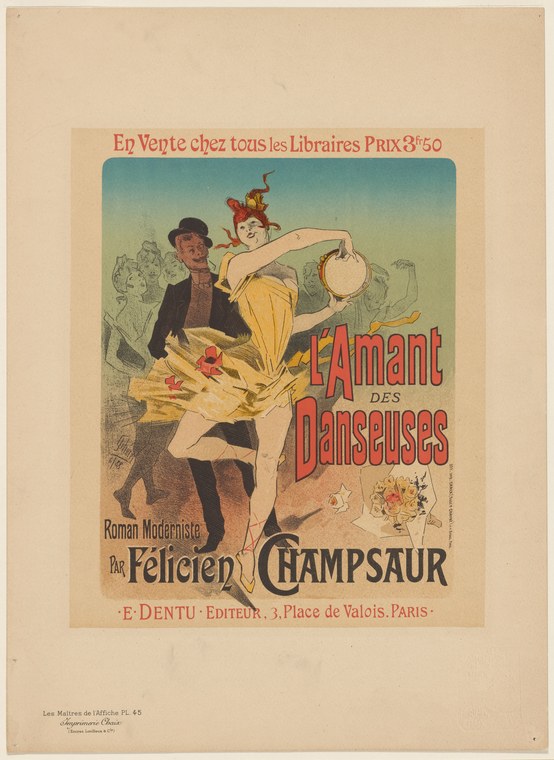
This poster documents the emergence of dance as mass entertainment and commercial spectacle in modern Europe. It shows how the image of the dancer—specifically the female performer in a state of motion and partial undress—became one of the most effective vehicles for selling products, books, and experiences to urban audiences, a pattern that would dominate 20th-century visual culture. For dance historians, it is evidence of how theatrical social dancing and music-hall performance were imagined and consumed by the reading public, and how the boundary between high literature and popular entertainment was negotiated through the figure of the dancer.
What you are looking at
This is a chromolithographic poster advertising a serialized modernist novel by Félicien Champsaur. The composition centers on a young woman in a bright yellow dress, caught mid-dance with one arm raised and her body tilted in an energetic pose suggesting swift movement. She wears a large feathered hat and looks back over her shoulder with a flirtatious expression. Behind her stands a man in dark formal dress (top hat, tuxedo) watching intently. The background is populated with ghostly male figures in formal wear, suggesting a ballroom or dance hall setting. The figures are rendered in soft focus, emphasizing the woman as the focal point. The color palette is warm—yellows, flesh tones, and muted greens dominate—with a pale blue sky suggesting an indoor venue lit by gaslight or early electric light. The overall mood is one of theatrical gaiety and mild scandal.
The dancing
The central female figure is drawn in an exaggerated contrapposto with her weight shifted to one leg, her torso twisting, and her raised arm extended backward—a posture of display rather than disciplined dance technique. Her head turns away from her body in a flirtatious glance. The male figures behind her maintain formal posture in closed tailcoats, creating a compositional echo of her movement. The woman's body is elongated and her limbs elegantly proportioned in the art nouveau manner; there is no suggestion of rigorous ballet training, but rather the loose, performative charm of social dance or music-hall entertainment.
The dance depicted
This is not a depiction of a specific named dance, but rather an evocation of Belle Époque social dancing—the world of Parisian dance halls, cabarets, and the theater. The woman's pose and costume suggest the can-can or chahut, dances associated with Montmartre venues and the demi-monde. The novel's title, *L'Amant des danseuses* (*The Lover of Dancers*), confirms the erotic and theatrical subject matter. The poster advertises popular fiction rather than documenting actual choreography, so the dance content is atmospheric rather than technical—it captures the mood of transgressive, pleasure-seeking modernity that these dances represented to the reading public.
How it was made
This is a chromolithographic poster, a process that allowed for vibrant colors, soft gradations, and theatrical composition at relatively low cost. Chromolithography dominated commercial advertising in France from the 1880s onward and was particularly suited to the promotion of serialized novels, theater productions, and entertainment venues. The technique allowed the artist to layer transparent inks and create subtle flesh tones and atmospheric effects; the soft-focus background figures are characteristic of chromolithographic printing. The poster's large format and prominent placement in commercial spaces meant it reached a broad urban audience, making it a powerful vehicle for shaping public taste and imagination around dance and female performers.
About this work
This poster advertises a serialized modernist novel set in the world of Parisian dance and entertainment. It is not a documentary image of dance but a marketing artifact that uses the visual language of Belle Époque poster design to sell fiction about the lives and loves of professional dancers. The work belongs in a dance gallery because it captures a crucial moment when dance was becoming mass entertainment, when the figure of the dancer (especially the female dancer) was central to modern urban fantasy, and when dance imagery could sell books and fill theaters. The poster is evidence of how dance was imagined, commercialized, and consumed as spectacle in the period 1890–1910.
The image reveals the collision between high modernist literary ambition (Champsaur's novel was experimental in form) and popular visual culture. Dance was the perfect subject for this collision: it was disreputable enough to sell, glamorous enough to attract serious artists, and visual enough to compress into a single charged image. The poster does not show us technique; it shows us how dance was *marketed* to readers and how the dancer's body was mobilized as a symbol of modernity, desire, and transgression.
How to look at it
Attend first to the frozen moment: the artist has chosen a pose of dynamic motion—the woman is mid-turn or mid-kick, captured at the apex of a gesture. This is the same compositional strategy used by Lautrec and other poster designers: a single arrested moment that suggests dance's continuous flow. Notice how the woman's body is elongated and her proportions exaggerated in ways that have nothing to do with naturalism; this is the aesthetic distortion of art nouveau, which treated the human body as a decorative line. The background figures are rendered as blurred silhouettes, a technique that emphasizes the foreground dancer and suggests the intoxication and visual confusion of a crowded dance hall. The poster's text and typography are integral to its design; read the title and the publisher's information as part of the overall composition.
The artist
The artist is not recorded in the catalogue, but the style is consistent with the work of anonymous chromolithographic designers working for Parisian printing firms in the 1890s–1900s. The composition and figure style show awareness of contemporary poster art (the influence of Toulouse-Lautrec and the art nouveau movement is evident), though the execution is commercial rather than auteur-driven. The poster was published by E. Dentu of Paris, a major publisher of serialized fiction. Champsaur (1841–1900) was a prolific and experimental novelist associated with naturalism and decadent literature; his novels often featured transgressive sexuality and urban low-life subjects.
The period
This poster dates to approximately 1890–1900, during the height of the Belle Époque and the era of serialized fiction in popular press. Dance in this period was experiencing rapid change: classical ballet was in a state of transition (the Paris Opéra was still training dancers in romantic repertory, but Russian imperial ballet was about to transform European taste), while social dancing, music-hall performance, and cabaret were thriving as commercial enterprises. The can-can and chahut, dances of questionable morality associated with working-class women and sexual display, were simultaneously scandalous and wildly popular. This poster sits at the intersection of that scandal and popularity: it markets a serious novel using the image of the disreputable dancer, suggesting that the world of dance was now a fit subject for literature and art. The 1890s were also the moment when chromolithographic posters became a dominant art form, blurring the boundary between fine art and commercial design.
Where it lives
This work is held by the New York Public Library as part of its collection of prints depicting dance. It is a commercial poster, not a unique artwork; multiple copies would have been printed and distributed for display in bookshops, kiosks, and public spaces throughout Paris and possibly other cities. As a mass-produced object, it represents the world of popular culture and commercial art rather than fine art practice.
Dance in this work
Questions about this work
Is this poster advertising a real dance, or just a novel?
It is advertising a novel, but the novel's subject matter *is* dance and dancers. The poster uses the image of a dancing woman to market fiction about the lives of Parisian performers. The pose and costume allude to popular dances of the era (especially the can-can), but this is not a technical depiction of a specific choreography. Rather, the poster is using dance as a symbol of modernity, transgression, and urban pleasure.
What was Félicien Champsaur's role in dance history?
Champsaur was a novelist and writer, not a choreographer or dancer. However, his novels engaged with the world of Parisian entertainment, theater, and social life, including the culture of professional dancers and the demi-monde. He was part of the literary movement that took popular entertainment seriously as a subject for experimental fiction.
What can this image tell us about how women dancers were perceived in the 1890s?
The poster reveals the complex and contradictory position of professional female dancers in this period. The woman is depicted as glamorous, desirable, and central to modern urban life, but she is also positioned as morally questionable (the novel's title suggests illicit relationships). The exaggeration of her body, the emphasis on her physical display, and the male gaze directed at her from the background all suggest that female dancers were understood primarily as objects of desire rather than as artists. This is both a celebration and an exploitation of the dancer's image.
How does this poster relate to other dance imagery of the same period?
Chromolithographic posters advertising dance, theater, and entertainment venues were ubiquitous in Paris during the 1890s–1910s. Artists like Toulouse-Lautrec, Jules Chéret, and Théophile Steinlen created iconic images of dancers and cabarets that shaped how dance was visualized and consumed. This poster is part of that visual culture, though it is more commercial and less distinctive in its artistic execution than the work of those named masters.
More dance artwork





