49 works in this view — arrow keys or swipe to move between them.
Dance in Art
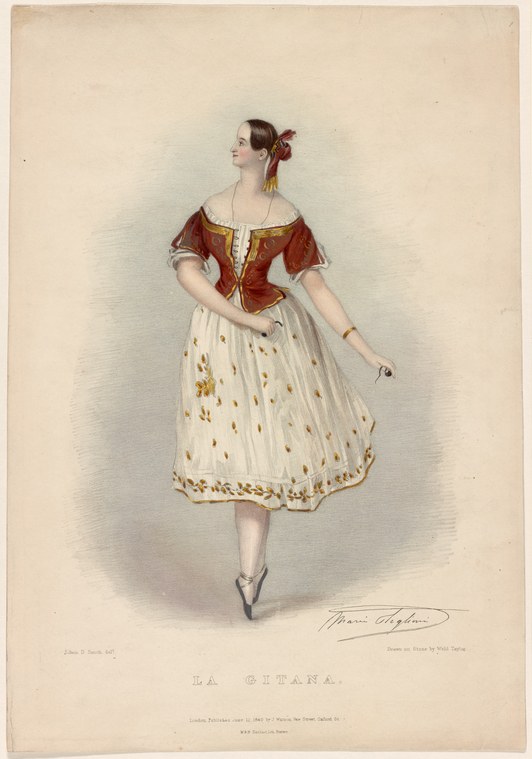
Marie Taglioni [facsimile signature] La gitana
Unknown artist
- Collection:
- Prints depicting dance
- Source:
- New York Public Library
- Rights:
- Public domain — free to use, share and adapt.
- Recorded as:
- Public Domain
This print is a direct window into how Romantic ballet dancers presented themselves and were presented to the public in their own time. The pose, costume, and aesthetic choices encode the values and techniques of Romantic ballet—the emphasis on the female dancer as a graceful, ethereal, slightly exotic figure. For historians and dancers studying Romantic ballet technique and the construction of the Romantic ballerina as a cultural figure, this image is primary evidence: not a later interpretation but a document made in the moment.
What you are looking at
A young woman in Romantic-era theatrical dress stands in a graceful pose against a plain background. She wears a red velvet off-shoulder bodice with gold trim and a full skirt of cream-white fabric scattered with small gold leaf motifs, reaching mid-calf. Her dark hair is gathered at the back with a gold ribbon. She stands in profile facing left, her weight on her right leg with the left leg extended lightly behind, her right arm hanging naturally while her left arm is raised in a gentle curve at shoulder height. Her gaze is lifted and distant. The composition is spare and elegant—a single figure study with soft shading that suggests volume and presence without narrative context. The hand-coloured lithograph technique gives the costume its jewel-like quality while the neutral background focuses all attention on the dancer's silhouette and refined bearing.
The dancing
The dancer stands in a characteristic Romantic ballet pose of the 1830s–1840s, with the body held upright and elegant, one leg supporting while the other extends behind in a light, effortless line. Her arms are positioned with soft grace rather than geometric precision—the raised arm at shoulder height suggests the languid arm port of the period. The pose conveys ease and nobility rather than the technical display that would dominate later ballet. Her posture shows the controlled lightness central to Romantic ballet technique, with the body elongated and the weight held forward on the supporting leg.
The dance depicted
This is a portrait of a Romantic ballet dancer, very likely depicting a role rather than a generic ballet study. The title identifies the subject as *La gitana* (The Gypsy), suggesting this is a character or scene from a ballet on that theme. The costume—Spanish-inflected with the red velvet and gold trim, combined with the full gathered skirt—points toward a folk or national character dance, a common Romantic ballet convention. The pose is pure classical ballet: the dancer is not in motion but posed in the kind of tableau or moment of repose that would punctuate a Romantic ballet performance, showing the dancer at ease in character rather than in technical effort.
How it was made
This is a hand-coloured lithograph, identifiable by the characteristic soft crayon marks, tonal variations, and subtle colour layering of the period. The medium was ideal for theatrical portraiture: lithography was cheaper and faster than engraving, allowing multiple impressions for distribution to audiences and within the theatrical world, while hand colouring gave each print individual character and richness. The signature visible on the print indicates it was made as a commercial theatrical souvenir or portrait—these prints were sold in theatres and by print sellers to collectors of dance and theatre. The technique allowed for soft modelling of the figure and fabric that engraving could not easily achieve.
About this work
This is a theatrical portrait lithograph of a Romantic-era ballet dancer in character costume, most likely made in the 1830s or 1840s when Romantic ballet was at its height. It captures the aesthetic of that era: the refined, ethereal bearing of the dancer, the folk-inflected costume, the focus on the beauty of the human figure in graceful repose rather than technical display. The print belongs to the vast tradition of theatrical portraiture that made famous dancers into cultural icons, circulating their likenesses in print form to fans and fellow theatre-goers. As a commercial artefact, it shows what Romantic ballet looked like to its contemporary audience—not as we know it from later descriptions, but as a living, embodied presence of grace and romantic longing.
How to look at it
Look at the pose and what it conveys: the dancer is not captured mid-leap or in a moment of visible effort, but posed in an attitude of rest or transition, which was typical of how Romantic ballet was represented in portraiture. The costume is the character—the red velvet and gold belong to a Spanish or gypsy world, not to the abstract classical tutu. Notice how the lithograph technique allows the fabric to have texture and depth, making the skirt and bodice feel substantial and real rather than decorative. The raised arm and the line of the body create a continuous curve from the supporting leg up through the torso to the lifted arm, which is the fundamental aesthetic principle of Romantic ballet—the body as a continuous, flowing line rather than as articulated joints.
The artist
The print is signed but the artist's name is not recorded in the catalogue. The signature visible on the print may identify the lithographer, who would have worked from a drawing or sketch (possibly by the same hand or another artist). Many theatrical portrait lithographs of the period were made by commercial print workshops in London, Paris, and other theatre centres, often without named artists being recorded in later catalogues. These prints were frequently produced rapidly and in bulk to meet demand from theatre audiences.
The period
This print dates to the height of Romantic ballet in Europe (approximately 1830–1850), when ballet became dominated by poetic narratives, exotic or supernatural settings, and the celebration of the ethereal female dancer. Marie Taglioni, to whom the signature on the print refers, was the pre-eminent Romantic ballerina of this era, famous for her lightness and technical innovations. Lithographic theatrical portraiture was a booming popular medium in this period—prints of famous dancers were mass-produced, traded, collected, and displayed, making dancers into celebrities in a modern sense. The Spanish or gypsy theme of *La gitana* reflects the Romantic era's fascination with folk culture, exoticism, and historical or national character dances as legitimate subjects for ballet.
Where it lives
This is a hand-coloured lithographic print from the New York Public Library's collection of theatrical prints depicting dance. It belongs to the tradition of commercial theatrical portraiture that was produced and distributed for sale in theatres and by print sellers throughout the 19th century. The print was likely made in London or Paris, the major centres of Romantic ballet and theatrical lithography.
Dance in this work
Questions about this work
Who was Marie Taglioni?
Marie Taglioni (1804–1884) was the most famous Romantic ballerina of her era, celebrated for her technical innovations (particularly her rise to full pointe) and her ethereal, weightless quality of movement. She was born in Stockholm, trained in Paris, and danced across Europe. She became the embodiment of the Romantic ballet ideal and a major celebrity of her time. Many theatrical portraits like this one were made of her, both as a record of her fame and to sell to admirers.
What is a gitana ballet?
A gitana (Spanish for gypsy woman) was a character type popular in Romantic ballet. Ballets featuring Spanish or gypsy characters allowed choreographers to introduce folk flavour, national costume, and a touch of exoticism while keeping the core technique of ballet. These roles often combined classical ballet vocabulary with Spanish or folk-inflected arm and upper-body movement. The character allowed the dancer to be both technically accomplished and dramatically expressive in a specific national or cultural register.
Why do theatrical prints like this matter for dance history?
Theatrical prints are among the only visual records we have of how dancers actually looked and moved in live performance before photography became common. They show us the costumes, the poses, the aesthetic ideals, and the dancer's own sense of how they wanted to be seen. They also show us that dancers were celebrities whose images were commercially valuable—evidence of dance's cultural importance in the 19th century.
How can you tell this is a lithograph and not an engraving?
Lithographs have soft, slightly grainy crayon marks and subtle tonal gradations; engravings have sharp lines and rely on hatching or cross-hatching for tone. The soft modelling of light and shadow on the dancer's body and fabric, and the gentle gradation of the background, are characteristic of lithography. The signature and the hand colouring also point to lithography, the faster, more flexible medium preferred for theatrical portraiture.
More dance artwork





