49 works in this view — arrow keys or swipe to move between them.
Dance in Art
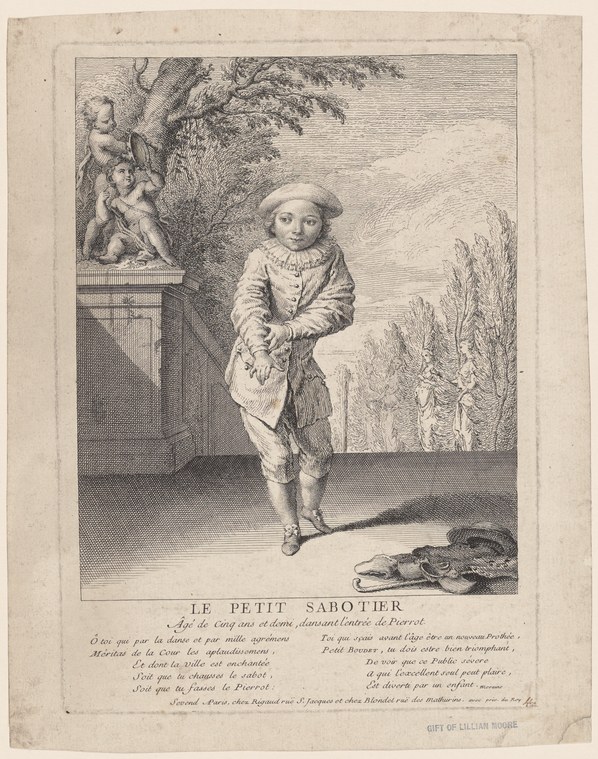
Le petit sabotier,: âgé de cinq ans et demi, dansant l'entrée de Pierrot
Unknown artist
- Collection:
- Prints depicting dance
- Source:
- New York Public Library
- Rights:
- Public domain — free to use, share and adapt.
- Recorded as:
- Public Domain
This image documents the existence and training of a child prodigy performer, and the serious codification of even comic character roles in eighteenth-century court and theatrical dance. It shows that the vocabulary of baroque theatrical dance—the lifted arms, the bent knee, the asymmetrical weight—was taught to and expected of very young children, revealing the professionalization and rigorous pedagogy of performance in this period. For historians of childhood, theater, and dance training, it is direct evidence of these practices.
What you are looking at
A young child, identified by the French inscription as a five-and-a-half-year-old sabot maker, stands center-stage in a theatrical or garden setting. He wears the costume of Pierrot—a loose-fitting white tunic or shirt with full sleeves, a cap or hat tilted to one side, and darker stockings or breeches—the iconic dress of the commedia dell'arte servant character. Behind him to the left rises a stone or marble base supporting a sculptural group of putti (cherubs), suggesting a formal garden or palace courtyard. To the right, tall cypress or similar trees frame the composition. The boy stands in an assertive, weight-shifted pose, one leg bent and the other extended, arms held away from the body with hands gesturing expressively. His body angle and limb placement suggest mid-movement, captured in what the inscription identifies as the 'entrée de Pierrot'—the entrance dance or opening movement characteristic of this figure in theatrical performance.
The dancing
The single dancer is a small child with an adult's theatrical training evident in the confidence of his stance. His weight appears to rest primarily on one leg while the other is extended or raised, a classic asymmetrical pose. Both arms are held away from the torso with the hands open and slightly raised, suggesting a formal arm carriage rather than the naturalistic gesture of a child at play. The pose reads as a prepared entrance or opening position—knees slightly bent, the body angled to display the Pierrot costume. There is no partner visible; this is a solo performance piece.
The dance depicted
This is a theatrical Pierrot entrance dance (entrée de Pierrot), a stock opening number in eighteenth-century court entertainment, ballet d'action, and commedia dell'arte-derived theatrical forms. The 'Petit Sabotier' (the little sabot or clog maker) was a famous comic character of the period, and this inscription documents a specific performance by a child prodigy dancer. The entrée was a formal, codified opening: a solo display of grace, character, and technique that announced the character to the audience. The pose here—asymmetrical, with lifted arms and a bent knee—suggests the vocabulary of the baroque theatrical dance that still governed even comic and character roles in this era. That a five-year-old was performing this role speaks to the intensive training and fashion for child performers in aristocratic and commercial theater.
How it was made
This is an engraving or etching on paper, likely French and of the eighteenth century, executed in the fine linear hatching and clear line characteristic of reproductive printmaking. The inscription, set in proper typographic form below the image, identifies both the character and the performance. The technique—line engraving—allowed for the wide distribution of this image and suggests it was published for sale to a broad audience interested in theatrical novelties and court entertainment. Such prints served as both documentation and marketing for celebrated performers and roles.
About this work
This is a document of eighteenth-century theatrical dance captured in a moment of performance. The image records a specific historical phenomenon: the 'Petit Sabotier,' a celebrated child dancer performing the entrance of Pierrot, a stock commedia dell'arte character, at court or in a fashionable theater. The Pierrot entrance (entrée) was a codified form—a solo display of grace and character skill—that opened comedic and character scenes in ballet and theatrical entertainment. The engraving's inscription and formal composition suggest this was a printed record of a notable performance, circulated among the aristocratic and theatrical circles that followed such novelties. It is a snapshot of how a five-year-old's body was shaped and displayed to embody a theatrical tradition, and of how those moments were preserved and celebrated in print.
How to look at it
Observe the child's asymmetrical stance and the deliberate carriage of the arms—this is not a naturalistic or candid moment, but a formal presentation pose, a 'point' or moment of display. The Pierrot costume (the white tunic, the cap, the stockings) is instantly recognizable as a theatrical type, signaling to a contemporary viewer exactly what role is being performed and what comic tradition it belongs to. The garden setting—the sculptural putti and formal trees—frames this as a spectacle, a performance in a space of leisure and display, not a street scene or commedia performance. Notice how small the figure is in relation to these architectural elements, emphasizing both the child's precociousness and the grandeur of the performance space.
The artist
The print is not signed or attributed in the record. The style and inscription suggest a French printmaker of the mid-to-late eighteenth century, working in the tradition of theatrical documentation and celebrity performance portraiture. Such prints were typically produced by professional engravers working from drawings by painters or from direct theater attendance, then published by theatrical or general print publishers.
The period
The mid-eighteenth century saw a flourishing fashion for child prodigies in aristocratic courts and commercial theaters across Europe. The Comedie Italienne (Comédie-Italienne) and similar theaters in Paris drew audiences fascinated by virtuosic displays of skill in young bodies. The Pierrot figure itself was undergoing a transformation from a simple comic servant of commedia dell'arte into a more refined theatrical character, still comic but now a vehicle for technical display and pathos. Engraved theatrical portraits like this one were a standard medium of publicity and memento, widely collected and circulated among the theatergoing public.
Where it lives
The print is held in the New York Public Library's collection of prints depicting dance. It is an example of theatrical documentation and celebrity promotion from the print culture of the ancien régime, when such images were produced, sold, and collected as records of fashionable performances.
Dance in this work
Questions about this work
Who was the Petit Sabotier?
The inscription identifies him as a sabot maker (cobbler) aged five and a half, but this is his stage name or character identity. He was a celebrated child dancer trained to perform the role of Pierrot, a commedia dell'arte type. He appears to have been a famous child prodigy, and this print documents his performance. Without additional research, his real identity cannot be established from the image alone.
What is an entrée de Pierrot?
An entrée was a formal opening dance or scene, typically a solo, that announced a character and displayed the performer's skill and grace. The 'entrée de Pierrot' was the conventional opening for scenes featuring the Pierrot character, a comic servant figure from commedia dell'arte. By the eighteenth century, this had become a codified theatrical form, complete with expected movements, poses, and costume.
Why was a five-year-old dancing professionally?
In eighteenth-century aristocratic and commercial theater, child prodigies were highly fashionable attractions. Wealthy families trained children intensively in dance, music, and acting, and successful child performers could achieve celebrity status and command high fees. This print documents that phenomenon and the rigorous training involved.
How do we know this is an engraving and not a painting?
The fine parallel lines (hatching) used to create tone and shadow, the uniform line weight, and the printed text below are all characteristic of line engraving. Paintings in this period would show brushwork and different handling of paint. The paper surface, the precise linear technique, and the format all confirm this is a reproductive print.
More dance artwork





