49 works in this view — arrow keys or swipe to move between them.
Dance in Art
The allemand dance
Unknown artist
- Collection:
- Prints depicting dance
- Source:
- New York Public Library
- Rights:
- Public domain — free to use, share and adapt.
- Recorded as:
- Public Domain
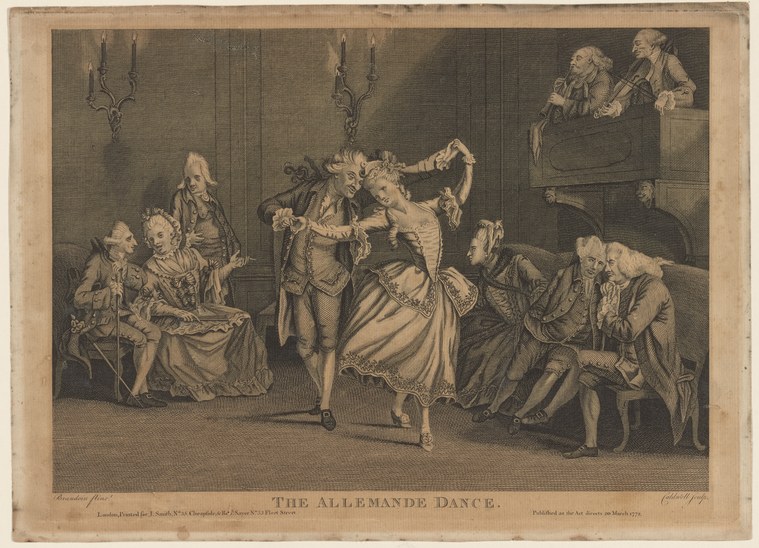
The allemande was one of the oldest and most prestigious dances of the European court, and this engraving captures it at the moment when it was becoming iconic rather than living choreography. The print is evidence of how dance was taught, circulated, and valued in the 18th century: not through video or notation but through prints that could be owned, studied, and imitated by dancers across Europe.
What you are looking at
A ballroom or palace interior with high walls and hanging candelabra depicts a formal allemande in progress. A woman in the center of the composition wears a pale striped gown with flowing skirts caught mid-turn; her partner, in dark coat and breeches, guides her hand. Four other couples occupy the space—some seated on benches at left and right, others standing in readiness. The seated figures gesture with animation, watching the dancers. Two observers lean from an elevated box or gallery at upper right. The setting is austere: tall paneled walls, candlelight, no ornament beyond the figures themselves. The engraver has rendered the scene in sepia tones with fine cross-hatching, creating depth through spatial recession and the contrast between the watching crowd and the dancing pair.
The dancing
The dancing couple holds in closed position, with the man's right hand on the woman's waist and her left hand resting on his shoulder—a formal ballroom frame standard to 18th-century dances. Their torsos are upright and composed, weight balanced. The woman's right arm extends toward her partner's left in the characteristic allemande hand-hold: the dancers do not clasp but rather hold each other by the fingers, allowing for the ornamental arm motions that define the dance. The other figures demonstrate varied poses of observation and social engagement, establishing the dance as a formal court occasion attended by an audience.
The dance depicted
The title and setting confirm this is an allemande, a central dance of the Renaissance and Baroque court. The allemande was a coupled dance for the nobility, marked by elegant walking and turning with an emphasis on the interplay of hands and arms. The hand-hold visible in the engraving—finger-to-finger rather than clasped—is diagnostic of the allemande and distinguishes it from later waltz forms. By the 18th century, when this print was likely made, the allemande had become a formal, almost ceremonial dance, often the opening dance of a ball. The woman's elaborate gown and the man's court dress confirm aristocratic context; the watching audience suggests this was a public or semi-public spectacle rather than intimate recreation.
How it was made
This is an engraving, a process of incising lines into a metal plate (likely copper) and inking the recessed lines to print on paper. The fine parallel lines (hatching and cross-hatching) visible throughout create tone and shadow; the artist has achieved considerable subtlety in rendering the folds of fabric and the play of candlelight on the figures. The medium allowed for detailed narrative and wide circulation—engravings were reproducible and more affordable than paintings, making them ideal for documenting court spectacles and social dances for a literate audience across Europe. The inscription at the base and the cartouche indicate this was a publication, not a private sketch.
About this work
This engraving documents the allemande, one of the foundational dances of European court culture from the 16th through 18th centuries. The print captures the formal choreography and social protocol of the dance: the iconic hand-hold, the upright carriage, the watching audience, and the aristocratic dress that announced wealth and status. The allemande was the ancestor of later ballroom dances and appears frequently in dance manuals and prints from this era; this image serves as a visual record of how the dance was performed and valued in aristocratic circles.
The work belongs in a gallery of dance art because it is simultaneously a document of social history, a technical record of choreography, and a window into the aesthetics of the ballroom. Engravings like this one were circulated among the dancing classes themselves—they taught steps and confirmed fashion. For historians, the image is invaluable; for dancers, it shows how the body was held and displayed at a particular moment in European culture.
How to look at it
Attend to the hand-hold: the woman's right arm and the man's left arm are extended in the characteristic allemande position—not clasped but held finger-to-finger, allowing the elaborate turning and ornamentation that was the dance's signature. Notice the uprightness of the torsos and the formality of the posture; the allemande was not a dance of hip motion or earthiness but of courtly restraint and arm elegance. The watching crowd, rendered with nearly as much detail as the dancers, reminds us that this was a spectacle—a moment of social display. The engraver has frozen the dance at a moment of turning, when the woman's skirts billow and her body is in motion, giving the static medium the illusion of fluidity.
The artist
The artist is not recorded in the catalogue. The inscription at the base of the print (partially visible in the image) would normally identify the engraver and the publisher; the style and technique suggest a professional print workshop of the 18th century, likely Continental (French, German, or Austrian), where such dance documentation was a standard genre. The formal, didactic approach and the careful spatial composition are consistent with prints made for aristocratic dance instruction.
The period
The 18th century saw the codification and formalization of court dance as the aristocracy began to document and regulate the steps and manners that distinguished the nobility from lower classes. Dance manuals with engraved illustrations became essential tools for instruction; Pehr Henrik Essén, Gottfried Taubert, and other dance masters published widely illustrated treatises. The allemande, originating in the 16th century, had by this period become a ceremonial opening dance for formal balls—less a living choreography to be improvised and more a rigid form to be performed with precision. This print sits within a large European tradition of dance documentation through engraving, a tradition that lasted until photography and film made such prints obsolete. The artwork reflects the Enlightenment impulse to systematize and illustrate natural philosophy, social customs, and the arts.
Where it lives
The print is held in the New York Public Library's collection of prints depicting dance, one of the largest archives of dance imagery in North America. It entered the collection as part of the Library's systematic documentation of dance in art and social history.
Dance in this work
Questions about this work
What is an allemande?
The allemande was a coupled dance of European courts from the 16th through 18th centuries, characterized by walking steps, turning, and ornamental arm movements. The name likely derives from 'Allemagne' (Germany), though its origins are debated. By the 18th century it had become a formal, almost ceremonial opening dance for aristocratic balls, performed with great precision and elegance.
How can you tell this is an allemande and not another dance?
The title inscribed at the base of the print identifies it; additionally, the hand-hold visible in the engraving—finger-to-finger rather than clasped—is diagnostic of the allemande. This hand position allowed for the characteristic ornamental arm motions and turns that defined the dance and distinguished it from other coupled dances.
Why are so many people watching?
Court dances were formal social events and often public spectacles. The dancers' status and skill were on display, and the watching audience—seated and standing in positions of honor—participated in the social ritual. Dance was a way to confirm one's place in the aristocratic hierarchy.
How do we know when this was made?
The catalogue record does not specify a date. The style of dress, the technique of the engraving, and the formality of the allemande suggest the 18th century, but the image alone cannot be precisely dated. The publisher's mark or inscriptions on the print itself would provide more certain information.
More dance artwork





