49 works in this view — arrow keys or swipe to move between them.
Dance in Art
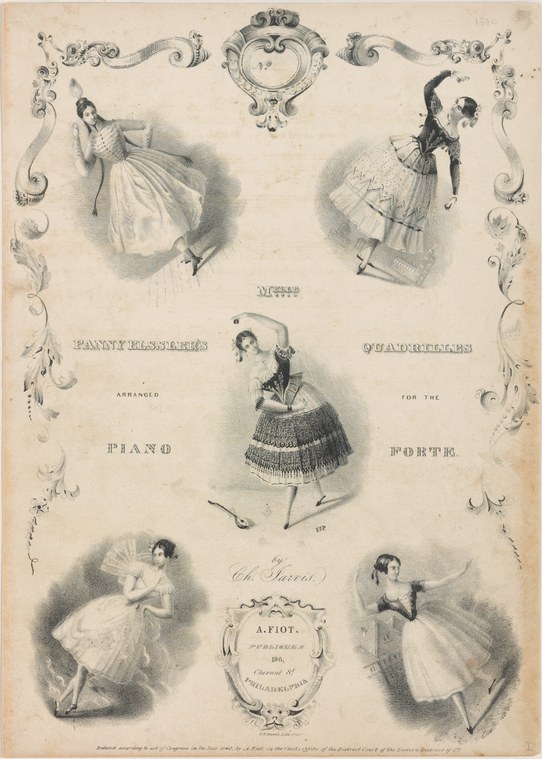
Melle Fanny Elssler's quadrilles
Unknown artist
- Collection:
- Prints depicting dance
- Source:
- New York Public Library
- Rights:
- Public domain — free to use, share and adapt.
- Recorded as:
- Public Domain
Fanny Elssler was one of the most celebrated dancers of the 19th century, and images like this one are primary evidence of how Romantic ballet was presented, marketed, and consumed as popular entertainment. The work shows how a dancer's individual technique and star status were commodified through commercial printing, and how sheet music covers served as affordable mass media for distributing images of theatrical dance to the public.
What you are looking at
This is a decorative print arranged around a central cartouche, presenting five poses of a female dancer in romantic-era costume. The composition is symmetrical: two figures occupy the upper corners in dynamic attitudes, one center figure performs below them, and two more figures flank a lower cartouche bearing the text 'Ch. Fanny's / A FIOT / Published by / Chappell & Co'. All five dancers wear the characteristic dress of 1840s theatrical ballet—fitted bodices with short, full skirts of tulle or gauze. The ornamental border consists of elaborate scrollwork and flourishes typical of 19th-century sheet music covers. The five poses show the dancer in different moments: some figures lean backward with extended arms, others stand in profile with one leg raised, and the overall effect is of a sequence capturing the lightness and ethereal quality associated with the Romantic ballet aesthetic. The print is executed as an engraving or lithograph on pale paper, with fine linework creating shadow and form.
The dancing
Each figure is rendered as a solitary dancer in balletic pose. The upper left figure leans dramatically backward with arms extended and one leg lifted behind. The upper right dancer stands in profile with arms curved upward in classical port de bras and the supporting leg appearing to be on demi-pointe. The center figure maintains an upright, frontal pose. The lower figures adopt similar attitudes—one leaning back with extended limbs, the other more contained. All five dancers demonstrate a high degree of verticality and extension typical of academic ballet training. The poses emphasize the raised leg and backward tilt of the torso characteristic of romantic-era arabesque and attitude positions, with particular attention to the graceful curve of the arms and the fullness of the skirt as it catches the movement.
The dance depicted
The work depicts Romantic ballet as performed in the 1840s, specifically featuring the celebrated dancer Fanny Elssler, as indicated by the title and the cartouche crediting 'Ch. Fanny's.' The quadrilles mentioned in the title are likely piano arrangements for quadrille dancing—a suite of four French country dances popular in ballrooms and on stage during this period—but the five figures shown are all presented in classical ballet positions rather than in the holds and lines characteristic of quadrille social dancing. This is a portrait of a star dancer's techniques and signature poses rather than documentation of the actual dance form named in the title, a common practice in 19th-century dance imagery where a performer's name and costume identified the work even when the depicted positions were balletic display.
How it was made
The print is executed as a lithograph or engraving, evident from the fine, consistent linework and the method of tonal shading through parallel hatching. This technique allowed for large print runs and made the work affordable enough to circulate as sheet music cover art or as a standalone theatrical souvenir. The ornamental border and careful composition suggest this was a professional commercial product, likely produced by Chappell & Co., the London music publisher credited in the cartouche. The pale ground with black line work is typical of 1840s lithographic practice, and the decorative typography and arrangement indicate this was intended for an educated, theatregoing audience purchasing sheet music or theatrical memorabilia.
About this work
This is a commercial print from the 1840s, likely a sheet music cover, depicting the famous dancer Fanny Elssler in five characteristic Romantic ballet poses. The work sits at the intersection of commercial popular culture, theatrical publicity, and music publishing. It documents not a social dance but the exhibition of ballet technique and the star power of a celebrated performer of the era. The five poses arranged around an ornamental border create a composite portrait of Elssler's physical vocabulary and the aesthetic ideals of Romantic ballet: verticality, extension, lightness, and the ethereal quality conveyed through costume and pose.
How to look at it
Observe how the artist has chosen to present the dancer in five distinct attitudes rather than a sequential narrative: this is a portrait gallery of technique and beauty, not a story. Notice the consistency of the costume across all five figures—the fitted bodice and voluminous skirt—and how the skirt's movement and volume are emphasized in every pose, indicating how central the costume was to the visual effect of Romantic ballet. Pay attention to the relationship between the figure's balance and the extension of the limbs: in each pose, the torso appears to float or lean while the legs extend dramatically, conveying the appearance of weightlessness that was central to the Romantic ideal. The ornamental frame around the figures elevates the dancer to the status of a precious object, much as theatrical stardom itself elevated Elssler.
The artist
The artist is not recorded. The work is attributed to the publisher Chappell & Co., a London music house active from the 1810s onward, known for producing sheet music covers and theatrical ephemera with fashionable imagery. The print was likely created by an in-house illustrator or a commercial printmaker working on commission.
The period
The 1840s were the height of the Romantic ballet era in Europe. Fanny Elssler (1810–1884) was at the peak of her career, celebrated for her virtuosity and charisma. She and the other great ballerinas of the period—notably Marie Taglioni—defined the aesthetic of Romantic ballet: an emphasis on pointe work, ethereal costume, and a narrative centered on the female dancer's body as the primary vehicle of expression. Simultaneously, the quadrille was becoming the dominant ballroom dance across Europe and North America, and its four-dance structure was also being adapted for theatrical use. This print captures the moment when ballet was transitioning from a court art to a popular commercial entertainment, and when printed imagery became the primary way that most people encountered theatrical dance.
Where it lives
The work is held in the New York Public Library's collection of prints depicting dance. It is cataloged as a theatrical souvenir or sheet music cover, typical of the commercial ephemera produced and distributed in London and New York during the height of Elssler's fame.
Dance in this work
Questions about this work
Who was Fanny Elssler?
Fanny Elssler (1810–1884) was an Austrian-Italian dancer who became one of the most celebrated performers of the Romantic ballet era. She was known for her technical virtuosity, dramatic presence, and charisma. She performed across Europe and made a famous tour of the United States in 1840–1842, where she was received with enormous acclaim. She was a rival and contemporary of Marie Taglioni, and the two dancers represented different aesthetics within Romantic ballet.
What are quadrilles and why is this print called 'Quadrilles'?
Quadrilles are a suite of four or five short dances performed in sequence, typically in sets of four couples. They were enormously popular in ballrooms throughout the 19th century. The title of this print likely refers to piano arrangements of quadrille music, but the five figures shown are all presented in classical ballet positions rather than in quadrille holds. This was common practice: sheet music covers and theatrical prints often bore a title referencing the musical work while depicting the star performer in balletic display poses.
How do we know this depicts Romantic ballet rather than another style?
The costume, pose, and era are definitive. The short, full skirt of tulle or gauze, the fitted bodice, the pointe work implied in several figures, and the overall emphasis on verticality and extension are all hallmarks of 1840s Romantic ballet. The title credits Fanny Elssler, and the ornamental style and printing technique date the work to the same period when she was famous.
Why is this print important?
It documents how theatrical dance was marketed and consumed in the 19th century, before photography was widely available. Prints like this were the primary way that most people encountered images of famous dancers. They show us what Romantic ballet looked like, how it was valued, and how a dancer's celebrity was commercialized through mass-produced imagery.
More dance artwork





