49 works in this view — arrow keys or swipe to move between them.
Dance in Art
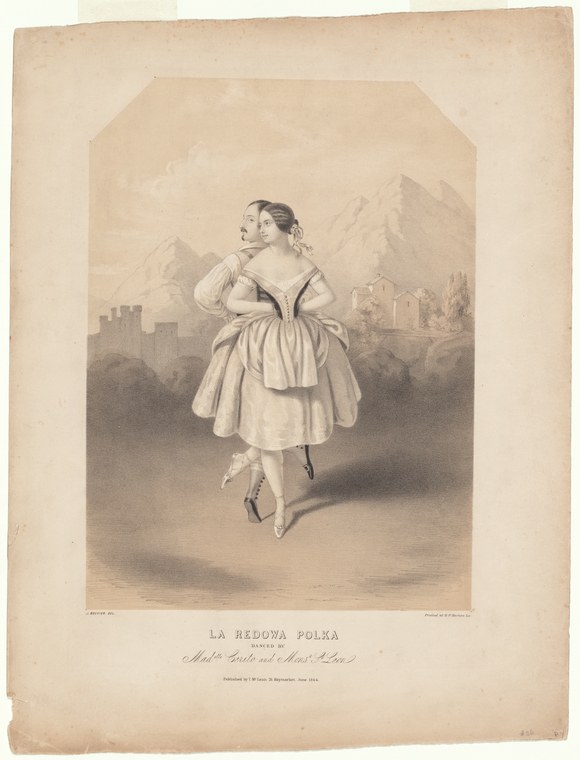
La redowa polka danced by Madelle Cerito and Monsr. St. Leon
Unknown artist
- Collection:
- Prints depicting dance
- Source:
- New York Public Library
- Rights:
- Public domain — free to use, share and adapt.
- Recorded as:
- Public Domain
This print documents the 19th-century practice of staging ballroom dances on the theatrical stage, a staple of Romantic ballet that directly shaped how social and theatrical dance influenced each other. Cerito was one of the most celebrated ballerinas of her era, and seeing her in a role as specific and dated as a redowa polka offers insight into the theatrical taste and technical repertory of the 1840s–50s.
What you are looking at
A single female dancer occupies the center of this toned lithographic print, posed in a moment of suspended elegance against a romantic landscape. She wears a pale, full-skirted dress with dark trim and ribbon detail at the waist, her shoulders bared, hair pulled back smoothly. Behind her rises a theatrical backdrop of distant mountains and a fortified town or castle, rendered in soft gray wash that creates atmospheric depth. The dancer's body is caught in a three-quarter turn, her left arm raised and bent at the elbow, her right arm extended downward; her weight appears shifted onto her left leg while her right leg is lifted or pointed. The composition places her isolated against the pale ground, with the landscape elements sufficiently distant to emphasize her as the sole focus of the image.
The dancing
The dancer's frame is upright and proud, with the characteristic posture of early 19th-century theatrical dance—elongated through the spine, arms held with control. Her left arm curves upward in what appears to be a port de bras position; her right arm is extended lower, creating an asymmetrical, expressive line. The leg position suggests either a relevé turn or a balletic pose with the supporting leg engaged and the free leg pointed or lifted. Her body conveys lightness and control rather than weight or grounding, consistent with the aesthetic demands of Romantic-era ballet technique.
The dance depicted
This print documents a performance of the redowa (or redowa polka), danced by the celebrated ballerina Mademoiselle Cerito and Monsieur Saint-Léon. The redowa was a moderately paced triple-meter couple dance that gained popularity in the 1840s, often incorporated into ballet. While this image shows only the female dancer in a posed, solitary moment, the notation and theatrical costume indicate this was a partnered ballroom dance adapted for the stage. The romantic landscape and theatrical lighting suggest this was a spectacular set piece or divertissement within a larger ballet.
How it was made
This is a lithographic print, identifiable by its soft tonal gradations, the crayon-worked atmospheric background, and the characteristic stone-printed appearance of mid-19th-century theater prints. Lithography allowed rapid and affordable production of theatrical imagery, making such prints widely circulated as both souvenirs and promotional material. The technique's capacity for subtle shading and the quality of the figure drawing suggest a skilled artist working from a theatrical commission or performance documentation.
About this work
This is a theatrical portrait of Romantic-era ballet spectacle, capturing one of the star dancers of the 1840s–1850s in costume for a fashionable ballroom dance. The redowa polka, a European social dance, was frequently featured as a divertissement in ballets of the period, bridging the world of aristocratic ballrooms with the theatrical stage. The image preserves both the precise costume of the performance and the idealized pose that conveyed the otherworldly elegance the Romantic ballet demanded.
As evidence of the 19th-century fascination with incorporating contemporary social dance into stage spectacle, this work documents how live dance forms continuously fed theatrical production. Cerito and Saint-Léon were among the major celebrities of their era, and such prints were essential tools for publicizing new works and capitalizing on a dancer's fame.
How to look at it
Notice the isolation of the dancer against the landscape—this is not a moment of interaction but a single figure posed for the viewer's admiration, a convention of theater portraiture. Her arm and leg positions reveal the vocabulary of Romantic ballet: the elongated line, the turned-out positioning, the sense of suspension rather than weight. The pale dress and romantic setting signal that she is presented as an idealized figure, despite the specificity of the dance title and the named performers. The absence of her partner is notable: this print emphasizes the star dancer rather than the social character of the redowa as a couple's dance.
The artist
The artist is not recorded. The print bears publication marks indicating London publication in the mid-19th century, suggesting it was produced by a commercial theater print publisher serving the London opera and ballet audience. Such prints were typically made from sketches by stage designers or from life studies commissioned by the publisher immediately following celebrated performances.
The period
The redowa appeared in European ballrooms and theatrical productions in the 1840s, overlapping with the height of the Romantic ballet movement. During this period, ballets routinely incorporated contemporary social dances—waltzes, polkas, galops, and quadrilles—as diversions, spectacles, and opportunities to showcase star dancers in character roles or fashionable dress. The Romantic era's fascination with the exotic and the ethereal coexisted with a taste for up-to-date ballroom culture, creating demand for both fantastic narratives and fashionable, recognizable dance forms on stage.
Mademoiselle Cerito was a leading ballerina of the London stage, celebrated particularly for her technical prowess and her ability to command prominent roles. Saint-Léon was a major male dancer and choreographer. Their celebrity made images of them in new roles highly marketable, particularly in London's West End where such prints were sold to audiences eager for mementos of performances.
Where it lives
This lithographic print is held in the New York Public Library's collection of prints depicting dance. It is one of a class of theatrical promotional and commemorative prints produced in London during the mid-19th century, likely issued during or shortly after the performance it documents.
Dance in this work
Questions about this work
What was the redowa?
The redowa (or radowa) was a triple-meter couple dance similar to a waltz, popular in European ballrooms from the 1840s onward. It was frequently adapted for theatrical performance and incorporated into ballets as a divertissement or character dance, allowing audiences to see contemporary ballroom fashions and steps on the stage.
Who was Mademoiselle Cerito?
Mademoiselle Cerito (Fanny Cerito) was one of the most celebrated ballerinas of the Romantic era, famous for her technical skill and theatrical presence. She performed extensively in London and Paris during the 1840s and 1850s, and was known for commanding significant roles in new productions.
Why is she alone in this print if it was a couple's dance?
Theater prints of the period typically featured star dancers in posed, solitary portraits rather than action scenes. This allowed the image to emphasize the celebrated performer and showcase her costume in detail, while still using the title to indicate the work's context. The print functioned as both a souvenir and a promotional image.
How can you tell this is a lithograph?
The soft tonal gradations, the crayon-worked atmospheric background of the landscape, and the characteristic stone-printed appearance all identify this as a lithograph. The fine detail in the figure combined with painterly shading in the background is typical of the technique's capabilities.
More dance artwork





