49 works in this view — arrow keys or swipe to move between them.
Dance in Art
Masquerades and fancy-dress balls in prints
Unknown artist
- Collection:
- Prints depicting dance
- Source:
- New York Public Library
- Rights:
- Public domain — free to use, share and adapt.
- Recorded as:
- Public Domain
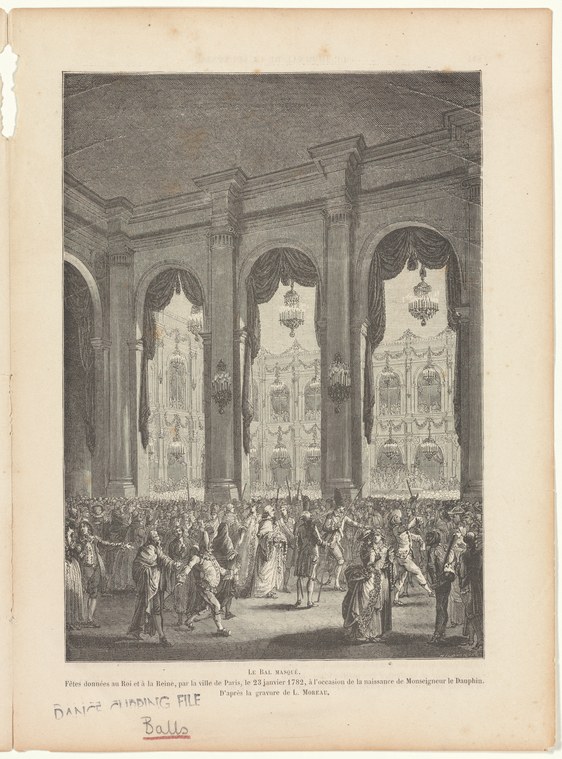
Masquerade balls were central to 18th-century European social life and directly influenced the development of ballet and theatrical dance; the image shows the actual spaces and social arrangements where courtly dances were performed and where new movement vocabularies were tested. The engraving is contemporary evidence of how an elite dancing public arranged itself, dressed, and moved in formal space—information rarely preserved in such visual detail.
What you are looking at
A grand interior architectural space with soaring arched openings and classical columns frames an elaborate masked ball or fancy-dress gathering. Three massive arched niches dominate the composition, their vaults receding in perspective and hung with swag drapery. The floor is crowded with figures in 18th-century dress—women in full skirts and men in formal coats and breeches—scattered across the space in conversation and promenade. The lighting is dramatic, with strong contrasts between the shadowed arches and the illuminated floor, creating an atmosphere of theatrical glamour. A central figure or small group appears to occupy the focal point of the composition, though the press of spectators and dancers fills the entire floor.
The dancing
The gathered figures stand predominantly upright in the social arrangements typical of formal balls—some paired, some in small groups, some solitary. The women wear hooped skirts and appear to be in conversation and observation rather than active dancing. The men stand with the posture of formal court dress. While masked, faces are rendered with precision, and the engraver has captured the slight inclinations and turns of the head that suggest the social performance of the masked ball. No obvious dance frame or hold is visible; this appears to be a moment of social circulation rather than active partnered dancing.
The dance depicted
This print depicts a masquerade ball or fancy-dress ball of 18th-century French high society. The French inscription (partially visible) and the architectural style suggest a Parisian venue of the Enlightenment era. Masquerade balls were a central social institution of the 1700s, occasions for both actual dancing and the ritual of display and flirtation that the masquerade enabled. The print captures the social choreography of the event—the movement, arrangement, and costume that structured the evening—rather than any single dance style. While courtly dances such as the minuet would have been performed at such an event, this image presents the broader spectacle of the gathering.
How it was made
This is a black-and-white engraving, printed from a copperplate. The technique is classical line-engraving, with fine parallel hatching used to create tonal effects and shadow, particularly in the architectural elements and the darker areas of the composition. The print would have been widely circulated and reproduced; the NYPL attribution suggests it is one of many engravings documenting French court life and urban social scenes of the period. The precision of the line and the careful rendering of the architectural perspective indicate a professional workshop production.
About this work
This engraving documents a masquerade ball of 18th-century Paris, capturing the social choreography and spatial arrangement of one of the era's most celebrated social performances. Masquerade balls were occasions where the formal structures of courtly life were both reinforced and temporarily suspended through costume and anonymity; they were settings for both prescribed courtly dances and improvisational social movement. The print preserves not a single dance moment but the larger spectacle of the event—the architecture of the venue, the distribution of bodies, the materials of dress—that framed the dancing and flirtation of the evening.
For historians and dancers, the image offers rare direct evidence of how ballroom space was used, how bodies arranged themselves in social dancing, and what the material conditions of an 18th-century dancing space looked like. The engraving's precision makes it a reliable document of costume, architectural proportion, and social practice.
How to look at it
The viewer should attend first to the architectural space, which is the true subject: the engraver has chosen a moment that displays the proportions and design of the ballroom itself, using the crowd as a measure of scale. Look at how the figures occupy the space—not clustered but distributed, arranged in the patterns of formal social circulation. The arches frame and contain the gathering, suggesting that the ballroom itself was as much a performer as the dancers. The light is theatrical, controlled, emphasizing the drama of the occasion. Notice that while costumes and masks are visible, no individual dance is being performed; the image captures the interval between dances, or the sustained spectacle of the masked gathering itself.
The period
In 18th-century France, masquerade balls were peak moments of aristocratic sociability. The tradition had emerged earlier but reached its height during the Enlightenment, when the masked ball became a subject of intense artistic and literary attention. Engravings of fashionable social scenes were a major print genre, circulating among the urban educated public and international courts. The architecture visible here—the grand arches and classical vocabulary—reflects the style of mid-to-late 18th-century Parisian venues. The masquerade was also associated with Venetian tradition; French aristocratic culture adopted and elaborated the custom. At these events, minuets, contredanses, and other courtly dances would have been performed, though the print emphasizes the social gathering rather than any specific choreography.
Where it lives
The print is held by the New York Public Library and catalogued within a collection on masquerades and fancy-dress balls in prints. The French inscription visible at the bottom edge indicates it was published or documented in France, likely in the 18th century, though the exact date and publisher are not stated in the available record.
Dance in this work
Questions about this work
What is a masquerade ball and why was it important?
A masquerade ball was a formal social gathering at which guests wore masks and elaborate costume, suspending ordinary social hierarchies while maintaining the structure of courtly ritual. Masks allowed anonymity and encouraged flirtation and frank conversation. These events were peak occasions for dancing, socializing, and display among European aristocracy and wealthy urban classes, especially in 18th-century Paris and Venice.
What dances would have been performed at such an event?
The evening would have included minuets, contredanses, and other prescribed courtly dances performed in sequence. Musicians would have led dancers through these structured forms, with courtly etiquette governing who danced with whom and in what order. The masquerade provided more opportunity for social movement and informal dancing than ordinary formal events, though the core dances remained the same.
How do we know this is a real place and time, not imaginative?
The engraving documents specific architectural details—the proportions of the arches, the style of the columns, the decoration of the space—that would correspond to actual Parisian ballrooms of the period. The inscription at the bottom anchors it to a specific occasion and date. The costumes, materials, and social arrangements are consistent with documented 18th-century practice. Such engravings were commercial products circulating among people who knew these spaces, so accuracy was expected.
More dance artwork





