49 works in this view — arrow keys or swipe to move between them.
Dance in Art
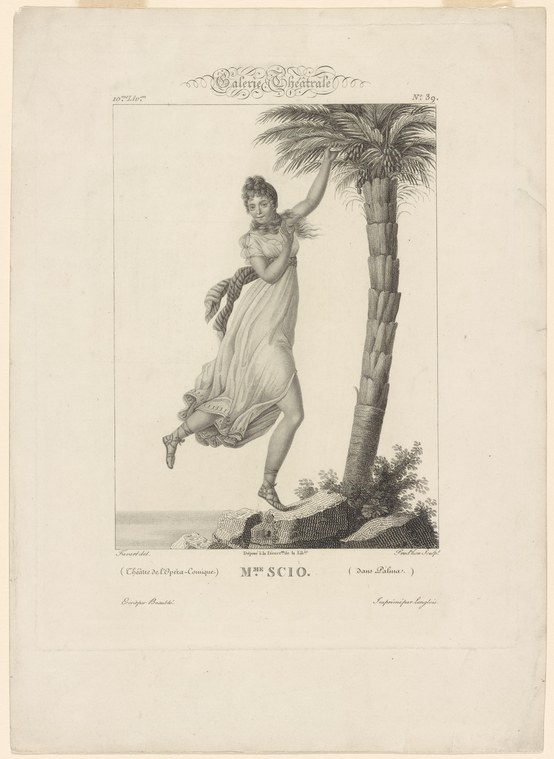
Mme. Scio dans Palma: Théâtre de l'opera comique
Unknown artist
- Collection:
- Prints depicting dance
- Source:
- New York Public Library
- Rights:
- Public domain — free to use, share and adapt.
- Recorded as:
- Public Domain
This work preserves the record of a form of performance—acrobatic display by women in Parisian theaters—that was popular and celebrated but has left almost no trace in standard dance history. It challenges the assumption that theatrical dance in this period was synonymous with ballet, and it shows how the language of fine printmaking was deployed to immortalize performers whose acts were ephemeral and whose names are now nearly forgotten. The image is also a remarkable document of the female body in extreme extension, presented not as a medical specimen or moral warning but as an object of aesthetic admiration.
What you are looking at
A young woman in classical dress performs an acrobatic or gymnastic movement against a palm tree in a tropical or exotic setting. She is suspended in air, her body arched backward in an extreme hyperextension, with one leg raised and the other supporting minimal contact with the ground. Her white drapery billows around her, caught mid-motion. The palm tree rises prominently behind her, its fronds at the top of the composition, while the ground is suggested by light hatching and a few botanical details. The entire scene is rendered in fine engraving technique, with careful attention to the play of light and shadow across her body and fabric. The mood is one of otherworldly grace and physical impossibility—the kind of idealized, ethereal moment prized in late 18th-century European theatrical imagery.
The dancing
A single female figure dominates the composition. Her body is in extreme dorsal extension (deep backbend), with her weight appearing to shift between a single point of contact and the momentum of her own movement. Her arms frame the motion—one raised toward the palm fronds above, the other across her torso. Her head is thrown back, eyes upward. The drapery clings and flows simultaneously, suggesting both the weight of linen and the lightness of suspended motion. There is no partner, no support visible, and no conventional dance frame; instead, the body itself is the architecture of the movement.
The dance depicted
This is not a recognizable social or theatrical dance form but rather an acrobatic or gymnastic display—what would now be called contortion or extreme flexibility performance. The work may document a circus or variety theater act rather than ballet proper, though it is presented with the aesthetic ambitions of fine art printmaking. The subject appears to be a professional performer, likely European, executing a signature feat of physical virtuosity. The exotic setting (the palm tree) suggests this may commemorate a specific performance or performer, possibly at a boulevard theater or traveling show in late 18th-century Paris. The inscription names 'Mme. Scio' and references the Théâtre de l'Opéra Comique, but the movement itself lies outside the classical ballet vocabulary of the period.
How it was made
This is a finely executed engraving, likely made from a drawing. The technique allows for precise rendering of the figure's musculature and the cascade of drapery, with controlled hatching to build form and shadow. The composition is framed within a rectangular border, and the inscription is set in typographic ornament at the foot—all conventions of the formal theatrical portrait print that circulated in subscription networks and print shops. Engravings of this quality were expensive to produce and aimed at a cultivated audience; they served as records of celebrated performers and as souvenirs of memorable performances. The fineness of the line work and the careful anatomical study suggest the engraver was a skilled practitioner, though the printmaker's name is not recorded in the catalogue.
About this work
This is a late 18th-century engraved portrait of the acrobatic performer Mme. Scio, shown executing an extreme feat of bodily flexibility at the Théâtre de l'Opéra Comique in Paris. It documents a moment at the boundary between dance, gymnastics, and circus performance—a form of spectacle that flourished in the variety theaters of the period but has largely vanished from historical memory. The work is both an artifact of theatrical history and a study in the representation of the female body in extreme motion: the artist has rendered the moment with the visual language of fine art, granting the acrobat the same compositional dignity and anatomical precision that would be lavished on a classical ballet dancer. It belongs in a gallery of dance because it shows us what 'dance' meant in popular theater—not the codified steps of the ballet d'action, but the exhibition of physical virtuosity and beauty in motion.
How to look at it
Attend to the anatomical impossibility of the pose: the extreme arch of the spine, the placement of the limbs, and the way the drapery both reveals and obscures the mechanics of balance. The artist has chosen to freeze the moment of maximum extension, not the moment of entry or recovery—a choice that emphasizes virtuosity and spectacle over the balletic values of harmony and control. Notice also the setting: the palm tree grounds this in a specific place and mood, suggesting either an exotic number within the show or a romanticized portrait. The engraving technique itself—the fine parallel lines that build shadow and form—creates an illusion of three-dimensionality that makes the feat seem both more real and more dreamlike than a sketch could convey.
The period
The late 18th century saw an explosion of variety and popular theater in Paris, with the boulevard theaters and smaller playhouses offering acrobatics, pantomime, and spectacular physical feats alongside or instead of the formal ballet d'action developing at the Opéra. These performances attracted paying audiences and inspired engravers to produce commemorative prints in the style of grand theatrical portraiture. The Théâtre de l'Opéra Comique itself, while famous for light opera and comedy, also hosted such spectacular acts. At the same time, neoclassical aesthetics were elevating the representation of the human body, and even acrobatic performers could be rendered with classical drapery and idealized anatomy. This print sits at the intersection of these currents: popular spectacle, fine printmaking, neoclassical form, and the documentation of a female performer whose skill and fame were real but whose legacy is fragmentary.
Where it lives
The work is held in the NYPL's Prints collection depicting dance. It is catalogued by performer name (Mme. Scio) and theater (Théâtre de l'Opéra Comique), suggesting it was part of a series of theatrical portrait prints aimed at collectors and enthusiasts.
Dance in this work
Questions about this work
Was Mme. Scio a ballet dancer?
No. Scio was an acrobatic or contortion performer, a specialist in feats of extreme flexibility and physical virtuosity. While she performed at a venue associated with comic opera, her act was separate from the classical ballet tradition. Acrobats and variety performers occupied a different (though adjacent) world from ballet dancers, and they often commanded high fees and celebrity.
What is she doing in this picture?
She is in an extreme dorsal extension (backbend), with her body arched nearly in a U-shape. Her right leg is extended high, and her weight appears to be supported by a single point of contact with the ground or possibly by momentum alone. This kind of extreme flexibility feat was a signature acrobatic move and would have been shocking and thrilling to a theater audience.
Why does she have a palm tree behind her?
The palm tree is likely a theatrical or romantic convention rather than a record of the actual stage. Palm trees were exotic and evocative in 18th-century European imagination, and they appear in prints and paintings to signal a sense of wonder, foreignness, or spectacle. It may also reference a specific 'exotic' number within the performance.
How was this image made?
This is an engraving, a printmaking technique in which an image is incised into a metal plate (usually copper) with a sharp tool called a burin. The plate is then inked and run through a press with paper. Engravings were expensive, time-consuming to produce, and therefore reserved for important subjects—in this case, a celebrated performer. The fine lines and careful shading show the skill of the engraver.
More dance artwork





