49 works in this view — arrow keys or swipe to move between them.
Dance in Art
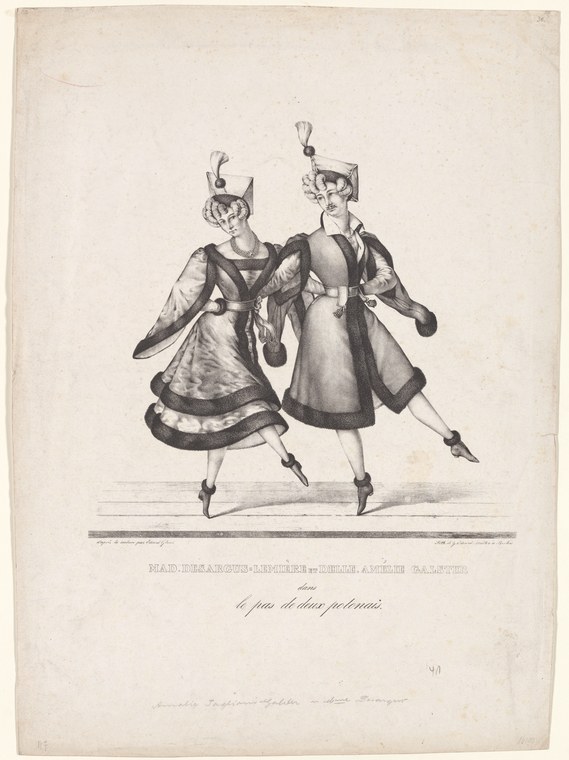
Mad. Desargus-Lemière et Delle. Amélie Galster dans le pas de deux polonais
Unknown artist
- Collection:
- Prints depicting dance
- Source:
- New York Public Library
- Rights:
- Public domain — free to use, share and adapt.
- Recorded as:
- Public Domain
Named dancer prints like this one document the actual performers and repertory of the Romantic stage—information lost to history when only choreographic description survives. The Polish pas de deux itself represents a significant thread in ballet's 19th-century development: the incorporation of national and folk idioms into the classical vocabulary, a practice that shaped the narrative ballets of the century and influenced the Ballets Russes.
What you are looking at
Two female dancers in elegant mid-19th-century dress perform a pas de deux, their bodies tilted dynamically toward each other in a moment of partnered movement. Both wear bell-shaped skirts with decorative borders, fitted bodices, and elaborate headdresses topped with feathered plumes. The dancer on the left wears a darker dress with patterned sleeves; the one on the right, a lighter garment. They stand en relevé on one leg each, their free legs raised and extended behind them in a posture suggesting rapid momentum or a suspended moment mid-turn. Their arms are raised and active—one extended outward, one held closer to the body—in the refined port de bras of classical theatrical dance. The composition captures the partnership of the form: the dancers lean into each other's space while maintaining perfect balance, their gazes directed outward. The setting is abstracted, indicated only by a baseline beneath their feet.
The dancing
Both dancers are en relevé on their supporting legs, with free legs raised high in back, creating the extended line characteristic of early Romantic ballet. Their arms are held in a lifted, controlled frame—not touching one another but coordinated in spatial relationship. The posture shows strong turnout and the elongated silhouette prized in the period. The tilt of their bodies toward the center and the lift through the torso suggest a moment of mutual support or sustained elevation, suggesting dancers of technical maturity performing a virtuosic passage.
The dance depicted
This is a Polish pas de deux, a form that emerged in the 19th-century Romantic ballet repertory. The Polish style—with its characteristic energy, quick footwork, and use of such raised leg positions—was distinct from the softer, more ethereal vocabulary of other Romantic dances. Mademoiselle Desargus-Lemière and Mademoiselle Amélie Galster were professional dancers of the period, likely performing this in a major European theatre. The pas de deux structure—two soloists in coordinated but independent roles—was central to the vocabulary of the time, and the Polish version was a showpiece for technical prowess and dramatic presence.
How it was made
This is an engraving, a medium well suited to the wide dissemination of theatre imagery in the 19th century. The fine linear work captures the precision of the dancers' lines and the fabric texture of their costumes with remarkable clarity. Engravings of this type were produced from designs made at or near the performances they documented, and were published as prints sold to theatre audiences and collectors. The technique allowed for subtle gradation of tone through cross-hatching, giving the figures volume and the composition theatrical depth.
About this work
This engraving documents a moment from a Romantic-era theatrical performance, showing two named professional dancers executing a Polish pas de deux—a paired dance form that combined the technical vocabulary of ballet with the character vocabulary of folk traditions. The work is a record of specific dancers and a specific dance, preserved through the reproductive print medium that made ballet imagery widely available to 19th-century audiences. The image shows the form in its full theatrical dress: the refined carriage, the elevated technique, and the structured partnership that defined the era's ideal of theatrical dance.
How to look at it
Notice the moment the artist chose to freeze: not a sustained pose, but a moment of motion—both dancers suspended in parallel rises, their bodies tilted, their arms articulated as if mid-phrase. The composition is perfectly bilateral, emphasizing the equality and coordination of the pair. Attend to the precision of the dress and the care taken to show the specific theatricality of the costume: the headdresses, the border ornaments, the patterning of the sleeves. These details would have been significant to a 19th-century viewer, marking these as specific dancers in a specific, named piece.
The period
The 1840s–1860s saw the flowering of Romantic ballet, when the Romantic movement's interest in the exotic, the distant, and the folk made room for national dances within the ballet repertory. The Polish dance had particular prestige and popularity in France and across Europe during this period, appearing regularly in mixed divertissements and as standalone pas de deux. The French print industry was at its peak, producing thousands of images of dancers and theatrical scenes for a hungry middle-class market. These engravings served as both souvenirs and publicity, and their distribution shaped how people understood and remembered theatrical performance.
Where it lives
The work is part of the NYPL's collection of prints depicting dance, a substantial archive of 19th-century theatrical documentation, predominantly Parisian in origin. These prints were widely published and distributed during the period and serve as primary documentary evidence for repertory, personnel, and performance practice.
Dance in this work
Questions about this work
Who were Desargus-Lemière and Amélie Galster?
They are identified in the print's inscription as the dancers who performed this pas de deux. Beyond what the image tells us—that they were skilled, professional dancers performing in a major theatrical venue—little may be readily available in published sources. Theatre archives, particularly in Paris and major European cities, may contain further information about their careers.
What is a pas de deux polonais?
A pas de deux (for two dancers) in Polish style—meaning it incorporated rhythmic and movement conventions of Polish folk dance, particularly in its footwork and character. It would have included lively, quick steps and a proud, energetic quality distinct from the more ethereal vocabulary of other Romantic dances. Such pieces were often performed as independent numbers within a ballet or as part of a mixed program.
Why do 19th-century dance prints matter to us now?
They are among the only direct visual evidence we have of how actual dancers performed the roles we read about in texts. Engravings like this preserve information about costume, carriage, partnering, and the presentation of specific dancers that would otherwise be lost. They also show us what audiences of the time paid to see and valued enough to buy as prints.
More dance artwork





