49 works in this view — arrow keys or swipe to move between them.
Dance in Art
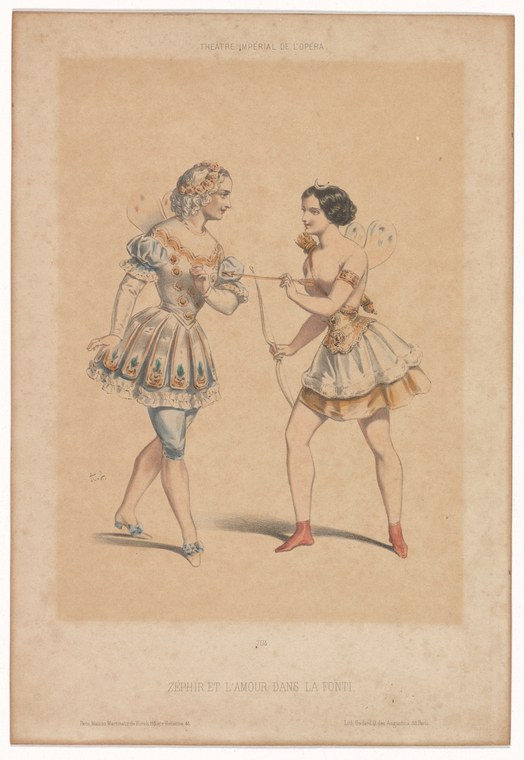
Zéphir et l'Amour dans La Fonti. Théâtre Imperial de l'Opéra
Unknown artist
- Collection:
- Prints depicting dance
- Source:
- New York Public Library
- Rights:
- Public domain — free to use, share and adapt.
- Recorded as:
- Public Domain
This print documents the visual language of nineteenth-century ballet pantomime—the gestural vocabulary through which dancers conveyed narrative and emotion before the twentieth-century shift to abstract movement. For historians and dancers studying Romantic ballet, such images are primary evidence of how performers held their bodies, used props, and positioned themselves relative to partners in dramatic scenes.
What you are looking at
Two figures in classical costume face each other in a confrontational stance against a plain background. The figure on the left wears a short, ornate tunic with elaborate trim and puffed sleeves, with curled blonde hair and bare legs ending in soft shoes. The figure on the right, darker-haired, wears similar dress and holds what appears to be a small bow or wand, pointing it toward the left figure in an aggressive gesture. Both stand in a shallow lunge position with knees bent and weight forward, suggesting arrested motion in the midst of a sparring or combat sequence. The composition is theatrical and intimate—a snapshot of dramatic confrontation rendered in colored pencil or chalk with fine hatching to suggest fabric and musculature. The title, printed below, reads 'Zéphir et l'Amour dans La Fonti' (Zephyr and Love in the Fountain), identifying these as classical allegorical figures rather than human dancers.
The dancing
Both figures occupy identical open stances with bent knees and forward weight distribution, suggesting simultaneous attack or defense. The left figure's arms are raised and tensed; the right figure extends one arm in a pointing or thrusting action with what may be a prop weapon. Their bodies are angled toward each other in profile or three-quarter view, creating visual opposition. The positioning and musculature visible in the line drawing suggest trained performers accustomed to balletic or pantomimic movement rather than social dance.
The dance depicted
This is a scene from ballet pantomime of the nineteenth century, likely from a divertissement or act within a larger work performed at the Théâtre Impérial de l'Opéra in Paris. The allegorical subject—Zephyr (god of the west wind) and Cupid (Amour) in conflict over a fountain—suggests mythological choreodrama typical of Romantic ballet. The confrontational pose and apparent use of a small prop (possibly representing a dart or weapon) indicates this is a moment of dramatic action rather than lyrical dancing, consistent with the theatrical pantomime that structured nineteenth-century ballet narratives. Without attribution or date, the specific choreography cannot be identified, but the style of representation and theatrical context point to a work from the 1850s–1870s.
How it was made
This is a hand-colored engraving or lithograph, identifiable by the fine parallel lines used to build tone and shadow in the fabric and bodies, and the precision of the outline. The color—applied by hand in muted tones of tan, pale blue, and rust—suggests this was a commercial theatrical print, possibly one of a series documenting scenes from popular ballets. The technique allowed for mass production and wide circulation among theater patrons and collectors; such prints were common souvenirs of successful Paris Opera productions.
About this work
A colored theatrical print documenting a moment from a nineteenth-century ballet pantomime performed at the Paris Opéra. The image captures two allegorical figures—Zephyr and Cupid—in a dramatic confrontation, their bodies tensed in opposition and poised for action. This is one of thousands of such prints that circulated in Paris during the Romantic era, offering the public visual access to celebrated choreography they had witnessed or hoped to see. The work belongs in a dance history collection not as a dance instruction or notation, but as evidence of what theater audiences understood ballet to be: narrative drama enacted through coded bodily gesture, costume, and mythological allegory.
How to look at it
Attend to the identical stance and mirrored opposition of the two figures: the artist has frozen them at the moment of maximum visual and dramatic confrontation, not in the ease of a formal pose. The bent knees and forward weight suggest balletic training (not the upright carriage of social dance), while the theatrical costume and mythological subject signal pantomimic action. Notice too how the print medium—the precise outline and careful hatching—conveys bodily detail in a way that emphasizes trained musculature and control; this is not a sketch but a finished document of a specific staged moment.
The period
This work dates to the second half of the nineteenth century, when the Théâtre Impérial de l'Opéra in Paris (now the Palais Garnier) was the center of European ballet. By this period, Romantic ballet had given way to the aesthetic of the Second Empire and later; choreography was increasingly spectacle-driven, with elaborate costumes, props, and scenic design. Mythological pantomime remained a staple genre. The print's existence reflects a robust commercial market in theatrical imagery—Parisian print publishers produced hundreds of such scenes from Opéra productions for sale to the public, making ballet visual culture widely distributed and accessible to those who could not attend performances.
Where it lives
Held in the New York Public Library's collection of dance-related prints. The inscription 'Théâtre Impérial de l'Opéra' at the top indicates this was official or semi-official theatrical documentation, likely published by or in association with the Paris Opéra during the Second Empire or early Third Republic.
Dance in this work
Questions about this work
What is Zephyr and Cupid doing in a fountain?
In classical mythology, Zephyr is the gentle west wind and Cupid (Amour) is the god of love. A fountain is a natural setting for such allegorical encounter—water, grace, and divine presence. The specific narrative of this ballet scene is not recorded in the print's caption, but such scenes typically staged conflict or interaction between mythological forces as part of a larger dramatic work or interlude.
Why are they both in the same pose if they're fighting?
In ballet pantomime, symmetry and mirrored positions often conveyed matched strength or conflict between characters. The identical stances here emphasize equality and opposition. This formal approach to gestural storytelling was typical of nineteenth-century ballet, where movement was coded and symbolic rather than naturalistic.
Is this actually a dance, or just actors in costumes?
By the standards of nineteenth-century ballet, this is both. Ballet of the period was theatrical pantomime—a performance genre that mixed danced passages (particularly for leading soloists and corps de ballet) with highly stylized gestural acting. The bent knees and trained posture visible in this print mark these as dancers trained in the ballet technique of the period, not dramatic actors.
Who created this print?
The artist is not recorded in the catalogue. Such prints were often issued by Parisian publishing houses in association with the Opéra; they might be credited to an engraver or lithographer rather than the original theatrical designer. Without a signature or publication mark visible in the image, attribution cannot be determined from the print alone.
More dance artwork





