49 works in this view — arrow keys or swipe to move between them.
Dance in Art
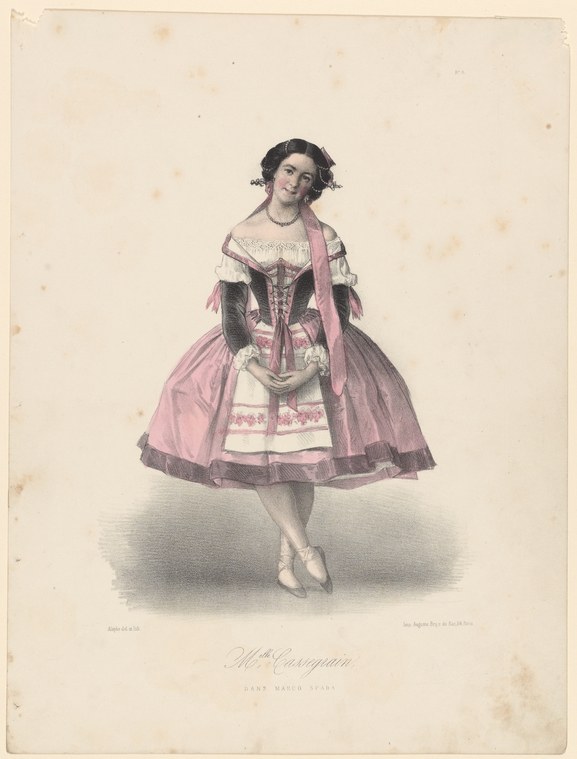
Melle Cassegrain dans Marco Spada
Unknown artist
- Collection:
- Prints depicting dance
- Source:
- New York Public Library
- Rights:
- Public domain — free to use, share and adapt.
- Recorded as:
- Public Domain
This print documents the Romantic ballet body in a specific moment—not a dramatic leap or narrative action, but the quiet discipline of the dancer's training and carriage. It is evidence that even portraits of individual performers were understood as documents of dance itself, not merely of celebrity. For historians and dancers, it reveals how the body was trained and displayed in theaters of the 1840s–50s, and how the image of the ballet dancer was commodified and circulated to the paying public.
What you are looking at
A young female dancer stands in a three-quarter pose against a neutral background, captured in a moment of suspended stillness rather than active motion. She wears a romantic-era costume: a white lace-edged corsage or bodice with short off-shoulder sleeves, a pale pink skirt with a darker pink or mauve underskirt visible at the hem, and what appears to be a darker jacket or bolero draped over her shoulders. Her dark hair is arranged with ringlets and adorned with a small ornament. She balances on the ball of one foot in a pointe-like position, the other leg slightly raised behind or to the side, and her arms rest gracefully at her sides with hands positioned delicately. The pale cream background and soft shading create an ethereal quality typical of mid-nineteenth-century theatrical portraiture. This is a hand-colored engraving or lithograph, a format used to circulate images of celebrated performers to the public.
The dancing
A single female figure in an upright, elongated frame characteristic of Romantic-era ballet practice. Her weight appears distributed on one pointed foot, with the supporting leg straight and the free leg held in a low position behind or to the side—a pose suggesting the dancer is captured between movements rather than mid-leap. Her arms hang naturally, neither in a dramatic port de bras nor in a closed ballroom frame. The overall carriage is upright and dignified, with the chest lifted and the neck extended, showing the postural discipline of ballet training. Her gaze is directed slightly to the viewer's left, creating a sense of inward focus rather than direct address.
The dance depicted
This depicts a professional ballet dancer of the mid-nineteenth century, almost certainly in the Romantic period (1830s–1850s). The costume—short skirt, fitted bodice, and pointe shoes—is consistent with the repertory of European theater ballet in this era. The title indicates this is Melle Cassegrain dancing in *Marco Spada*, likely an opera-ballet or theatrical work that required this performer's talents. Without access to performance records for this specific dancer or work, we cannot determine the precise choreography or national origin of the piece, but the style of dress and the physiognomy of the print place this squarely in Parisian or European ballet culture of the 1840s–50s.
How it was made
This is a hand-colored engraving or lithograph, a reproductive print technique that allowed theatrical images to be disseminated widely and affordably to middle-class audiences. The delicate coloring—applied by hand after printing—gives the work an intimate quality despite its mechanical origins. The soft tonal shading around the figure and the careful modeling of the fabrics suggest a lithograph rather than a line engraving, a technique that became standard for theatrical portraiture in this period. Such prints were sold as souvenirs of performances and as mementos of celebrated dancers, functioning as both commercial products and documents of performance practice.
About this work
This is a theatrical portrait of a professional ballet dancer captured in a pose of poised elegance characteristic of Romantic-era ballet. The hand-colored print documents both the costume conventions of mid-nineteenth-century European ballet and the physical vocabulary of the dancer's art—the emphasis on verticality, turnout, and the lifted carriage of the body. The work belongs to a large body of theatrical portraiture produced for public consumption in Paris and other European capitals, images that shaped the public's understanding of what ballet was and how dancers moved. As a record of a performer now unknown to us, it carries information about the repertory, the fashion, and the physical ideal of ballet at a moment when the form was establishing itself as a serious art.
How to look at it
Look at the pose itself: the dancer is not caught mid-movement but held in a moment of perfect stillness and balance—a moment that would be nearly impossible to hold in actual performance, but that captures the ideal of Romantic ballet training. Notice how the lifted ribcage, the extended neck, and the pointed foot are aligned vertically—not an accident of anatomy, but the deliberate creation of a line that the Romantic ballet considered beautiful and expressive. The off-shoulder corsage and the pale pink skirt are not incidental costume details but part of the visual language that distinguished ballet from other theatrical forms. Finally, observe that despite the idealization of the pose, the rendering of fabric and the soft modeling of the body suggest an attempt to capture a real performer in a real garment, not a fantasy figure—a tension between the everyday and the transcendent that characterizes the period.
The period
The Romantic period in ballet (1830s–1850s) saw the emergence of the female dancer as the primary focus of theatrical attention, a shift marked by the adoption of the pointe shoe as standard practice, the shortening of the skirt to the knee, and a new aesthetic emphasizing lightness and otherworldliness. This theatrical portraiture emerged from Paris, where the Opéra was the center of European ballet innovation, and rapidly became a commercial form: prints of celebrated dancers were sold in music shops and theaters, functioning as both souvenirs and advertisements. The lithographic and engraving technologies that produced these images had made hand-colored portraiture affordable to middle-class audiences, creating a market for images of performers that had no precedent before the 1820s. By the time this print was made, such images were an essential part of theatrical culture, shaping how dancers understood their own bodies and how the public understood dance.
Where it lives
The work is held in the Prints depicting dance collection at the New York Public Library, a substantial gathering of theatrical portraiture and dance imagery accumulated over the late nineteenth and twentieth centuries. This categorization suggests it was recognized as a document of dance practice by collectors and curators who built these holdings.
Dance in this work
Questions about this work
What is Marco Spada and who was Melle Cassegrain?
Without additional documentation, we cannot determine whether *Marco Spada* was an opera, a ballet, or a theatrical work combining both forms. Melle Cassegrain was a professional dancer whose name appears on this print, but she does not figure prominently in published histories of nineteenth-century ballet. This is typical: most dancers of the period left behind only these prints and scattered references in playbills, and have since been forgotten. The print is evidence of her existence and her professional status, but not a complete biography.
How do I know this is Romantic ballet and not classical ballet?
The costume is the clearest indicator: the short skirt ending at the knee, the fitted bodice with short puffed sleeves, and the off-shoulder neckline are characteristic of the 1830s–1850s. Classical ballet, as it developed after the 1890s, adopted longer skirts and different silhouettes. The pointe shoe position and the lifted carriage are consistent with both periods, but the fabric and cut of the dress place this squarely in Romanticism.
Why are there no readable signatures or publication information visible on the print?
Many of these theatrical prints carry printing information at the bottom of the sheet, but it is often small and can fade or be cut away in binding and collection. The image itself—the rendering of the figure and the hand-coloring—reveals the techniques and conventions of the 1840s–50s, but without the printed attribution, we cannot name the engraver or publisher. This is a common situation in theater history.
Could this have been made from a photograph or was it copied from life?
The print predates the widespread use of photography for theatrical portraiture. It was almost certainly made from a drawing or sketch taken of the performer, or from the memory of the engraver working from a live performance or theater rehearsal. The hand-coloring was then applied to create the finished product for sale.
More dance artwork





